 |
 |
| Page 49A |
 |
 |
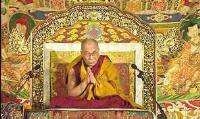
| "I find that because of modern technological evolution and our global economy, and as a result of the great increase in population, our world has greatly changed: it has become much smaller. However, our perceptions have not evolved at the same pace; we continue to cling to old national demarcations and the old feelings of 'us' and 'them.' "War seems to be part of the history of humanity. As we look at the situation of our planet in the past, countries, regions and even villages were economically independent of one another. Under those circumstances, the destruction of our enemy might have been a victory for us. There was a relevance to violence and war. However, today we are so interdependent that the concept of war has become out-dated. When we face problems or disagreements today, we have to arrive at solutions through dialogue. Dialogue is the only appropriate method. One-sided victory is no longer relevant. We must work to resolve conflicts in a spirit of reconciliation and always keep in mind |
| the interests of others. We cannot destroy our neighbors! We cannot ignore their interests! Doing so would ultimately cause us to suffer. I therefore think that the concept of violence is now unsuitable. Non-violence is the appropriate method." The Dalai Lama |
 |
 |
| Long Live His Holiness The Dalai Lama |
| The Vanity of Worldliness... There was a poet who had acquired the spotless eye of truth, and he believed in the Buddha, whose doctrine gave him peace of mind and comfort in the hour of affliction. And it happened that an epidemic swept over the country in which he lived, so that many died, and the people were terrified. Some of them trembled with fright, and in anticipation of their fate were smitten with all the horrors of death before they died, while others began to be merry, shouting loudly, "Let us enjoy ourselves to-day, for we know not whether tomorrow we shall live;" yet was their laughter no genuine gladness, but a mere pretence and affectation. Among all these worldly men and women trembling with anxiety, the Buddhist poet lived in the time of the pestilence, as usual, calm and undisturbed, helping wherever he could and ministering unto the sick, soothing their pains by medicine and religious consolation. And a man came to him and said: "My heart is nervous and excited, for I see people die. I am not anxious about others, but I trem-ble because of myself. Help me; cure me of my fear." The poet replied: "There is help for him who has compassion on others, but there is no help for thee so long as thou clingest to thine own self alone. Hard times try the souls of men and teach them righteousness and charity. Canst thou witness these sad sights around thee and still be filled with selfish-ness? Canst thou see thy brothers, sisters, and friends suffer, yet not forget the petty cravings and lust of thine own heart?" Noticing the desolation in the mind of the pleasure-seeking man, the Buddhist poet composed this song and taught it to the brethren in the vihara: "Unless refuge you take in the Buddha and find in Nirvana rest, your life is but vanity - empty and desolate vanity. To see the world is idle, and to enjoy life is empty. The world, including man, is but like a phantom, and the hope of heaven is as a mirage. The worldling seeks pleasures fattening himself like a caged fowl. But the Buddhist saint flies up to the sun like the wild crane. The fowl in the coop has food but will soon be boiled in the pot. No provisions are given to the wild crane, but the heavens and the earth are his." The poet said: "The times are hard and teach the people a lesson; yet do they not heed it." And he composed another poem on the vanity of world-liness: "It is good to reform, and it is good to exhort people to reform. The things of the world will all be swept away. Let others be busy and buried with care. My mind all unvexed shall be pure. After pleasures they hanker and find no satis-faction; riches they covet and can never have enough. They are like unto puppets held up by a string. When the string breaks they come dowm with a shock. In the domain of death there are neither great nor small; neither gold nor silver is used, nor precious jewels. No distinction is made between the high and the low. And daily the dead are buried beneath the fragrant sod. Look at the sun setting behind the western hills. You lie down to rest, but soon the cock will announce morn. Reform today and do not wait until it be too late. Do not say it is early, for the time quickly passes by. It is good to reform and it is good to exhort people to reform. It is good to lead a righteous life and take refuge in the Buddha's name. Your talents may reach to the skies, your wealth may be untold but all is in vain unless you attain the peace of Nirvana." |
|
| The Goal - And the Blessed One thus addressed the bhikkhus: "It is through not understanding the four noble truths, O bhikkhus, that we had to wander so long in the weary path of samsara, both you and I. Through contact thought is born from sensation, and is reborn by a reproduction fo its form. Starting from the simplest forms, the mind rises and falls according to deeds, but the aspirations of a Bodhisatta pursue the straight path of wisdom and righteous-ness, until they reach perfect Enlightenment in the Buddha. All creatures are what they are through the karma of their deeds done in former and in present existences. The rational nature of man is a spark of the true light; it is the first step on the upward road. But new births are required to insure an ascent to the summit of existence, the Enlightenment of mind and heart, where the immeasurable light of moral comprehension is gained which is the source of all righteous-ness. Having attained this higher birth, I have found the truth and have taught you the noble path that leads to the city of peace. I have shown you the way to the lake of Ambrosia, which washes away all evil desire. I have given you the refreshing drink called the perception of truth, and he who drinks of it becomes free from excitement, passion, and wrong-doing. The very gods envy the bliss of him who has escaped from the floods of passion and has climbed the shores of Nirvana. His heart is cleansed from all defilement and free from all illusion. He is like unto the lotus which grows in the water, yet not a drop of water adheres to its petals. The man who walks in the noble path lives in the world, and yet his heart is not defiled by worldly desires. He who does not see the four noble truths, he who does not understand the three characteristics and has not grounded himself in the uncreate, has still a long path to traverse by repeated births through the desert of ignorance with its mirages of illusion and through the morass of wrong. But now that you have gained comprehension, the cause of further migrations and aberrations is removed. The goal is reached. The craving of selfishness is destroyed, and the truth is attained. This is true deliverance; this is salvation; this is heaven and the bliss of a life immortal." |
|
| Selections from Tibetan Buddhist Texts - Ultimate Reality... The "great completion" (dzogchen) tradition of Tibetan Buddhism is practiced by all of the four main schools - Nyingma, Kagyu, Sakya, and Geluk - but most closely associated with the Nyingma. In this system all phenomena are said to be creations of mind that, like mind, are a union of luminosity and emptiness. In the following passage, the appearances of things to the mind are compared to the reflec-tions of forms in a mirror. Ultimate reality is the mandala of the perfectly pure expanse of emptiness. It is like a magic mirror. What unimpededly appears on it are the things of relative reality, your mind included. These things appear nat-urally on this 'magic' mirror, through and to your mind. There is no third reality of a truly existing mind or objects jux-taposed to the ultimate reality of the mirror and the relative reality of the images in it. Bardo, the State Between Lives The following excerpts are drawn from a Tibetan classic on death and dying entitled 'Liberation through Hearing in the Intermediate State,' attributed to Padmasambhava. According to the tradition, it was hidden by Padmasambhava and rediscovered by the "treasure finder" Karma Lingpa in the fourteenth century. The book describes the "intermediate state" (bardo; translated here as "the between") that all beings are said to enter after death. During the process of dy-ing, the physiological changes that occur are accompanied by mental changes in which the coarser levels of mind drop away, revealing progressively more subtle aspects of consciousness. At the moment of death, the most subtle level of mind dawns. This is called the "mind of clear light," and compared to it all other minds are adventitious. At this point one enters the intermediate state and experiences strange and terrifying sights. These are all said to be aspects of one's own mind, and they include visions of mild and terrifying beings, deafening sounds, and other intense sense experiences. The intermediate state is a time of great opportunity, however, and if one is able to maintain awareness and focus on the clear light nature of mind and perceive all experiences as merely aspects of mind, one may become a Buddha, or at least attain rebirth in the pure land of a Buddha. In such places the conditions are optimal for beings who seek Buddha-hood. If one is unable to maintain mindfulness, one will be reborn in accordance with one's accumulated karma. Hey! Now when the life between dawns upon me, / I will abandon laziness, as life has no more time, / Unwavering, enter the path of learning, thinking, and meditating, / And taking perceptions and mind as a path, / I will realize the Three Bodies of Enlightenment! / Conscious of dreaming, I will enjoy the changes as clear light. / Not sleeping mindlessly like an ani-mal, / I will cherish the practice merging sleep and realization! / Now when the death-point between dawns upon me, / I will give up the preoccupations of the all-desiring mind, / Enter unwavering the experience of the clarity of the pre-cepts, / And transmigrate into the birthless space of inner awareness; / About to lose this created body of flesh and blood, / I will realize it to be impermanent illusion! / I will enter into the recognition of all objects as my mind's own vi-sions, / And understand this as the pattern of perception in the between; / Come to this moment, arrived at this most critical cessation, / I will not fear my own visions of deities mild and fierce! / Now courage and positive perception are essential. |
| Milarepa on Meditation Milarepa, one of the most influential figures in Tibetan Buddhism, was born into a fairly well-to-do family, but his greedy aunt and uncle took everything away from him, his mother, and sister. Overcome by rage, his mother coerced Milarepa into learning black magic and sending a curse on the aunt and uncle, with the result that a number of people died, but not the primary objects of his revenge. Milarepa, terrified of the consequences of his evil deeds, searched for a spiritual guide (lama) who could help him escape the consequences of his actions. He eventually found Marpa, who gave Milarepa a series of difficult and dispiriting tasks, which cleansed his negative karma. After this Milarepa spent many years living in a cave and practicing solitary meditation, which culminated in his attainment of awakening. He is consider-ed in Tibet to be the supreme example of the attainment of Buddhahood in one lifetime through tantric practice. Look up into the sky, and practice meditation free from the fringe and center. Look up at the sun and moon, and practice meditation free from bright and dim. Look over the mountains, and practice meditation free from departing and changing. Look down at the lake, |
| and practice meditation free from waves. Look here at your mind, and practice meditation free from discursive thought. The Joys of Solitude In the following poem, Milarepa celebrates the joy of solitary meditation. His biography reports that during his stay in the wilderness, a number of people tried to convince him that such a life was unpleasant, to which he replied that because he had discovered the natural luminosity of mind all phenomena appeared as the interplay of luminosity of emptiness, and that as a result he lived in a constant state of sublime happiness. This mountainous area is a happy place, a place of meadows and bright flowers. / The trees move in the forest; it is a place in which monkeys play. / The birds sing various kinds of songs, and bees whirl and hover. / Day and night a rainbow shines, and in summer and winter a gentle rain falls. / In spring and fall a mist moves in. / In this sort of solitude / Mila, wearing cotton clothes, has found happiness. / Because I perceive the clear light and contemplate the emptiness of phenomena. / I am happy when things appear before me, / And happier when more [appear], / Because my body is free from evil actions, / The realm in which a strong mind wanders is a happy one, / And I find happiness in my spontaneous strength. Niguma on Mahamudra Niguma is said by Tibetan tradition to have been the founder of the Shangpa lineage of the Kag-yu tradition. In the following passage she describes the view of mahamudra (literally, "great seal"), which is said by the Kagyu school to be the supreme form of Buddhist practice. In mahamudra, one dispenses with the visualizations and rituals of tantra and focuses on the natural state of mind, which is said to be a union of clear light and emptiness. All phenomena are viewed as the spontaneous play of mind, and by cultivating this awareness it is said that the meditator moves quickly toward the attainment of Buddhahood. Don't do anything whatsoever with the mind-- / Abide in an authentic, natural state. / One's own mind, unwavering, is reality. / The key is to meditate like this without wavering; / Experience the great [reality] beyond extremes. / In a pellucid ocean, / Bubbles arise and dissolve again. / Just so, thoughts are no different from ultimate reality. / So don't find fault; remain at ease. / Whatever arises, whatever occurs, / Don't grasp--release it on the spot. / Appearances, sounds, and objects are one's own mind; / There's nothing except mind. / Mind is beyond the extremes of birth and death. / The nature of mind, awareness, / Uses the objects of the five senses, but / Does not wander from reality. / In the state of cosmic equilibrium / There is nothing to abandon or practice, / No meditation or post-meditation period. Instructions from Manjushri The following verses, according to the Sakya tradition of Tibetan Buddhism, were spoken to G�nga Nyingpo (1092-1158, the "Great Sakyapa" (Sachen). They are a summary of the entire Buddhist path, includ-ing the renunciation of the world, the development of compassion, and the importance of avoiding extreme views. If you cling to this life, then you are not a Dharma practitioner. / If you cling to existence, then you do not have renuncia-tion. / If you are attached to your own interests, then you do not have the mind of Enlightenment. / If you hold to [a position], then you do not have the correct view. The Triple Appearance The Sakya school teaches that there are three main levels of awareness, which are summarized in the following stanzas from Virupa's Vajra Verses. The first verse refers to the perceptions of ordinary beings, which are colored by ignorance and mental affliction. The second verse describes the perceptions of people on the path, who have some experience with meditation and thus have overcome some of their mental afflictions. The final verse indi-cates that Buddhas perceive the world unafflicted by ignorance, hatred, desire, etc. and so are at the level of the "pure appearance." The Sakya tradition stresses that although they appear to be incompatible, the three appearances are fun-damentally non-different. For sentient beings with the afflictions is the impure appearance. / For the meditator with transic absorption is the appearance of experience. / For the ornamental wheel of the Sugata's [Buddha's] inexhaustible Enlightened body, voice and mind is the pure appearance. / |
| One then resolves to repay this kindness, and generates a feeling of love toward others, wishing that they have happi-ness and the causes of happiness. One then develops compassion for sentient beings, since they are experiencing suffer-ing as a result of contaminated actions and afflictions. In the next stage one attains the "unusual attitude," which in-volves vowing to work to free all beings from suffering and establish them in Buddhahood. The final step is attainment of the mind of Enlightenment, which is a resolve to do whatever is necessary to attain Buddhahood in order to help all sentient beings. From one's own viewpoint, since one has cycled beginninglessly, there are no sentient beings who have not been one's friends hundreds of times. Therefore, one should think, "Whom should I value?" "Whom should I hate?" Imagine your mother very clearly in front of you. Consider several times how she has been your mother num-berless times, not only now, but from beginningless cyclic existence. When she was your mother, she protected you from all danger and brought about your benefit and happiness. In particular, in this life she held you for a long time in her womb. Once you were born, while you still had new hair, she held you to the warmth of her flesh and rocked you on the tips of her ten fingers. She nursed you at her breast, and wiped away your filth with her hand. In various ways she nour-ished you tirelessly. When you were hungry and thirsty, she gave you drink, and when you were cold, clothes, and when poor, money. She gave you those things that were precious to her. Moreover, she did not find these easily. When you suffered with a fever she would rather have died herself than have her child die; and if her child became sick, from the depths of her heart she would rather have suffered herself than have her child suffer.... Disclaimer: All images and/or articles retain the original copyrights of their original owners. |
 |
| Developing the Mind of Enlightenment Ordinary beings are consumed by self-centered desires and think primarily of their own narrow interests. Bodhisattvas spend countless eons working toward Buddhahood for the benefit of all beings, cheerfully accepting all the tribulations that occur along the path. Given the vast gulf between the attitudes of Bodhisattvas and ordinary be-ings, it is difficult to for people enmeshed in mundane concerns to imagine making the transi-tion to true altruism. The following passage by Tsong Khapa (the founder of the Gelukpa school of Tibetan Buddhism) outlines a seven step program for developing the "mind of Enlighten-ment," which marks the beginning of the Bodhisattva path. It begins by recognizing that be-cause one has been reborn in an infinite variety of situations since beginningless time, one has been in every possible relationship with every other sentient being. Thus, every sentient being has been one's mother, and has been a nurturing and caring friend. One should reflect on the kindness of one's own mother, and then think that every other being has been equally kind. |
|
| By ourselves is evil done, By ourselves we pain endure, By ourselves we cease from wrong, By ourselves become we pure. No one saves us but ourselves, No one can and no one may; We ourselves must tread the Path: Buddhas only show the way. |
| May you live every day of your life. Jonathan Swift Finish each day and be done with it. You have done what you could; some blunders and absurdities have crept in; forget them as soon as you can. Tomorrow is a new day; you shall begin it serenely and with too high a spirit to be encumbered with your old nonsense. Ralph Waldo Emerson There will one day spring from the brain of science a machine or force so fearful in its potentialities, so absolutely terrifying, that even man, the fighter, who will dare torture and death in order to inflict torture and death, will be appalled, and so abandon war forever. Thomas Edison |
| "He who joyfully marches to music in rank and file has already earned my contempt. He has been given a large brain by mistake, since for him the spinal cord would fully suffice. This disgrace to civilization should be done away with at once. Heroism at command, senseless brutality, and all the loathsome nonsense that goes by the name of patriotism, how violently I hate all this, how despicable and ignoble war is; I would rather be torn to shreds than be part of so base an action! It is my conviction that killing under the cloak of war is nothing but an act of murder." Albert Einstein "Peace is the happy natural state of man; war is corruption and disgrace." James Thomson "War grows out of the desire of the individual to gain advantage at the expense of his fellow man." Napoleon Hill "The pursuit of peace and progress cannot end in a few years in either victory or defeat. The pursuit of peace and progress, with its trials and its errors, its successes and its setbacks, can never be relaxed and never abandoned." Dag Hammarskjold "It isn't enough to talk about peace. One must believe in it. And it isn't enough to believe in it. One must work at it." Eleanor Roosevelt "But peace does not rest in the charters and covenants alone. It lies in the hearts and minds of all people. So let us not rest all our hopes on parchment and on paper, let us strive to build peace, a desire for peace, a willingness to work for peace in the hearts and minds of all of our people. I believe that we can. I believe the problems of human destiny are not beyond the reach of human beings." John F. Kennedy |
| July 6, 2004 |
 |
 |
 |