 |
| Page 39 |
 |
| whose six children evolved the main tribes of Tibet. Later adapted by Buddhism, the monkey became the Bodhissatva of compassion. A sparsely settled country of several million people in an area of nearly 500,000 sq miles, most of the popu-lation is concentrated in southern Tibet, living as farmers and herders in valleys of the Salween and Brahmaputra Riv-ers. The political history of Tibet remains buried in legend prior to the introduction of writing in the 7th century AD. By about AD 600, Yarlung forces led by their 32nd king, Namri Songtsen (AD 570-619) had overcome Qiang tribes and uni-fied much of Tibet. This set the stage for further expansion under his son, Songtsen Gampo (AD 618-649). Both legend and history agree that it was through two Buddhist brides of Songtsen Gampo (one Chinese, the other Nepalese) that Buddhism was permanently introduced to Tibet. A century later, by the time of King Trisong Detsen who founded the first Buddhist monastery in Tibet at Samye, Buddhism was firmly implanted. The vast majority of people speak Tibetan, in the Tibeto-Burman subgroup of the Sino-Tibetan language family and more closely related to Burmese than Chinese. During Songtsen Gampo's reign, writing had been introduced into Tibet based on Sanskrit texts from India, Kashmir and Nepal. All available Buddhist literature in India and Tibet was translated into Tibetan by the 14th century, including both the main Buddhist canon (the Tripitaka, meaning "three baskets": discipline [dulva], sermons [do], and metaphys-ics [chos-nonpa]); and some Sanskrit texts now known only in Tibetan translations. Tibetan Buddhism or Lamaism evolved from the late 6th century AD Mahayana Buddhism brought into Tibet by missionaries from India. Lamaism in-corporated ritual practices of the mystical sect known as Tantric Buddhism, which showed affinities with shamanistic features of B�n (somewhat analogous to the relation of Buddhism to Taoism in China). In AD 1040 a reform movement was initiated by the arrival of Atisa (AD 982-1054) a great Buddhist scholar from Bengal, India, invited by the king of Guge in western Tibet. Over the next centuries, a number of sects emerged. Since the 17th century, the predominant sect has been the Gelugpa, commonly known as the Yellow Hats, which includes the order of the Dalai Lama, political and spiritual ruler of Tibet, and the Panchen Lama, a main spiritual authority. When the Dalai or Panchen Lama dies, his spirit is thought to enter the body of a baby boy. Monks search the country for a boy born about the same time as the lama's death, who must pass several tests before being declared the successor. Religious rites and festivals central to the yearly round of life include pilgrimages to sites of important temples at Shigatse or Lhasa. On a daily basis, Ti-betans recite prayers and use prayer wheels. Since the 1951 Chinese takeover, Lhasa's Chi- |
| Buddhist Monasteries in Tibet - The Tibetan origin myth, first arising among pre-Buddhist, B�n cultures in the Yarlung Valley, features the marriage of a monkey and a demoness named Sinmo, from |
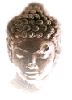
| yas from outsiders, Lhasa ("God's place") is the religious, commercial, and political center of Tibet. In the heart of Lha-sa is the Jokhang, built between AD 637-647 by King Songtsen Gampo as a shrine to store an image of the Buddha, the dowry of his wife Princess Bhrikuti. This Buddha image still stands inside. Also in Lhasa are the Norbulingka, summer palace of the Dalai Lama, while several monasteries, Sera, Dreprung, and Nechung, lie just outside the city. Lhasa's most famous shrine is the Potala palace, built by Ngawang Lozang Gyatso (1617-1682). This thousand-room structure (featured in the recent movie Seven Years in Tibet, based on the book by Austrian mountaineer Heinrich Harrer), was built on an ancient fort on a ridge overlooking the northern part of the city. After 1642 it served as the home of the Dalai Lama. In 1959, eight years after the Chinese takeover, the 14th Dalai Lama fled to northern India. where he still resides. The Potala has since been converted by the Chinese into a museum. Reting, situated in the Rong Chu Valley of Central Tibet, was founded in AD 1056. The monastery was initially associated with the Indian scholar Atisha, a water-shed figure in the revival of Buddhism in Tibet, and later had important ties to the Dalai Lamas and the Gelugpa Order. It contained a main assembly hall with murals of venerable lamas and Tantric gods, and a much revered gold statue of Guhyasumaja, usually defined as the personal Tantric deity of Atisha. Destroyed after the Communist takeover, the monastery is now slowly being rebuilt. Dung-kar is located in the valley of Tro-mo just north of Yatung Monastery. Of fairly recent date, its monks are of the Gelugpa Order. The 3rd Grand Lama of the Gelugpa sect converted Mongol chief Altan Khan to the Tibetan version of Buddhism, and in 1578 obtained from him the name Dalai or "the Ocean" which implied wisdom. The monastery consists of a large courtyard surrounded by wooden buildings. There is also a temple with frescoes of the Four Kings of the Directions of Space (gyal-chen de-shi) and Two Protectors, Vajrapani (Chana-dor-je) and Hayagriva (Tamdrin). Sakya, located at an altitude of 4280 meters in the province of Tsang, contains two monas-teries on the north and south sides of the Trum River. The northern site, whose name means "tawny soil," was founded in 1073 by K�n K�nchag Gyelpo. By the 13th century it was a center of learning. In AD 1270, the abbot received special favors from the Mongol emperor Kublai Khan (Marco Polo's contemporary) who adopted Lamaism after investigating different religions. Very little remains of the northern monastery, which once housed about 3,000 monks in over 100 buildings. Visitors can still see a white stupa reconstruction honoring the remains of Kunga Nyingpo, founder of the Sakyapa Order. The southern monastery, first built in 1268, is a defensive structure which retains immense, thick walls. An entrance in the east wall leads to a central courtyard and the huge main assembly hall. Within, among mas-sive pillars, are statues and reliquaries of Sakyapa abbots, along with a library for Buddhist texts. Ganden, established in 1417 by Tsong-kapa (AD 1357-1419), founder of the Gelupga sect, became the first and main Gelugpa monastery. Situa-ted only 40 km east of Lhasa on a ridge overlooking the Kyi Chu valley, it was totally destroyed by the Red Guards in 1966. Currently undergoing restoration, among its most impressive buildings is the Golden Tomb of Tsong-kapa, a for-tress-like structure containing a silver and gold ch�rten, or reliquary, with fragments of Tsong-kapa's remains. Other buildings include the Golden Throne Room, the residence of the Ganden tripa (abbot), and the small temple known as the Nagam Ch� Khang. Dreprung, only three miles west of Lhasa, was founded in AD 1416 by a monk called Jamyang Ch�je, a disciple of Tsong-kapa. Named after the Indian monastery of "The Rice Heap" in Kalinga, it is one of the most powerful of all monasteries and was formerly one of the most populous religious centers. Many of its buildings remained relatively unscathed during the turmoils of the Chinese cultural revolution, and much of interest can be seen today. Sera, meaning "the merciful hail," was founded in 1419 by Sakya Yeshe, one of the disciples of Tsong-Kapa. Sera is a neighbor to the Dreprung Monastery with whom it often feuded. Until the Chinese invasion of 1959, Sera maintained five colleges of instruction but today only three remain. Of particular note is the debating courtyard which is still active on a daily basis. Nechung, which is only a short walk from Dreprung, now houses a small number of monks. Up until 1949 |
 |
| nese population has grown rapidly, and now dominates the once secluded Tibetan capital. Many religious institutions were destroyed during the "Cultural Revolution" of the 1960s and `70s. In the 1980's, some monasteries were allowed to re-open and recruit new monks. Today, however, Tibet has far fewer monasteries, which nevertheless remain centers of edu-cation, art, and public worship. A Short List of Tibetan Monasteries - Samye, the oldest mon-astery in Tibet, was founded between AD 765-780, during the reign of King Trisong Detsen. Here occurred a debate in the 790's between a more traditional approach of Enlightenment through scholarship, and a radical doctrine of Zen Buddhism favoring simple contemplation. Samye is now a popular tourist destination. Its architecture, copied from Odantapuri temple in Bihur, India, is based on a mandalic symbol of the universe. The central temple represents a mountain, and those around it are oceans and continents. Lhasa: Seated in a fertile plain along the Lhasa River, a Brahmaputra tributary, and until recently isolated by the Himala- |
| 1949 it was the seat of the State Oracle or medium, consulted by the former government before any important decisions were taken. The Oracle fled with the Dalai Lama in 1959. The monas-tery's chapel contains images of Pehar, sometimes portrayed as a demon-king and identified as the protective spirit manifested in the State Oracle. Tashilhunpo, meaning "the mass of glory," was founded in 1447 at Shigatse by a disciple of Tsong-kapa (1357-1419). Associated with the Gelugpa Order, it is one of the largest functioning monasteries in Tibet today, and one of the few not dam-aged during the Cultural Revolution. The monastery includes dozens of chapels, shrines with Bud-dhist images, and a 15th century assembly hall containing the throne of the Panchen Lama. Be-tween 1642-59, the Abbot of Tashilhunpo Monastery received from the Fifth Dalaia Lama the title of Panchen Lama or great scholar. The monastery has remained the main headquarters of the Panchen Lama. During the Manchu Qing dynasty (1644-1912), Chinese backed the Panchen Lama against the Dalai Lama, a political maneuver recently repeated. Kumbum is located on the far northeast side of Tibet in Amdo province. Prior to his exile in India, Thubten Jigme Norbu, elder brother of the Dalai Lama, was Abbot of the Kumbum Monastery. 19th century conditions in Kum-bum and several other monasteries were described by �variste Huc (1813-1860) ordained a priest |
 |
| in 1839 and sent in the same year as a Lazarist missionary to China. During his travels he penetrated Mongolia and Ti-bet as far as Lhasa. The last Europeans to enter Tibet for a number of years, Huc and his companion Gabet established a mission but were eventually expelled and the borders of Tibet closed. Huc wrote a valuable account in 1852 of his experi-ences, entitled Souvenirs of a Journey to Tartary, Thibet, and China. Recent Political History: Communists gained con-trol of China's government in 1949 and in 1950; Chinese forces entered Tibet. In 1951, Tibet surrendered its sovereign-ty to the Chinese government, but kept its right to regional self-government and freedom of religious belief. In 1956, Tibet was promised status as an autonomous (self-governing) region. At the same time, however, China began tighten-ing its control on Tibet. The Dalai Lama fled to India in 1959, establishing a government-in-exile, which still exists. (Courtesy and Copyright � 1996-2001 Athena Publications, Inc. All Rights Reserved). |
 |
 |
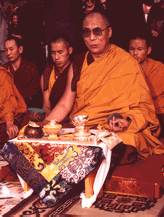
| Today the Dalai Lama is perhaps one of humankinds most beloved spokspersons, not only for the Buddhist perspective, but also for all spiritually minded people seeking a pathway and a refuge to their own inner dialogue with the divine source of knowledge. The Dalai Lama has the unique gift of combing both simplicity and profound philosophical understanding concerning our spiritual life. His teachings are direct as well as rooted in parables and metaphors. The Dalai Lama states in simple terms his advice for meditation; "....in your life, unless you make specific time for something that you feel commited to, you will always have other obligations and you will always be too busy." In philosophical terms the Dala Lama states; "In Buddhism it is thought that there is a special relationship between the emanation and the emanating force, and that an emanation comes to an end when it has fulfilled its destiny" With parables the Dali Lama quotes from the Buddha as saying; "....when you are looking into the ocean trying to locate a fish, you will not be able to find one while the ocean is still and the fish are under the water. But when a wave comes, you will occasionally be able to glimpse the fish. |
 |
|
| The Righteous One is not righteous if one decides a case without due consideration, but the wise man who takes in-to account both for and against, and comes to his decision about others with due consideration - such a man of discrim-ination who keeps to the truth, he is to be called righteous. One is not a learned man by virtue of much speaking. He who is patient, without anger and fearless, he is to be called learned. One is not a bearer of the teaching by virtue of much speaking, but he who, even if he has only studied a little, has experienced the truth in person, he is indeed a bearer of the teaching, who has not forgotten the teaching. One is not an elder by virtue of having white hair. One is just advanced in years, and called "grown old in vain." He in whom there is truthfulness, non violence, restraint and self control, however - that wise and faultless sage is to be called an elder. It is not just by fine speech or by flower-like beauty that one is admirable, if one is envious, mean and deceitful, but when that sort of behaviour has been eliminated, rooted out and destroyed, that faultless sage is said to be admirable. A shaven head does not make one a man of religi-on, if one is irreligious and untruthful. How could a man full of desires and greed be a man of religion? But when a man has put aside all evil deeds, both great and small, by that putting away of evil deeds he is indeed called a man of religion. One is not a bhikkhu by virtue of taking alms from others. By taking up any old teaching, one is not a bhikkhu on that account. But he who has here and now ejected both good and evil, and in leading the holy life lives in accordance with reason - he is indeed called a bhikkhu. Silence does not make a sage if he is stupid and ignorant, but when a man avoids evil as if he were choosing something of value on the scales - he is a sage. That indeed makes him a sage. He who dis-criminates in both worlds is for that reason called a sage. One is not noble if one harms other living creatures. It is by non violence to all forms of life that one is called noble. It is not just by means of morality and religious observances, not by great learning nor by attainments in meditation, nor by living alone, nor by thinking,"I am enjoying a spiritual happiness which ordinary people do not know" that a bhikkhu achieves peace if he has not achieved the elimination of inflowing thoughts. The Way Of paths the Eightfold one is best, and of truths the Fourfold. Dispassion is the best of mental states, and of human beings the best is the seer. This indeed is the Way - there is no other - for the purification of one's vision. Follow this way. It leads to Mara's confusion. Following this Path you will put an end to suffering. I have taught you the Way after realising the removal of the arrow myself. Making the effort is your affair. The Buddhas have pointed out the Way. Those who are on the way and practising meditation will be freed from Mara's bonds. All processes are imperma-nent. When one sees this with understanding, then one is disillusioned with the things of suffering. This is the Path of Purification. All processes are painful. When one sees this with understanding, then one is disillusioned with the things of suffering. This is the Path of Purification. All processes are out of my control. When one sees this with understand-ing, then one is disillusioned with the things of suffering. This is the Path of Purification. Since he will not exert himself at the time for exertion, and although young and strong is full of indolence and irresolution and idleness, the lazy man is incapable of recognising the way of wisdom. Be guarded in speech, restrained of mind and not doing anything wrong physically. Perfect these three forms of action, and fulfil the way taught by the sages. From meditation springs wisdom. From lack of meditation, loss of wisdom. Recognising these alternative roads of progress and decline, one should so di-rect oneself so that one's wisdom will increase. Cut down the forest, not just a tree. Out of the forest of desire springs danger. By cutting down both the forest of desire and the brushwood of longing, be rid of the forest (pun on the word "Nirvana"), bhikkhus. So long as the least desire of a man for women has not been eradicated, he is fettered in mind, like a sucking calf to its mother. Pluck out your desire, like one does an autumn lotus with one's hand. Devote yourself to the path of peace, the Nirvana proclaimed by the Blessed One. "Here I will spend the rainy season, and here the hot season." This is the way a fool thinks. It does not occur to him what may happen in between. Death comes and snatches away the man infatuated with children and livestock, while his mind is still full of desire, like a great flood sweeping away a sleeping village. There are no children to take refuge in then, no father or any other relative. When a man is seized by that terminator, Death, there is no taking refuge in family. When he has seen the implications of this, a wise man, restrained by morality, should quickly develop the path leading to Nirvana. |
| Hell He who speaks untruth goes to hell, as does he who, having done something, says, "I didn't do it." Men of ignoble behaviour, they both end up the same in the next world. Many of those dressed in the yellow robe are evil and unrestrained, and the evil end up in hell because of their evil deeds. It is better to swallow a red-hot, flaming iron ball than for an unrestrained and immoral person to eat the alms food of the land. The thoughtless man who consorts with another man's wife encounters four things - ac-cumulation of demerit, disturbed sleep, thirdly disgrace, and hell fourth. Accumulation of demerit, a bad rebirth and the slight pleasure of a frightened man and a frightened |
 |
| woman - while the authorities impose a severe penalty too. Therefore a man should not consort with another man's wife. In the same way that a wrongly handled blade of grass will cut one's hand, so a badly fulfilled life in religion will drag one down to hell. Lax behaviour, broken observances and dubious chastity - these are on no great benefit. If it ought to be done, then do it; apply yourself to it strenuously. A lax man of religion just spreads even more dust. A bad action is best left undone. One is punished later for a bad action. But a good deed is best done, for which one will not be punished for doing it. Guard yourself like a frontier town, guarded inside and out. Don't let a moment slip you by. Those who have missed their opportunity grieve for it when they end up in hell. Ashamed of what is not a matter for shame, and not ashamed of what is, by holding to wrong views people go to a bad rebirth. Seeing danger where there is no dan-ger, and not seeing danger where there is, by holding to wrong views people go to a bad rebirth. Seeing a fault in what is not a fault, and not seeing a fault in what is, by holding to wrong views people go to a bad rebirth. Recognising a fault as a fault, and what is not a fault as not one, by holding to right views people go to a good rebirth. The Buddhas He whose victory is not relost, and whose victory no-one in the world can take away, that Buddha, whose home is in the infinite, pathless as he is, by what path will you lead him? He who has no entrapping, clinging de-sire to lead him in any direction, that Buddha, whose home is in the infinite, pathless as he is, by what path will you lead him? Those wise men, who are much given to meditation and find pleasure in the peace of a spiritual way of life, even the devas envy them perfect Buddhas and recollected as they are. A human birth is hard to achieve. Difficult is the life of mortals. To hear the true teaching is difficult, and the achievement of Buddhahood is difficult. To abstain from all evil, the practice of good, and the thorough purification of one's mind - this is the teaching of the Buddhas. Long suffer-ing patience is the supreme ascetic practice. Nirvana is supreme, say the Buddhas. He is certainly not an ascetic who hurts others, and nor is he a man of religion who causes suffering to others. Not to speak harshly and not to harm oth-ers, self restraint in accordance with the rules of the Order, moderation in food, a secluded dwelling, and the cultivation of the higher levels of consciousness - this is the teaching of the Buddhas. There is no satisfying the senses, not even with a shower of money. "The senses are of slight pleasure and really suffering." When a wise man has realised this, he takes no pleasure, as a disciple of the Buddhas, even in the pleasures of heaven. Instead he takes pleasure in the elim-ination of craving. Driven by fear, men take to many a refuge, in mountains, forests, parks, sacred groves and shrines, but these are not a secure kind of refuge. By taking to this sort of refuge one is not released from suffering. He who has gone to Buddha, Dhamma and Sangha for refuge, though, and who with true wisdom understands the Four Noble Truths of Suffering, the Origin of Suffering, the End of Suffering and the Noble Eightfold Path, leading to the Elimina-tion of Suffering, this is a secure refuge, this is the ultimate refuge; by taking to this refuge one is indeed released from all suffering. A truly thoroughbred man (a Buddha) is hard to find. He is not born anywhere, but where that seer is born, the people prosper. Happy is the attainment of Buddhahood, happy the teaching of the true Teaching, happy is the concord of the Sangha, happy the training of those in concord. When a man venerates those worthy of veneration, be they Buddhas or their disciples, who have transcended all obstacles and passed beyond sorrow and tears - venerating such as these, whose passions are extinguished and for whom there is no further source for fear, no one can calculate how great his merit is. Disclaimer: All images and/or articles retain the original copyrights of their original owners. |
 |
 |
| Visit our main Buddhism site. More information, images, and, NO pop-ups! |
 |
| Last Update: 11/30/04 |