 |
 |
| Page 38A |
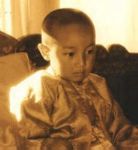
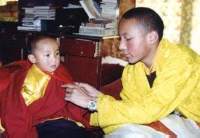
| Child lama forced to leave monastery following Karmapa escape... Pawo Rinpoche, an eight-year old incarnate lama who was recognised by the 17th Karmapa, has been moved from his monastery to Lhasa, prevented from wearing monastic robes and made to attend a normal primary school since the Karmapa's escape into exile last year. The young Rinpoche, who is one of the most important Karma Kagyu lamas remaining in Tibet and whose recognition was endorsed by the Chinese authorities, has been kept under close surveillance since his removal to Lhasa last sum-mer and is not permitted to undertake religious studies. Two security personnel accompany him to his primary school each day and visits to his residence, where he is living with his mother, are restricted. Several Tibetan monks who are now in exile and who knew Pawo Rinpoche said that the removal of the boy from his monastery is in reprisal for the es-cape of the Karmapa into exile in January 2000. Pawo Rinpoche's traditional seat, Nyenang monastery in Toelung De-chen (Ch: Duilong Deqing) county, Lhasa municipality, is near Tsurphu, the Karmapa's monastery in Tibet, and the two institutions have close religious and social ties. There are important historical links between the incarnations of Pawo Rinpoche and the Karmapa; in previous incarnations, they had a student-teacher relationship. A senior lama at Nyenang monastery, Lama Tsewang Tashi, escaped to India together with Ugyen Trinley Dorje, the 15-year old recognised as the 17th Karmapa, in January 2000. Morale at both Nyenang and Tsurphu monasteries is low following the removal of Pawo Rinpoche to Lhasa and the escape of the Karmapa. The number of monks at both monasteries has declined, partly as a result of patriotic education campaigns at the monasteries leading to expulsions of monks, and also because monks are leaving due to the absence of a senior religious figure. A monk from the area who is now in exile told TIN: "Before, many pilgrims and tourists came to Nyenang monastery but now very few come because there is no lama there. It is the same as Tsurphu since the Karmapa left. Several monks have left Nyenang because they did not want to stay there any more without Pawo Rinpoche. Everyone feels sad now." The same Tibetan source told TIN that monks at Nyenang are not allowed to keep photographs of Pawo Rinpoche. Tsuglag Mawe Dayang was 15 months old when he was recognized in 1994 by the 17th Karmapa as the 11th incarnation of Pawo (dPa'Bo) Rinpoche. The search party who set out to find him were seeking the incarnation of the 10th Pawo Rinpoche, who had died in India in August 1991. They were assisted by a letter written by the teenage Karmapa, then at Tsurphu, giving details of the location and time of year of the child's birth and clues to the names of his parents and information on the environment. Following his recognition, Tsuglag Mawe Dayang was brought from his home in Nagchu (Chinese: Naqu) prefecture to Nyenang and enthroned in 1995. A monk from the area told TIN: "After Pawo Rinpoche was recognised, he was brought to Tsurphu and the Karmapa gave him the possessions belonging to the 10th Pawo Rinpoche." The Chinese authorities acknowledged Pawo Rinpoche's sta-tus following his recognition by the Karmapa, who is himself recognised by the Dalai Lama and was accepted by Beijing as head of one of the four major schools of Tibetan Buddhism. A second Tibetan monk who is now in exile told TIN that while the authorities had previously accepted Pawo Rinpoche, "Now [that] the Karmapa has left the Chinese do not like Pawo Rinpoche, they say that he is a fake lama." The sensitivity of the authorities to the situation at Nyenang was evi-dent when in December 2000 a Western governmental delegation was denied permission to visit the monastery despite a specific request. Religious activities at Nyenang and at Tsurphu monastery have declined since the Karmapa's departure |
| "Another kind of love and compassion is not based on something appearing beautiful or nice, but based on the fact that the other person, just like oneself, wants happiness and does not want suffering and indeed has every right to be happy and to overcome suffering. On such a basis, we feel a sense of responsibility, a sense of closeness toward that being. That is true compassion. This is because the compassion is based on reason, not just on emotional feeling. As a consequence, it does not matter what the other's attitude is, whether negative, or positive. What matters is that it is a human being, a sentient being that has the experience of pain and pleasure. There is no reason not to feel compassion so long as it is a sentient being." The Dalai Lama |
 |
 |
 |
 |
| and the removal of Pawo Rinpoche to Tibet's capital. "Since the Karmapa left, religious order and discipline as well as the devel-opment of Tsurphu monastery have suffered," said one of the Tibetan monks from the area. "The local authorities sent in cadres who, with the help of the Democratic Management Com-mittee of the monastery, started enforcing a strict programme of political and ideological education for the monks. Their tra-ditional religious curriculum and activities were undermined and neglected, and as a result religious studies are not being |
| Pawo Rinpoche |
| 17th Karmapa & Pawo Rinpoche |
| taken as seriously as before." Development projects were in progress at both Tsurphu and Nyenang monasteries before the Karmapa's escape to India. The road from Tsurphu to Lhasa was to be rebuilt with the assistance of funding from Western and Taiwanese Buddhist organisations, and Lama Tsewang Tashi from Nyenang monastery was involved in helping with the development of education and health-care facilities in the area. The authorities have reportedly discon-tinued work on the road to Tsurphu since the escape of the Karmapa. (02 July 2001) |
|
 |
| THE RIM� MOVEMENT OF JAMGON KONGTRUL THE GREAT - Abstract - The different traditions of Tibetan Bud- dhism keep their identity through a particular lineage of teachers. Sometimes misunderstanding occurs because the teacher confines his studies to the literature of his own tradition. However, the philosophical differences are so subtle that they are extremely difficult to grasp in the right perspective. Jamgon Kongtrul the Great, one of the leading schol-ars of the nineteenth century, broke the sectarian confinement and forged a deep understanding of rival philosophies. With great courage and ability, this fine scholar compiled the basic teachings of all Tibetan Buddhist Schools in his en-cyclopedic work "The Five Great Treasures." This work saved the traditions from destruction during the recent cultural crisis in Tibet. This article will mainly discuss the principle of "Rim�" in Jamgon Kongtrul�s view on debated subjects such as, Rangtong and Shentong philosophies and criticisms on New and Old Tantric Schools. The Rim� Movement Of Jamgon Kongtrul The Great By Ringu Tulku - In the 1970�s I was doing research work on the Rim� Movement. This gave me the opportunity to meet and interview a number of prominent Tibetan Lamas, including His Holiness, the Dalai Lama, and the heads of the four main Schools of Tibetan Buddhism. I prepared a questionnaire. One of the questions I asked was whether they believed that other Schools of Buddhism showed the way to attain Buddhahood. I have never been so rebuked in my life as when I asked that question! All of them, without exception, were shocked and felt insult-ed, deeply saddened that I, a monk, could ever have such doubts. They would not speak with me until I persuaded them to believe that this was one of those unimportant, procedural questions that are part of the modern University system. "How can you say such a thing?" they rebuked me. "All Schools of Buddhism practice the teachings of the Lord Bud-dha. Moreover, the Schools of Buddhism in Tibet have even more common ground. They all base their main practice on Anuttara Tantra of Vajray�na. Madhyamika is their philosophy; they all base their monastic rules on the Sarvastivadin school of Vinaya. One of the unique features of Buddhism has always been the acceptance that different paths are nec-essary for different types of people. Just as one medicine cannot cure all diseases, so one set of teachings cannot help all beings - this is the basic principle of Buddhism. One chooses the most appropriate Sutras and / or Tantras from the Bud-dhist Canon and bases one�s own practices on these. This is the origin of different Schools in Buddhism. There are no "sects" in Buddhism because there are no break-away groups from the main School. Different lineages came into being even among those who practiced the same teachings. In Tibet, like other places, these different Schools practiced and studied in their own isolated environments and thereby lost much of the contact with other Schools and lineages. Non-communication breeds misunderstanding. Even where there was no misunderstanding or disrespect to other Schools, some practitioners, in their ardent enthusiasm to keep their own lineages pure and undiluted, went so far as to refuse any teachings from the masters of other lineages, and would not study the texts of other Schools. Ignorance is the most fertile ground for growing doubts and misconceptions. This is the area where the Rim� movement of Jamgon Kongtrul (1813-1899) and Jamyang Khentse (1820-1892) had most to contribute. What is "Rim�?" - Ris or Phyog-ris in Tibetan means "one-sided," "partisan" or "sectarian". Med means "No." Ris-med, or Rim�, therefore means "no sides," "non-partisan" or "non-sectarian." It does not mean "non-conformist" or "non-committal," nor does it mean forming a new School or system that is different from the existing ones. A person who believes the Rim� way almost certainly follows one lineage as his or her main practice. He or she would not dissociate from the School in which he or she was raised. Kongtrul was raised in the Nyingma and Kagyu traditions; Khentse was reared in a strong Sakyapa tradition. They nev-er failed to acknowledge their affiliation to their own Schools. Rim� is not a way of uniting different Schools and lin-eages by emphasizing their similarities. It is basically an appreciation of their differences and an acknowledgement of the importance of having this variety for the benefit of practitioners with different needs. Therefore the Rim� teachers always take great care that the teachings and practices of the different Schools and lineages and their unique styles do not become confused with one another. To retain the original style and methods of each teaching lineage preserves the power of that lineage experience. Kongtrul and Khentse made great efforts to retain the original flavor of each teach-ing, while making them available to many. Kongtrul writes about Khentse in his biography of the latter. "Many people |
| these days become involved and confused in the assertion and negation of so-called philosophical differences such as Rangtong and Shentong, etc. They try to win everybody over to their side to the point of breaking their necks! When he (Khentse Rinpoche) taught, he would give the teach-ings of each lineage clearly and intelligibly without confusing the terms and concepts of other teachings. He would then advise his students and would say: �The ultimate subject we need to define is the Ultimate Nature, or Dharmata, of phenomena. The Prajna-paramita Sutra says, "Dharmata is not knowable (with the intellectual mind) and cannot be perceived in concepts." Even Ngog Lotsawa, the jewel on the head of all Tibetan logicians, says, "The Ultimate Truth is not only beyond the dimension of language and expression, but it is also beyond intellectual un- |
| derstanding." The Ultimate Nature cannot be fully measured by our samsaric mind. The great saints (Siddhas) and scholars examined it from different aspects, and each of the ways outlined by them has many reasons and logical se-quences. If we follow the tradition of our own lineage and study our own lineage masters in depth, we shall find no need to feel sectarian. However, if we confuse the terms and systems of different traditions, or if we try to introduce the ways of other systems because we do not have a deep understanding of our own tradition, we shall surely make our minds as muddled as the yarns of a bad weaver. The problem of being unable to explain our own traditional teachings arises out of ignorance of our own studies. If this happens, we lose our confidence in our own traditions; neither are we able to copy from others. We become a laughing stock for other scholars. Therefore it is best to understand thoroughly the teachings of our own School.� This way we can see the harmony of all paths. All teachings can be seen as instruc-tions and therefore the roots of sectarian feelings should shrivel and die. The Lord Buddha�s teachings will take root in our minds. The doors to the 84,000 groups of teachings will open up at one time." The Rim� concept was not original to Kongtrul and Khentse - neither were they new to Buddhism! The Lord Buddha forbade his students even to criticize the teachings and teachers of other religions and cultures. The message was so strong and unambiguous that Chandra Kirti had to defend Nargarjuna�s treatises on Madhyamika by saying, "If, by trying to understand the truth, you dispel the misunderstandings of some people and thereby some philosophies are damaged - that cannot be taken as criticizing the views of others" (Madhyamika-avatara). A true Buddhist cannot be but non-sectarian and Rim� in their approach. Doctrinal Disputes - Why then, are there so many debates and criticisms among the different Schools of Buddhism? There is an old saying in Tibetan: "ITa.wa.mThun.na.mKhas.pa.min. dGongs.pa.ma.mThun.na.Grub.thob.min." "If two philosophers agree, one is not a philosopher. If two saints disagree, one is not a saint." It is accepted that all realized beings have the same experience but the problem is how to describe this to others. Almost all debates are basically con- cerned with ways of using language. For example, the main debate between Sautrantika and Prasangika Madhyamikas is whether to use Don.dam.par, (ultimately), or not. For example, whether to say, "The form is empty" or "The form is ultimately empty." The legendary, ten-year debate between Chandra Kirti and Chandra Gomin is a good example. Both of these masters are regarded as realized beings by all sides. What were they debating then? They debated on how to phrase the teachings to present the least danger of misinterpretation. Rangtong and Shentong - There has been a great deal of heated debate in Tibet between the exponents of Rangtong, (Rang-stong) and Shentong, (gZhen-stong) philoso-phies. The historic facts of these two philosophies are well known to the Tibetologists. This is what Kongtrul has to say about the two systems: "Rangtong and Shentong Madhyamika philosophies have no differences in realizing as �Shunya-ta,� all phenomena that we experience on a relative level. They have no differences also, in reaching the meditative state where all extremes (ideas) completely dissolve. Their difference lies in the words they use to describe the Dharma-ta. Shentong describes the Dharmata, the mind of Buddha, as �ultimately real,� while Rangtong philosophers fear that if it is described that way, people might understand it as the concept of �soul� or �Atma.� The Shentong philosopher be-lieves that there is a more serious possibility of misunderstanding in describing the Enlightened State as �unreal� and �void.� Kongtrul finds the Rangtong way of presentation the best to dissolve concepts and the Shentong way the best to describe the experience." Nyingma and Sarma - Kongtrul dealt in the same way with the problems of the Old and New Translation of Tantras. Kongtrul said that there are two reasons why these Tantras are genuine. Firstly, the original Sanskrit versions were found and secondly, both the old and the new translations of Tantras have the same perspectives and understanding. Kongtrul has made this very clear in his works Vol.Ta entitled ITa.wai.�Bel.gTam. "Thus the Maha-mudra path was clearly stated in all Sutras and Tantras. It is the same as the Sems.sde teachings of Zogpa Chenpo. The five great Sakyapa Lamas also stood for the ultimate Madhyamika philosophy and the Mahamudra view. Although Sak-ya Pandita criticized (some aspects of Kagyu way of practices) his actual views are clearly stated in bDag.med.bTod.� Grel. The final view of Je Tsongkhapa is also indisputably the same as Zogpa Chenpo. Please refer to Shus.len.bDud.tsi. sMan.mChog." The Rim� understanding of Buddhist paths is clearly described by a highly respected Nyingma Master of the eleventh century, Rangzom Chokyi Zangpo."All the teachings of Buddha are of one taste, one way - all leading to the truth, all arriving at the truth. Although there are different Yanas, they neither contradict each other nor reject the basis of each other. The things that are fully made clear in the lower Yanas are neither changed nor rejected by the higher Yanas but accepted as they are. The points that are not made completely clear in the lower Yanas are made clear in the higher Yanas but the basic structure is not changed and none of the points that are already clear are contradict-ed. Therefore different Yanas and Schools do not go in different directions and they do not arrive at different conclu-sions." (Rough translation) "bsTan.pa.thams.ced.�gal.med.du.rTogs, gzung.lugs.thams.ced.gDams.par.shan." "See har-mony in all doctrines. Receive instructions from all teachings." This is one of the most important sayings of the Ka- |
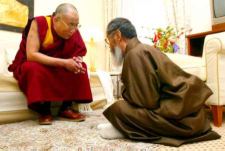
| been lost but for the efforts of these two luminaries to preserve it. Although Khentse was the source of inspiration and greatly contributed towards this effort, it was Kongtrul who actually put together the gigantic work, "The Five Great Treasures." The compilation and transmission of the teachings of "The Five Great Treasures" of Kongtrul, together with sGrub.thabs.kun.bTus and rGyud.bDe.kun.bTus., broke the isolation of single lineage teachings in the majority of Tibetan Buddhist Schools. A tradition of receiving the teachings of various lineages and Schools from one teacher in one place became established. Take the example of gDams.ngag.mZod. A compendium of most of the essential teachings of all the eight Practice lineages (sGrub.brGyud.Shing.ta.brGyad) is now preserved in one lineage. Teachings of these kinds have become not only common, but popular among the masters of all Schools of Tibetan Buddhism. The great success in this field also goes to the fact that Kongtrul gave these teachings himself, many times over, to a wide range of students, from the heads of Schools to the humblest of lay practitioners There were many among his wide range of students who could spread the lineage in their own Schools and monasteries. Kongtrul was also able to have almost all of his major works published (wood blocks) while he was still alive. When Tibetans came out of India in 1959, the full set of "The Five Great Treasures" of Kongtrul was available. H.H. the Karmapa and H.H. Dudjom Rinpoche started to give the teachings of different collections in India from 1960-61 onwards. The only Tibetan books Chogyam Trungpa brought to Europe when he and Akong Rinpoche first came to England in the early 1960�s, were a set of Kongtrul�s She-bya.dZod (Treasury of Knowledge) besides their daily practices. His Holiness, XIV Dalai Lama, has been strongly influenced by some great Rim� teachers such as Khunu Lama Tenzin Gyatso, Dilgo Khentse Rinpoche and the 3rd Dodrupchen Tenpe Nyima. Due to their efforts in recent years, there has been more interchange of teachings amongst different Schools of Tibetan Buddhism than ever before. Following the traditions of Rim�, the Dalai Lama has been receiving and giving teachings of all Schools in their respective traditions and lineages. (Ringu Tulku) |
 |
| dampa masters. If we examine the lives of the great masters of any School we find how many teachers of different Schools and lineages they studied with and how much respect they had for them. The conflicts between lamas and monasteries, and sometimes regions of Tibet, are often presented these days as religious or doc-trinal conflicts. However, almost none of them have anything to do with basic doc-trinal or even philosophical disagreements. Most of these conflicts were based on personality problems or mundane establishment rivalries. The Rim� movement of Kongtrul and Khentse was not a new concept, but it was a timely and unique move-ment with great consequences. A great portion of Buddhist literature would have |
|
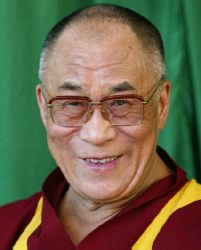
| one Dalai Lama in Tibetan has mouth service - lip service, but in heart there's anoth-er genuine Dalai Lama who is outside Tibet. So, that is the reality. Byrne: Do you feel in any way that you have failed the People of Tibet because they are still not free - they are have to fight for their belief and their freedom? HH: Yes. I give one example - reunion inside Tibet, outside of Tibet - now for the three years past, anyway, failed. But at same time preserved Tibetan culture heritage on this planet. Not only amongst Tibetans, but also among Tibetan friends - including some Australians. I think we achieved something. I think that we created some kind of source - of hope - for Tibet-ans inside Tibet. So that's our achievement, so it's not a complete failure. I think there always is some failure, some field, some aspect of achievement. So that's what I think, the nature of life. Byrne: Your holiness it's a great pleasure to meet you - thank you. HH: Thank you. Thank you very much. |
| Interview with His Holiness The Dalai Lama... (Exiled leader of Tibet, His Holiness The Dalai Lama, spoke to Jennifer Byrne in Melbourne during his Australian tour, 22/5/2002.) Transcript: Byrne: Thank you very much for joining us. The Chinese as you've said... they are the guests who came with guns... Now they come with money, is it even harder to stop the conquest of Tibet ? HH: (laughs) Your question's quite sharp. Now, actually the Chinese government you see, they are putting... pouring more and more money into Tibet with hope eventually that the Tibetan spirit will diminish. Byrne: What do you believe? HH: Two years ago I received one letter from Tibet. It said the Chinese government now decided to make a railroad to Tibet - a railway link - and then within thirty years twenty million Chinese were going to settle in Tibet. So if that kind of situation happened, then Tibet would finish. Byrne: I'd like to ask Your Holiness, even though you've been insulted by experts - by our own politicians who won't meet you, by the Chinese, by Rupert Murdoch. do you ever allow yourself the luxury of being offended? HH: Sometimes there is a little irritation, but then, of course, one of the main practices you see is to try to cultivate respect towards one 's own enemy, or the people who create problems or harm to you. Byrne: Even to Rupert Murdoch? HH: Oh certainly. Byrne: Even when he talks about your Gucci shoes - rudely. HH: Okay... I don't think it's true. Out of his ignorance, I think. It doesn't matter. When sometimes the Chinese accuse me as a murderer, or as a rapist - it doesn't matter. Mainly they are ignorant. And in some cases they have to say things like that. Byrne: What is the time that you have been offended, when it actually wounds you? HH: When I heard this story of torture and beating inside Tibet, then sometimes I feel I think besides sadness, a little irritation. Sometimes a little anger, I also succumb. But then I consci-ously say this is not right. I am a Buddhist. I am a practitioner of altruism. So I try to minimise these negative feelings. Byrne: As you have said, people have tried to paint you as a living God - as a living Buddha - a man God... you say you are very much a human.? HH: (laughs) If it is some Tibetan, you see - they say or I think believe, the Tibetan sort of bright future can be achieved through just praying to the Dalai Lama. That is nonsense. Byrne: So they should not pray to the Dalai Lama? HH: It is useless. We work hard, we have to work hard, even Dalai Lama himself. Through prayer nothing can be achieved. I'm always telling people prayer of course is good, but through prayer we can't change the re-ality. Very different. So change reality through heart, through action! Byrne: Through work? HH: Yes. Karma means action. So things change through action not by prayer, not by wish. Byrne: But it's a long time coming isn't it - will they ever leave you be? HH: Well, firstly, I'm not seeking independence. I'm not seeking complete separation from China. Tibet's a landlocked country - materially backward. Of course spiritually very rich - I think very rich - but spirituality alone cannot fill our stomachs. So we need money. We need more material development. For that reason if we remain within the Peoples Republic of China, providing the Chinese government treat us well, respect us, respect our culture, respect our own basic right, then as far as material development is concerned we might get greater benefit if we remain in the Peoples Republic of China. Byrne: You have said that your successor will come from outside China. China has said that it will come from inside China - is this also a worry for you? Can you be sure that the Dalai Lama will continue as you wish? Forgive me for asking about your death like this, but... HH: No, no... I understand...it's okay... it's okay... no problem. Now whether the Dalai Lama institution should continue or not is entirely up to the Tibetan people. If un-der present circumstances, if I die and the Tibetan people want another sort of reincarnation, then the genuine reincar-nation will appear outside of Tibet because the main purpose of reincarnation is to fulfil the task which was started by the previous life but is not yet fulfilled. So logically, if, you see, the reincarnation is in Chinese hands and becomes a puppet, it will not help. But of course they have their power, they have their force. So one artificial Dalai Lama - I think |
 |
|
| "One great question underlies our experience, whether we think about it or not: what is the purpose of life? From the moment of birth every human being wants happiness and does not want suffering. Neither social conditioning nor education nor ideology |
| affects this. From the very core of our being, we simply desire contentment. Therefore, it is important to discover what will bring about the greatest degree of happiness. "The most important thing is practice in daily life; then you can know gradually the true value of religion. Doctrine is not meant for mere knowledge, but for the improvement of our minds. In order to do that, it must be part of our life. If you put religious doctrine in a building and when you leave the building depart from the practices, you cannot gain its value. "As far as your personal requirements are concerned, the ideal is to have fewer involvements, fewer obligations, and fewer affairs, business or whatever. However, so far as the interest of the larger community is concerned, you must have as many involvements as possible and as many activities as possible." The Dalai Lama |
|
| The Eight Verses on the Training of the Mind by Geshe Langri Thangpa With a determination to accomplish the highest welfare for all sentient beings who surpass even a wish-granting jewel, I will learn to hold them supremely dear. Whenever I associate with others I will learn to think of myself as the lowest among all and respectfully hold others to be supreme from the very depths of my heart. In all actions I will learn to search into my mind and as soon as an afflictive emotion arises endangering myself and others I will firmly face and avert it. I will learn to cherish beings of bad nature and those oppressed by strong sins and suffering as if I had found a precious treasure very difficult to find. When others out of jealousy treat me badly with abuse, slander, and so on, I will learn to take on all loss, and offer victory to them. When one whom I have benefited with great hope unreasonably hurts me very badly, I will learn to view that person as an excellent spiritual guide. In short, I will learn to offer to everyone without exception all help and happiness directly and indirectly and respectfully take upon myself all harm and suffering of my mothers. I will learn to keep all these practices undefiled by the stains of the eight worldly conceptions and by understanding all phenomena as like illusions be released from the bondage of attachment. |
|
 |
 |
 |
| "But peace does not rest in the charters and covenants alone. It lies in the hearts and minds of all people. So let us not rest all our hopes on parchment and on paper, let us strive to build peace, a desire for peace, a willingness to work for peace in the hearts and minds of all of our people. I believe that we can. I believe the problems of human destiny are not beyond the reach of human beings." John F. Kennedy "Peace and friendship with all mankind is our wisest policy, and I wish we may be permitted to pursue it." Thomas Jefferson "The object of the superior man is truth." Confucius "One cannot subdue a man by holding back his hands. Lasting peace comes not from force." David Borenstein Those wise ones who see that the consciousness within themselves is the same consciousness within all conscious beings, attain eternal peace. The Upanishads "The wisdom of life consists in the elimination of nonessentials." -Lin Yutang Age doesn't always bring wisdom. Sometimes age comes alone. -Unknown Disclaimer: All images and/or articles retain the original copyrights of their original owners. |
 |
| Visit our main Buddhism site. More information, images, and, NO pop-ups! |
| Last Update: 11/30/04 |