| Page 37A |
 |
 |
| Tibetans first came into contact with Buddhism when they occupied the oasis cities of central Asia. Some time later, in the 8th century AD, the first of many mission-ary monks arrived and the country's first monastery was established in 787AD. However, despite some early success Buddhism soon went into decline due to opposi-tion from Bon, the indigenous religion, and political turmoil. In the 10th century monks from India and Tibetans going to India re-introduced the religion together with many aspects of Indian civilisation and it soon began to flourish. As Tantra was the main type of Buddhism in India at the time, it was that which became establish-ed in Tibet. There are Four Principle Schools in Tibetan Buddhism. In the 17th cen-tury the head of the country's most powerful sect, the Fifth Dalai Lama (1617-82), made himself king and his successors ruled the country until 1951. Although living in a sparsely populated and geographically isolated region, the Tibetans gradually evolved one of the richest and most sophisticated forms of Buddhism. However, the |
 |
| powerful and conservative clergy refused to allow any form of modernisation or contact with the outside world, which made Tibet an easy target for communist China which invaded the country in 1951. Between 1959 and 1977 almost all traces of Buddhism were destroyed and hundreds of thousands of people were driven into exile. However, refugee monks have been highly successful in re-establishing themselves in India and since the 1960s have been equally succes-sful in founding temples and centres in the West. |
| BUDDHISM IN TIBET: THE INITIAL INTRODUCTION - Probably Buddhism was first introduced to Tibet in 173 CE during the reign of the 28th Yarlung king Lha Thothori Nyantsen, but had apparently no impact. The first official historic introduction of a Buddhist scripture into Tibet happened during reign of King Hlato Ri Nyentsen (28th king of Tibet - around 500 CE), however, the book was not translated at the time. The 33rd King of Tibet, Song Tsen Gampo, (born 617) had the book translated and married two Buddhist princesses. With this, one can say that Buddhism was first really introduced to Tibet as a practice. The 37th King of Tibet, Trisong Detsen, invited Indian Pandit Shantarakshita and Kamalasila, who suggested to invite Padmasambhava (or Guru-Rinpoche) to Tibet, who arrived in 817. An ordained spiritual community was established in the first Buddhist monastery; Samye, which was built by Padmasambhava. In this period, translation of scriptures genuinely began. As of this time, one can say that Buddhism was firmly established in Tibet, as the presence of Sangha is considered essential. In 792, after a great philosophical debate, King Trisong Det-sen officially declared Indian Buddhism and not Chinese Buddhism to be the religion of Tibet. DECLINE AND REVIV-AL - Buddhism almost disappeared after 842 when King Lang Dharma violently persecuted Buddhism. After this, for a long time there were no ordinations and no central religious authority in Tibet. Instead, the original Bon religion pre-vailed. In 978, with the introduction of several Indian Pandits and Tibetan monks studying in India, Buddhism revived, with the help of king Yeshe O. A real revival occurred after 1042, when Atisha-di-Pankhara (or Lama Atisha) put Ti-betans "back on the right track." He presented the Buddhist philosophy in a very clear and condensed manner, which became the basis for philosophical teachings in most Tibetan traditions. After Atisha, the influence from Indian teach-ers was limited. Atisha's main disciple was the layman Dromt�npa, who founded the Kadam tradition. This tradition does not exist in that form anymore, but strongly influenced the later schools of Kargyu, Sakya and especially Gelug. Note that Tibetan teachers like His Holiness the Dalai Lama insist that Tibetan Buddhism these days still carefully re-flects the Buddhism as was present in India around the 11th century. He also rejects the term Lamaism, as it suggests as if the Tibetan teachers have developed their own form of Buddhism. NYINGMA - The Nyingma school is more or less a continuation of the initially introduced Buddhism by the Indian Pandit Padmasambhava. Historic information of Pad-masambhava is generally shrouded in myths, (he is said to have lived for 3,600 in India prior to coming to Tibet), but he came to Tibet in 817 at the invitation of King Trisong Detsen. Initially, the study of logic and philosophy was limited, but much emphasis was put on tantric practice. It must be noted however, that also within the Nyingma school consider-able reformation has taken place over the ages. Some typical aspects for the Nyingma tradition: the practice of Dzog-chen (seeking to examine the fundamental nature of mind directly, without relying on visualizations and images) and the presence of hidden scriptures or "terma" from Padmasambhava, which are discovered by later Masters. KADAM - Not existing as such anymore, but it was the main reformation school after revival of Buddhism in the 11th century by Atisha di Pankara from India (c. 982-1052) and Dromtonpa as his Tibetan disciple. Atisha combined two lineages: from Manjushri via Nagarjuna (emphasising emptiness) and from Maitreya via Asangha (emphasising compassion). Atisha's brief text 'A lamp for the path to full awakening' formed the basis of the later Gelug presentation of Lamrim. KAR-GYU - This tradition started with the Tibetans Marpa Ch�kyi and Khyungpo Nyaljor, in the 11th. century, who had Tilo-pa (988-1069) and his disciple Naropa (1016 - 1100) as Indian masters. Probably the most famous practitioner and mas-ter in the lineage is Milarepa (1040-1123), who attained Buddhahood in one life time by an incredible display of perse-verance. Milarepa was a disciple of Marpa who in turn was a pupil of Naropa. The Kargyu tradition is both a meditation lineage and philosophy training lineage. Typical aspects of the Kargyu tradition are the practice of Mahamudra (not un-like Dzogchen of the Nyingma) and the Six Yogas of Naropa. It should be noted that currently several suborders of the Kargyu lineage exist, like the Karma Kargyu (with as leader the Karmapa), the Drikung Kargyu and the Drukpa Kar-gyu schools. SAKYA - The Sakya tradition has its origins with the translator Drogmi, who transferred the lineage of the |
 |
 |
| Indian master Virupa to Khon Konchog Gyalpo. On this occasion, Khon Konchog Gyalpo built the Sakya monastery (meaning grey earth) and founded the Sakya tradition. In 1247, the Mongolian prince Godan Khan conquered Tibet and gave temporal authority over Tibet to Lama Kunga Gyaltsen (better known as Sakya Pandita), who was one of the earliest major figures in this lineage. In 1254 Mongol emperor Kublai Khan invited Ch�g-yal Phagpa for teachings. Also Kublai Khan made Buddhism the state religion in Mongolia and made Chogyal Phagpa the first religious and secular leader over Tibet. Sakya masters ruled Tibet more than 100 years before the Gelug took over secular power with the Dalai Lamas. A typical aspect of the Sakya tradition is called Lamdrey (leading to state of He-vajra), a concise presentation of the Buddhist philosophy. The Sakyas were much influ-enced by the Kadam lineage. In 1354, the rule over Tibet was given to the monk Chang-chub Gyaltsen, who was not a Sakya. After this, the tradition declined in importance. |
| GELUG - The Gelugs (yellow hats) tradition was founded by Tibetan teacher Je Tsongkhapa (1357-1419). The basis is formed by the old Kadam lineage, but it in fact includes all other Tibetan traditions. For example; Tsongkhapa's main teacher was the Sakya teacher Rendawa. Sonam Gyatso (1543-1588), received the title 'Dalai Lama' (Ocean of Wisdom) from the Mongol ruler Althan Khan in 1578. In 1642, the 5th. Dalai Lama became temporal and spiritual leader of Tibet by order of the Mongol ruler Gushri Khan. Although trained in all four schools, basically all Dalai Lamas were Gelug; one of the reasons that Gelug tradition is most widespread in Tibet. Note that the posthumously declared "First Dalai Lama" named Gedun Truppa (born 1391) was a disciple of Je Tsongkhapa. Unlike what many people think, the Dalai Lamas are not the spiritual heads of the Gelugpa school; this is always the Gaden Tripa. Some typical aspects of the Gelug tradition: emphasis on ethics and sound scholarship. Main Buddhist teachings are collected in the Lamrim pre-sentation (not unlike the Lamdrey teachings of the Sakya). The Gelug introduced a scholarly title, Geshe, for a fully qualified and authoritative spiritual master. |
|
| QUESTION: Aren�t elements of Vajrayana borrowed from Hindu Tantric Yoga, the Bon religion or Shinto? The Maha-yana and Vajrayana seem to be caused by a �synthesis� of Buddhism with the other countries in East Asia, the native people adapted Buddhism to suit their own ideas. Such as how Ch�an Buddhism got its distinct style from Taoism and Confucianism. ANSWER: These ideas have been developed by a couple of western scholars due to noticing a few simi-larities between Buddhism and Hinduism, Buddhism and Taoism, Buddhism and Shintoism, or whatever other religion Buddhism might seem similar to. Though this logic is distorted since most religions have something in common. Histor-ically speaking, the various Buddhist lineages existed and thrived in much of Asia centuries ago. Presently some of these lineages only exist in certain areas. So for present-day westerners it poses this false idea that the Buddhism in one area was altered by the native people. That causes them to propose theories which attempt to explain why Bud-dhism looks or appears to be different from one area to another, however they do this without the proper historical background (which shows so obviously that the Vajrayana and Mahayana existed in India and in Southeast Asia). They also lack the proper understanding that the Buddha did not teach only one method or one gospel per se; the Buddha's teachings span volumes and in total sum include numerous teachings and methods. The Vajrayana existed very strongly in Southeast Asia at one time. Today, in Indonesia, one can still see the mandalas and complex structures built for the Buddhas and Bodhisattvas of the Mahayana, and even Tantric deities. Atisha�s (the great Indian master who arrived in Tibet in the 11th Century AD) main teacher Serlingpa was from an isle of Indonesia. Furthermore, the ancient statues found in Java (of Vajrasattva, Maitreya, Vairochana among other Mahayana and Vajrayana personages ) resemble quite remarkably the style and exact features on images which are produced today by the Tibetan Vajrayana schools. In Cambodia and Thailand, statues of deities such as Hevajra, a Vajrayana Yidam, still can be seen today. The Metropoli-tan Museum of Art, in New York, has these items on display. The present-day Shignon sect of Japan is none other than a Vajrayana sect, its lineage is directly traced to Indian masters. Almost all the present-day deities of Buddhism can be traced directly to India, as statues of these forms still exist there as they have for centuries. Therefore, the types of Buddhism which presently exist in much of Asia are not adaptations. These Asian countries did not alter original Bud-dhism which was in India (prior to the Muslim invasions and the Hindu renaissance). This is clear since even something so esoteric as the Vajrayana was spread directly from India to Tibet, India to Indonesia, India to China and Japan, and India to Southeast Asia. Vajrayana Buddhism therefore is not merely a Tibetan or Japanese phenomenon, it existed throughout Asia and still also exists very strongly in Japan and somewhat in China. Ch�an Buddhism takes its main stance from the Buddhist scriptures such as the Lankavatara Sutra which expound on the concept of Buddha Nature. Ch�an Buddhism was directly brought from India to China by the Indian Master Bodhidharma, who through using the Buddha-Nature concept, taught methods for students to realize their true nature of mind in meditation. This theory of practice is not just prevalent in East Asia where Ch�an exists, but also in Tibet. These points vividly show that the Bud-dhism which spread from India to Tibet, to Japan, to Southeast Asia or to China was the same; that in each country, the Dharma was not altered by the native people as much as scholars claim it was. Last, we can examine and refute the idea that Vajrayana or Mahayana Buddhism is simply the product of mixing Buddhism with Hindu elements. If Bud-dhism was to �exclude� all of its commonalties with other religions, there would be nearly nothing left. Since Buddhism is from the Indian sub-continent, just like Hinduism, it is going to use similar terms and phrases such as tantra and sutra. Do western scholars expect Buddhism to use Latin phrases instead? As Sakya Trizin Rinpoche said: �Some per-sons have suggested that Buddhist Tantra must not belong to pure Buddhism because it shares many elements of prac-tice with the Hindus. This is specious reasoning because certain methods are bound to be shared by different religious traditions. Suppose we had to abandon each and every element of practice shared with Hindu traditions. In that case we would have to give up generosity, morality, and much more!� Scholars have hilariously attempted to equate Buddhism with practically every religion. Some say the concept of the Dharma-body of the Buddha (personified through deities such as Vajradhara) as the supreme form of Buddha was due to Islamic influence of monotheism. Some propose the Vajrayana in Tibet is really a mix with Bon, while others say something totally different - that in Japan it was Shinto-ism which caused the esoteric Vajrayana ideas. And now, we also have some scholars saying that in India the Vajrayana was assimilating Hinduism into Buddhism. Presently, certain scholars have even began to claim that Christianity is not its own religion and was actually made up by Jews in Israel who got wind of the Buddha�s teachings, or even propose that Jesus himself traveled to India and studied Buddhism. Much more time would be required to tell if these theories are true, but it is certainly obvious that practitioners shouldn�t fall for believing everything western scholars propose. One can see from the above, we do not want to fall into sympathizing with these far-fetched and contradictory ideas. |
 |
|
| THE FOUR NOBLE TRUTHS - Once there was a woman named Kisagotami, whose first-born son died. She was so stricken with grief that she roamed the streets carrying the dead body and asking for help to bring her son back to life. A kind and wise man took her to the Buddha. The Buddha told her, "Fetch me a handful of mustard seeds and I will bring your child back to life." Joyfully Kisagotami started off to get them. Then the Buddha add-ed, "But the seeds must come from a family that has not known death." Kisagotami went from door to door in the whole village asking for the mustard seeds, but everyone said, "Oh, there have been many deaths here," "I lost my father," I lost my sister." She could not find a single household that had not been visited by death. Finally Kisagotami returned to the Buddha and said, "There is death in every family. Everyone dies. Now I understand your teaching." The Buddha said, "No one can escape death and unhappiness. If people expect only happiness in life, they will be disappointed." Things are not always the way we want |
| them to be, but we can learn to understand them. When we get sick, we go to a doctor and ask: What's wrong with me? Why am I sick? What will cure me? What do I have to do get well? The Buddha is like a good doctor. First a good doc-tor diagnoses the illness. Next he finds out what has caused it. Then he decides what the cure is. Finally he prescribes the medicine or gives the treatment that will make the patient well again. The Four Noble Truths - 1. There is Suffering - Suffering is common to all. 2. Cause of Suffering - We are the cause of our suffering. 3. End of Suffering - Stop doing what causes suffering. 4. Path to end Suffering - Everyone can be En-lightened. 1. Suffering: Everyone suffers from these things. Birth- When we are born, we cry. Sickness- When we are sick, we are miserable. Old age- When old, we will have ache and pains and find it hard to get around. Death- None of us wants to die. We feel deep sorrow when someone dies. Other things we suffer from are: Being with those we dislike, Being apart from those we love, Not getting what we want, All kinds of problems and disappointments that are unavoid-able. The Buddha did not deny that there is happiness in life, but he pointed out it does not last forever. Eventually ev-eryone meets with some kind of suffering. He said: "There is happiness in life, happiness in friendship, happiness of a family, happiness in a healthy body and mind, ...but when one loses them, there is suffering." 2. The cause of suffering: The Buddha explained that people live in a sea of suffering because of ignorance and greed. They are ignorant of the law of karma and are greedy for the wrong kind of pleasures. They do things that are harmful to their bodies and peace of mind, so they can not be satisfied or enjoy life. For example, once children have had a taste of candy, they want more. When they can't have it, they get upset. Even if children get all the candy they want, they soon get tired of it and want something else. Although, they get a stomach-ache from eating too much candy, they still want more. The things people want most cause them the most suffering. Of course, there are basic things that all people should have, like ade-quate food, shelter, and clothing. Everyone deserve a good home, loving parents, and good friends. They should enjoy life and cherish their possessions without becoming greedy. 3. The end of suffering: To end suffering, one must cut off greed and ignorance. This means changing one's views and living in a more natural and peaceful way. It is like blowing out a candle. The flame of suffering is put out for good. Buddhists call the state in which all suffering is ended Nirvana. Nirvana is an everlasting state of great joy and peace. The Buddha said, "The extinction of desire is Nirvana." This is the ultimate goal in Buddhism. Everyone can realize it with the help of the Buddha's teachings. It can be experienced in this very life. 4. The path to the end of suffering: The path to end suffering is known as the Noble Eightfold Path. It is also known as the Middle Way. |
 |
| THE NOBLE EIGHTFOLD PATH - When the Buddha gave his first sermon in the Deer Park, he began the 'Turning of the Dharma Wheel.' He chose the beautiful symbol of the wheel with its eight spokes to represent the Noble Eightfold Path. The Buddha's teaching goes round and round like a great wheel that never stops, leading to the central point of the wheel, the only point which is fixed, Nirvana. The eight spokes on the wheel represent the eight parts of the Noble Eightfold Path. Just as every spoke is needed for the wheel to keep turning, we need to follow each step of the path. 1. Right View. The right way to think about life is to see the world through the eyes of the Buddha--with wisdom and compassion. 2. Right Thought. We are what we think. |
| Clear and kind thoughts build good, strong characters. 3. Right Speech. By speaking kind and helpful words, we are re-spected and trusted by everyone. 4. Right Conduct. No matter what we say, others know us from the way we behave. Before we criticize others, we should first see what we do ourselves. 5. Right Livelihood. This means choosing a job that does not hurt others. The Buddha said, "Do not earn your living by harming others. Do not seek happiness by making others unhappy." 6. Right Effort. A worthwhile life means doing our best at all times and having good will toward oth-ers. This also means not wasting effort on things that harm ourselves and others. 7. Right Mindfulness. This means be-ing aware of our thoughts, words, and deeds. 8. Right Concentration. Focus on one thought or object at a time. By doing this, we can be quiet and attain true peace of mind. ...Following the Noble Eightfold Path can be compared to cultivating a garden, but in Buddhism one cultivates one's wisdom. The mind is the ground and thoughts are seeds. Deeds are ways one cares for the garden. Our faults are weeds. Pulling them out is like weeding a garden. The harvest is real and last-ing happiness. |
|
| The Buddha spoke the Four Noble Truths and many other teachings, but at the heart they all stress the same thing. An ancient story explains this well: Once a very old king went to see an old hermit who lived in a bird's nest in the top of a tree, "What is the most important Buddhist teaching?" The hermit answered, "Do no evil, do only good. Purify your heart." The king had expected to hear a very long explanation. He protested, "But even a five-year old child can understand that!" "Yes," replied the wise sage, "but even an 80-year-old man cannot do it." |
 |
|
| Buddhism in India... Buddhism, or the spiritual tradition of the awakened one, Buddha, (Buddha-dharma) is regarded as one of the three most widespread major world religions. Buddhism was founded by the historical Buddha Shakyamuni or Gautama, in the 5th or the 6th centuries B.C.E. The basic teachings of the Buddha can be recapitulated in the Tripitaka - the three collections of: Vinaya-pitaka (the collection of discipline), Sutra-pitaka (collection of dis-courses), and Abhidharma-pitaka (collection of abhidharma or metaphysics). The main subject matter or the purpose of theses teaching are, respectively, the development of the three higher trainings of discipline, concentration and trans-cendental knowledge, while their function is to remedy the three poisons of desire, anger and delusion. EARLY DEVEL-OPMENT OF BUDDHISM IN INDIA - In brief, the historical development of Buddhism can mainly be classified in four phases: 1. The Phase Of Early Buddhism: The historic Buddha expounded the teachings and his disciples preserved the teachings. This occurred approximately from the middle of the 6th to the middle of the 5th century B.C.E. 2. The Phase Of Interpretations Of The Teachings: The beginning of the divisions into various (Hinayana) schools on the basis of different interpretations of the teachings of Buddha (Councils) started to occur, the criterion of the second phase. This took place approximately from the 4th century to the 1st century C.E. The Hinayana Schools developed between the mahaparinirvana (death) of the Buddha and the end of first century B.C.E. After the third council, the first split into schools took place and Hinayana Buddhism was divided into eighteen sub-schools. It is said that its doctrines are essen-tially based on the sutras taught by the Buddha, its discipline based on Vinaya, and the analysis of the Abhidharma teachings. Hinayana primarily presents the path of individual salvation or liberation called the Pratimoksha. 3. The Phase Of The Rise Of Mahayana Buddhism: The rise of Mahayana Buddhism with its two sub-schools - Chitamattra (or the Yogacharya) and Madhyamaka was the third historical phase of Buddhism. This occurred approximately from 1st to the 7th century C.E. Mahayana Schools developed especially during the time of Asanga, Vasubhandu, Nagarjuna, and other great masters. 4. The Phase Of Buddhist Tantra: The revelation of Buddhist Tantras (in Tibet) started to take place after the 7th century. Tantric buddhism existed in India at the time in an extremely hidden or secret form and was not made public or accessible to the general buddhist practitioners. It expanded even more during the time of Sara-ha, Nagarjuna, and other great mahasiddhas and finally came to Tibet in full through the blessings of Guru Padmasam-bhava, Marpa the Great Translator, and many other great Indian and Tibetan masters. THE SPREAD OF BUDDHISM IN ASIA - Starting about the 3rd century Buddhism began to grow and spread outside India, adjusting to local cultures and the varying conditions of different countries. Buddhism began to take root in different countries in Asia as they came in contact with Buddhism from early 2nd century B.C.E. Buddhism was brought to Ceylon (Shri Lanka) in 250 B.C.E. by Mahinda and Sanghamitta, children of King Ashoka. This marked the first time for Buddhism to spread out-side India. In the 3rd century C.E., Buddhism then came to: Burma (Myanmar) during the reign of the King Ashoka; Cambodia; China in the 2nd or 3rd century C.E.; and Indonesia in the 3rd century C.E. From the 4th through the 8th century C.E.: Buddhism came to: Korea from China in the 4th century C.E.; to Japan from Korea in 522 C.E.; to Thai-land from Burma in the 6th century C.E.; and to Tibet in early 8th century C.E. DECLINE AND REESTABLISHMENT OF BUDDHISM IN INDIA - Buddhism became nearly extinct in India, the country of its origin, after the 13th century C.E., primarily due to continuous destructive activity of different fundamentalist muslim emperors. However, it con-tinued to grow and expand in other countries to the present day. Buddhism is now reestablished in India by many Ther-avadin schools of Hinayana and Tibetan Mahayana-Vajrayana buddhist schools in the recent years. |
|
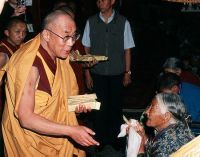
| sands listened quietly to the Mongolian translation. At one point, he raised his hand and hundreds of others shot up to wave in response. He also led the group in chants. "The Dalai Lama talked about praying together for peace. I liked the message. I think I will try to put this in practice in my life," said one believer, Sainaa, a Buddhist from Ulan Bator. The Dalai Lama, the leader of Tibetan Buddhism, is expected to tour smaller monasteries, give more speeches and receive an honorary doctorate from a local university. He is scheduled to leave on Friday. China considers the Dalai Lama a po-litical schemer determined to end Chinese rule in Tibet. On Tuesday in Beijing, Chinese Foreign Ministry spokesman Kong Quan reiterated China's objections to travel and public appearances by the Dalai Lama. "We are against his devi-sive efforts in this kind of forum," Kong said at a briefing. "We have asked Mongolia and other countries not to give this kind of forum to him." Mongolia shares strong religious ties to Tibet and has been rediscovering its Buddhist heri-tage since the end of communist rule in 1990. Some 90 percent of Mongolia's 2.4 million people consider themselves Buddhists. The Dalai Lama, who lives in exile in India, has visited Mongolia five times, most recently in 1995. He had planned to come in September, but was blocked when Russia and South Korea refused him transit visas, possibly to avoid angering China. There are no direct flights to Mongolia from India. Before the lesson, the Dalai Lama met with monks at the monastery. Temperatures fell to 5 degrees Fahrenheit as the Dalai Lama, wearing his traditional robe with one arm bare in the cold, made his way through the compound. "We believe that the Dalai Lama is the Buddha. I am very happy and excited to be here," said Ananda, 19, who was perched on a wall. He traveled from Russia this week to see the spectacle. Hundreds of Mongolians, their faces bundled in fur coats, jostled and held up cameras in hopes of a glimpse of the Dalai Lama. When he arrived, he strode along a multicolored carpet flanked by legions of monks from the monastery, known commonly by its shorter name, Gandan. Other monks prostrated in his path as he walked for-ward, shielded from the sun by a yellow silk umbrella and a hat. Horns blew, cymbals clanged and drums beat as he made his way toward a private meeting in the monastery. "He is the Buddha of compassion," said Lhawang, a Tibetan monk who teaches at the monastery and has seen the Dalai Lama nine times. "I feel so strongly, I cry every time." Both Tibetans and Mongolians follow the tantric school of Buddhism, which recognizes the Dalai Lama as a high spiritu-al authority. A 16th-century Mongol king is thought to have bestowed the first Dalai Lama title - a designation that means "Ocean of Wisdom." Chinese communist forces occupied Tibet in 1951 and Beijing says the Himalayan region has been Chinese territory for centuries. The Dalai Lama fled to India after a failed uprising in 1959 and travels fre-quently to conduct Buddhist ceremonies and seek support for his campaign for Tibetan political and cultural rights. |
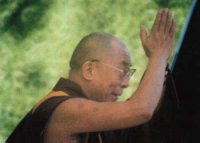
| Dalai Lama Visits Mongolia Monastery ULAN BATOR, Mongolia (Nov. 05, 2002 ) - The Dalai Lama gave a lesson to thousands of followers in Mongolia's largest Buddhist monastery Tuesday, where he was welcomed by overjoyed monks during a trip to the north Asian country that has raised Chinese protests. "If you do good for others, goodness will return to you," he said before the crowd from a massive stage in front of the main temples of the Gandantegchillen Monastery. Some people shoved their way to the front, while others shared steaming bowls of salted yak's milk tea to combat the cold. Vendors sold everything from chocolate and phone services. The Dalai Lama spoke in Tibetan, his voice booming through a microphone, as the faithful thou- |
|
| To laugh often and love much; to win the respect of intelligent people and the affection of children; to earn the approbation of honest critics and endure the betrayal of false friends; to appreciate beauty; to find the best in others; to give one's self; to leave the world a little better, whether by a healthy child, a garden path, or a redeemed social condition; to have played and laughed with enthusiasm and sung with exultation; to know even one life has breathed easier because you have lived, this is to have succeeded. Ralph Waldo Emerson |
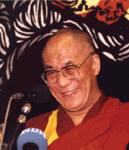 |
| "When unfortunate things happen in our lives there are two possible results. One possibility is mental unrest, anxiety, fear, doubt, frustration and eventually depression, and, in the worst case, even suicide. That's one way. The other possibility is that because of that tragic experience you become more realistic, you become closer to reality. With the power of investigation, the tragic experience may make you stronger and increase your self-confidence and self-reliance. The unfortunate event can be source of inner strength." The Dalai Lama Disclaimer: All images and articles retain the original copyrights of their original owners. |
 |
 |
 |
| Visit our main Buddhism site. More information, images, and, NO pop-ups! |
 |
| Last Update: 11/30/04 |