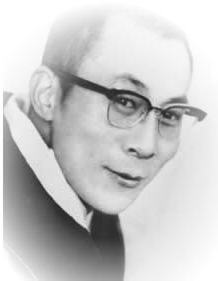
Rinchen Dharlo, the representative of H.H. the Dalai Lama in N. America asked to have the following article printed. "It is very relevant for Westerners to consider these thoughts carefully and for all of us to do what we can. I am very happy today to communicate with all of you American Buddhists from [the Tibetan Buddhist Learning Center], the old-est of the Tibetan Buddhist monastic centers in America. It is encouraging to note the present spread of Tibetan Bud-dhism, some 1000 centers around the world with over 250 in the United States alone. As I often say, Buddhism has a special gift for helping people calm their minds and learn to live more happily. In the midst of what can accurately be called "the Buddhist holocaust" of the 20th century, we Tibetans were forced into exile by the Chinese invasion of our homeland. Since then, we have been privileged to share the gifts of Buddhism with fellow beings of other nations, who all must face the countless difficulties of life in our restless, anxious, modern world. Perhaps the only good thing that has come from our tragedy is the spread of the teaching and practice of Tibetan Buddhism. Of course, it would have been much better for everyone if it could have happened without such an unspeakable toll of human suffering. Imagine, Tibetan lamas could have come out to teach in different countries, travelling with their visas stamped on Tibetan pass-ports! Western Dharma students could have freely come into Tibet's peaceful mountains to enjoy her fresh air, study at her monastic universities, and meditate in her inspiring solitude. I say this not just to complain about our ordeal but be-cause I have noticed that people tend to adopt a sort of fatalism about the history and problem of Tibet; 'Well, it had to happen that way - otherwise Tibetans would not have come out of isolation into the world.' Thinking this way can make them slow to take action to try to improve the real Tibetan situation, to solve the Tibetan problem, the human problem of six million Tibetan human persons. Now, it is a useful practice to reflect on one's own suffering, to think of it as the 'return of one's own karma,' and thus get the benefit of cultivating patience with one's difficulties. But it is not useful, nor compassionate, to be patient about the sufferings of others. In fact, as Shantideva says, the Bodhisattva should be absolutely intolerant of the sufferings of others, should find them utterly unbearable. To give a personal example, I have said that I myself have actually benefited from the hardships of losing my homeland and wandering in exile - and I meant it. Not having a sheltered life and having to suffer and struggle has helped me to grow. Worldly difficulty can lead to faster spiritual growth and greater strength of mind, and I personally am quite content with my lot. I have been given the inspiration to take the Buddha Dharma seriously and the opportunity to work hard to put it into practice. I cannot complain. Yet the plight of my people, the six million Tibetans who look to me to help them, is different - I cannot forget their cries. How can I pray and recite the Bodhisattva vow to save all beings from suffering and the cause of suffering, and at the same time leave anything undone that could actually help these suffering people who are my im-mediate responsibility? So I am always trying to do as much as I can. Perhaps my example can help other Buddhists who want to maintain their spiritual practice and also want to work for the good of society. In the past, scholars have said that Buddhism was single-minded in its focus on Nirvana, giving up the mundane world as a hopeless case. With this preconception, they thought that Buddhism made very little contribution to civilization, letting social problems go their own way. Now, it may be true that Buddhist persons and institutions could have done a better job of helping people in different periods and different countries. But I believe that from the time of Buddha until today all forms of Buddhism have been continuously trying to help people, whether in social groups or individually. It has never been the case that Buddhism did not care about the world. The freedom and happiness of all living beings have always been the ultimate ideal and the working goal. Tibetan civilization is very much a product of the socially transformative power of Buddhism. Brought from India by the great Emperor Songsten Gampo in the 7th century. Buddhist wisdom began its slow but steady work of making the people more gentle, happy and peaceful. After a few centuries, Tibetans had become so fond of the Buddha Dharma that they made great efforts to make it the center of their lives, even without the support of a royal dynasty. Finally, after one thousand years, Tibetans succeeded in expressing Buddhist ideals in the national gov-ernment itself, established as the integration of the sacred and the secular by the Fifth Dalai Lama in the 17th century. We believed that the Buddha's teaching was the indispensable key to achieving national as well as individual happiness. So our whole social system - our culture, arts and life style - was centered on people's spiritual development according
to the Dharma. Though we never achieved perfection, we did preserve many unique teachings and traditions; some of them long lost to other Buddhist countries. But I don't need to say too much about this, as I know many of you have come to realize the preciousness of Tibetan Buddhism, to cherish it just as we do. I have been very moved on this trip because so many people have expressed to me, in actions as well as words, their respect, not only for the teachings of Tibetan Buddhism, but also for their source, namely, Tibetan culture and civilization, which itself is ultimately rooted nowhere else than in the living hearts of the Tibetan people. Tibetan culture belongs to all humanity, and its extinction would not just affect Tibetans, but all humanity. We, therefore, appeal to the members of all other cultures to help the Tibetans preserve our unique and rich cultural heritage. Our friends in the Congress of the United States have acted powerfully to express their support for our cause, urging China to cease her attempts to eliminate the Tibetan race, erase the Tibetan nation from history, and eradicate the Tibetan culture. These senators and representatives will in-creasingly need your help and the help of all Buddhists, all religious persons, all humanists, and all friends of Tibet, to make an even stronger push to get China to change her attitude. This push is urgent and essential to save our people and culture before it is too late. For China, too, it is an emergency because if her leaders do not change their present course, it will eventually rebound upon themselves in a negative way. But I do not wish to elaborate on this, as I am ba-sically an optimist and still have great hope that sanity will prevail and that good and truth will triumph. You might be surprised, but I think such optimism is quite practical. For, you see, everyone just wants happiness. If we investigate the human heart, not just to follow religious teaching, but to analyze carefully what is really there, we find that what everyone wants, what gives satisfaction, is the warm heart, the good heart, compassion and love. These give calmness, tranquillity, and real contentment; and that gives inner strength. On the other hand, hatred, anger, and greed simply produce uneasiness and always more dissatisfaction. Even nations need to control and minimize anger and hatred; it is the only way they can avoid suffering and bring their people happiness. So nations will eventually do the right thing, be-cause it is in the ultimate best interest of their people. Goodness is finally the most practical, the most realistic solution. Perhaps most of you already know the importance of compassion and love. The practice of compassion is what gives me greatest satisfaction. No matter what the circumstances, no matter what kind of tragedy I am facing, I practice compas-sion. This gives me inner strength and happiness. This gives me the feeling that my life is useful. So you see, up to now - I am 57 years of age - I have tried my best to practice these things, and will continue to do so until my last breath, my last day. I myself, you see, am the devoted servant of compassion. That is the way I really feel. We need public support, the active expression of your goodwill towards us. Please keep this in mind, and whenever the occasion arises, express your deep sympathy towards the Tibetan cause. As Buddhist practitioners, you should understand the necessity of pre-serving Tibetan Buddhism. For this, the land, the physical country of Tibet, is crucial. We have tried our best to pre-serve the Tibetan traditions outside Tibet for almost thirty years, and we have been comparatively successful. But even-tually, after our time, there is a real danger that they will change, that they will not survive, away from the protective nurture of our homeland. So, for the sake of preserving Tibetan Buddhism, which can be seen as a complete form of the Buddha Dharma, the sacred land of Tibet is vitally important. It is very unlikely that it can survive as a cultural and spiritual entity if its physical reality is smothered under Chinese occupation. So we cannot avoid taking responsibility in trying to improve its political situation. Clearly, in this light, active support for the Tibetan cause is not just a matter of politics. It is the work of Dharma. We are not against the Chinese; we, in fact, have a deep admiration for the Chinese civilization. We are only trying to gain our rights, to save our people, and to preserve our Buddha Dharma. I dream of a new Tibet - a free land, a zone of peace - where my six million people can restore our spiritual way of life while becom-ing attuned to the best aspects of the modern world. I see it as a place where all people, not excluding our eastern neighbor - can visit and enjoy the fresh air and brilliant mountain light, can find inspiration in a peaceful, spiritual way of life, and perhaps can learn to understand their own worlds better by getting away for a little while to meditate at our high altitude. With your help, we can return there. Now is the time when your action is practice. Thank you, thank you very much." (1993) |