 |
 |
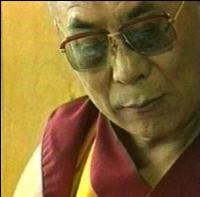
| "In order to achieve a human existence in the future with a precious body, the causes and conditions that bring about such a result should also be precious, because there should be a concordance between causes and their effects. Just as the result is very rare, similarly the causes themselves are very rare. So the appropriate cause for obtaining human existence in the future as the text here discusses, is to have a very proper foundation of a practice of morality- at minimum an abstention from the ten negative actions. In addition to this basis, the practice of generosity, patience, and so on are also required, which will contribute to the positive qualities of human existence such as having a better intelligence, as so forth. These complementing factors should themselves be complemented by aspirational prayers dedicated to the obtaining of such a human form conducive to the practice of dharma. So, you need these three factors: the foundation, the complementing practices, and a strong force of aspiration to obtain such a body." The Dalai Lama |
| Page 29 |
 |
| Drablha, Engineer. Raised the Tibetan flag for a day. To Tibetans, the concrete box in a prison cell is known as a "Chi-nese coffin.'' Chinese call it a jinbi. For 22 hours a day over a three-month period, this box the size of a coffin confined a 40-year-old Tibetan man named Drablha (like many Tibetans, he has only one name). He was confined to the box while imprisoned for the crime, in Chinese-occupied Tibet - of raising the Tibetan national flag one day in 1988. During the two hours a day that he was taken out of the box by Chinese police, Drablha said in an interview in India, he was often hung by his thumbs and beaten with iron bars. Drablha, a former engineer for the Chinese government, spent his life in Tibet but was educated in Beijing. He was jailed for 11 months. He believes he was stuck in the box for so long be-cause he was unwilling to say what the Chinese police wanted to hear: that Chinese rule in Tibet was good for Tibetans. He decided to raise a flag for Tibetan independence because he discovered, through his work, that the Chinese used Ti-bet as a colony. "I'd have to design a bridge to a forest, or a mine,'' Drablha recalled. "The Chinese always calculated in advance what they'd get out of Tibet.'' Inside the box, he said, "there wasn't even a hair of light. I was in there day and night, and I couldn't tell when it was day, when it was night.'' It was only as wide as Drablha and barely as long, with an iron door at one end. Some air could enter, Drablha said, but breathing was difficult. The only thing inside was a small bucket. By contorting himself, Drablha used it as his toilet. "I couldn't move in there, and it was very hot; I'd be sweat-ing,'' Drablha said. "I'd rather be tortured than stay in there. Sometimes I wished they'd take me out and execute me.'' He said that most of the time, he meditated, reciting the mantra Om Mani Padme Hum of the patron deity of Tibet, who symbolizes compassion. "I dreamed that I was moving, always moving, in a jeep, going to China.'' When he was taken out, Drablha said, he was hung - either by his thumbs, or upside down, his feet near the ceiling. "They'd suspend me for 15 minutes, then take me down, then put me back up because they'd say I wasn't confessing to advocating indepen-dence for Tibet," Drablha said. "Sometimes I'd be naked while suspended. Then they'd ask me: 'Where is your inde-pendence for Tibet?' If I didn't answer, they'd spray me with a hose. It was winter and the water was very cold.'' He re-members the name of the Chinese policeman who tortured him: Xiao Li. "Xiao Li twisted my arm behind my back so that it made a noise - Crack! - and he pulled it off the track - out of its socket," Drablha said. In India, Drablha pulled up his sleeves to reveal his elbows. The right elbow is out-of-joint, at a different angle than the left. "This is the most I can straighten it,'' he said, bringing his arm to a 45-degree angle. An X-ray of Drablha's arms shows that his elbows are at odd angles, according to a New Zealand doctor who examined him in India in June. She also said that imprints on his fingers showed that he had been locked in finger cuffs. His thumbs had line-thin horizontal scars at the joints. The doc-tor also said Drablha had scars from cigarette burns on his legs. X-rays of Drablha's hands suggest that his thumbs were subjected to unusual pressure. During the examination, Drablha pulled up his right pants leg to his knee to reveal five dark round circles, each about a half-inch in diameter. "Police did this while interrogating me,'' he said. Each day, Drablha said, police opened the metal door once or twice to give him a small piece of bread and black tea. He said he was always hungry. Earlier this year, Drablha and his wife decided to leave Tibet and flee to India. They made the trek over the Himalayan mountains. Now Drablha is hoping to find a job - any job. (1996) |
|
 |
 |
| April 11, 2004 |
| Om Mani Padme Hum The Meaning of the Mantra in Tibetan Buddhism - Overview - Tibetan Buddhists be-lieve that saying the mantra (prayer), Om Mani Padme Hum, out loud or silently to oneself, invokes the powerful be-nevolent attention and blessings of Chenrezig, the embodiment of compassion. Viewing the written form of the mantra is said to have the same effect - it is often carved into stones, like the one pictured at right, and placed where people can see them. Spinning the written form of the mantra around in a Mani wheel (or prayer wheel) is |
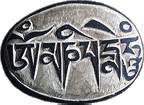 |
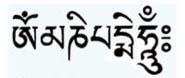
| also believed to give the same benefit as saying the mantra, and Mani wheels, small hand wheels and large wheels with millions of copies of the mantra inside, are found everywhere in the lands influenced by Tibetan Buddhism. It is said that all the teachings of the Buddha are contained in this mantra: Om Mani Padme Hum can not really be translated in-to a simple phrase or sentence. It is appropriate, though, to say a little about the mantra, so that people who want to use it in their meditation practice will have some sense of what they are doing, and people who are just curious will un-derstand a little better what the mantra is and why it is so important to Tibetan Buddhists. The Mani mantra is the most widely used of all Buddhist mantras, and open to anyone who feels inspired to practice it - it does not require prior initi-ation by a lama (meditation master). The six syllables of the mantra, as it is often pronounced by Tibetans - Om Mani Padme Hum - are written below in the Tibetan alphabet. Reading from left to right the syllables are: Om(ohm), Ma |
| (mah), Ni(nee), Pad(pahd), Me(may, ) Hum(hum). The vowel in the sylable Hu (is pro-nounced as in the English word 'book'. The final consonant in that syllable is often pro-nounced 'ng' as in 'song' -- Om Mani Padme Hung. There is one further complication: The syllable Pad is pronounced Pe (peh) by many Tibetans: Om Mani Peme Hung. The mantra originated in India; as it moved from India into Tibet, the pronunciation changed |
 |
| because some of the sounds in the Indian Sanskrit language were hard for Tibetans to pronounce. Sanskrit form - Om Mani Padma Hum - mantra of Avalokiteshvara - Tibetan form Om Mani Peme Hung - mantra of Chenrezig. The True Sound of Truth, an old story speaks about a similar problem. A devoted meditator, after years concentrating on a par- ticular mantra, had attained enough insight to begin teaching. The student's humility was far from perfect, but the teachers at the monastery were not worried. A few years of successful teaching left the meditator with no thoughts about learning from anyone; but upon hearing about a famous hermit living nearby, the opportunity was too exciting to be passed up. The hermit lived alone on an island at the middle of a lake, so the meditator hired a man with a boat to row across to the island. The meditator was very respectful of the old hermit. As they shared some tea made with herbs the meditator asked him about his spiritual practice. The old man said he had no spiritual practice, except for a mantra which he repeated all the time to himself. The meditator was pleased: the hermit was using the same mantra he used himself - but when the hermit spoke the mantra aloud, the meditator was horrified! "What's wrong?" asked the her-mit. "I don't know what to say. I'm afraid you've wasted your whole life! You are pronouncing the mantra incorrectly!" "Oh, Dear! That is terrible. How should I say it?" The meditator gave the correct pronunciation, and the old hermit was very grateful, asking to be left alone so he could get started right away. On the way back across the lake the medi-tator, now confirmed as an accomplished teacher, was pondering the sad fate of the hermit. "It's so fortunate that I came along. At least he will have a little time to practice correctly before he dies." Just then, the meditator noticed that the boatman was looking quite shocked, and turned to see the hermit standing respectfully on the water, next to the boat. "Excuse me, please. I hate to bother you, but I've forgotten the correct pronunciation again. Would you please re-peat it for me?" "You obviously don't need it," stammered the meditator; but the old man persisted in his polite re-quest until the meditator relented and told him again the way he thought the mantra should be pronounced. The old hermit was saying the mantra very carefully, slowly, over and over, as he walked across the surface of the water back to the island. The Meaning of the Mantra: "There is not a single aspect of the eighty-four thousand sections of the Bud-dha's teachings which is not contained in Avalokiteshvara's six syllable mantra "Om Mani Padme Hum," and as such, the qualities of the "mani" are praised again and again in the Sutras and Tantras.... Whether happy or sad, if we take the "mani" as our refuge, Chenrezig will never forsake us, spontaneous devotion will arise in our minds and the Great Vehicle will effortlessly be realized." Dilgo Khyentse Rinpoche |
| Heart Treasure of the Enlightened Ones - People who learn about the mantra naturally want to know what it means, and often ask for a translation into English or some other Western language. However, Om Mani Padme Hum can not really be translated into a simple phrase or even a few sentences. All of the Dharma is based on Buddha's discovery that suffering is unnecessary: Like a disease, once we really face the fact that suffering exists, we can look more deeply and discover it's cause; and when we discover that the cause is dependent on certain conditions, we can explore the pos-sibility of removing those conditions. Buddha taught many very different methods for removing the cause of suffering, methods appropriate for the very different types and conditions and aptitudes of suffering beings. For those who had the capacity to understand it, he taught the most powerful method of all, a method based on the practice of compassion. It is known as the Mahayana, or Great Vehicle, because practicing it benefits all beings, without partiality. It is likened to a vast boat that carries all the beings in the universe across the sea of suffering. Within the Mahayana the Buddha re-vealed the possibility of very quickly benefiting all beings, including oneself, by entering directly into the awakened state of mind, or Buddhahood, without delay. Again, there are different ways of accomplishing this, but the most power-ful, and at the same time the most accessible, is to link ones own mind with the mind of a Buddha. In visualization prac-tice we imagine ourselves to be a Buddha, in this case the Buddha of Compassion, Chenrezig. By replacing the thought of yourself as you with the thought of yourself as Chenrezig, you gradually reduce and eventually remove the fixation on your personal self, which expands your loving kindness and compassion, toward yourself and toward others, and your intelligence and wisdom becomes enhanced, allowing you to see clearly what someone really needs and to communicate with them clearly and accurately. In most religious traditions one prays to the deities of the tradition in the hopes of receiving their blessing, which will benefit one in some way. In the vajrayana Buddhist tradition, however, the blessing and the power and the superlative qualities of the enlightened beings are not considered as coming from an outside source, but are believed to be innate, to be aspects of our own true nature. Chenrezig and his/her love and compassion are within us. In doing the visualization practice we connect with the body and voice and mind of the Buddha by the three aspects of the practice. By our posture and certain gestures we connect with the body, by reciting the words of the liturgy and by repeating the mantra we connect with the voice, and by imagining the visual form of the Buddha we con-nect with the mind. Om Mani Padme Hum is the mantra of Chenrezig. In the words of Kalu Rinpoche, "Through man- |
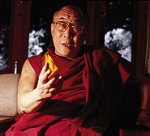 |
| you. Please bless them that they may achieve the omniscient state of buddhahood. With the power of evil karma gathered from beginningless time, Sentient beings, through the force of anger, are born as hell beings and experience the suffering of heat and cold. May they all be born in your presence, perfect deity." Glimpsing a Few More Facets of the Mantra - There are many ways to understand the meaning of the mantra. Here are a few of them: The Transfor-mation of Speech The second aspect of transformation [of confusion into wisdom] concerns our speech. Although it may be easy to consider speech as intangible, that it simply appears and disappears, we actually relate to it as some-thing real. It is because we become so attached to what we say and hear that speech has such power. Mere words, which have no ultimate reality, can determine our happiness and suffering. We create pleasure and pain through our funda-mental clinging to sound and speech. In the Vajrayana context, we recite and meditate on mantra, which is Enlightened sound, the speech of the [Bhodisattva of Compassion], the union of Sound and Emptiness. It has no intrinsic reality, but is simply the manifestation of pure sound, experienced simultaneously with its Emptiness. Through mantra, we no lon-ger cling to the reality of the speech and sound encountered in life, but experience it as essentially empty. Then confu-sion of the speech aspect of our being is transformed into enlightened awareness. At first, the Union of Sound and Emp-tiness is simply an intellectual concept of what our meditation should be. Through continued application, it becomes our actual experience. Here, as elsewhere in the practice, attitude is all-important, as this story about a teacher in Tibet il-lustrates... The teacher had two disciples, who both undertook to perform a hundred million recitations of the mantra of Chenrezig, OM MANI PADME HUNG. In the presence of their lama, they took a vow to do so, and went off to complete the practice. One of the disciples was very diligent, though his realization was perhaps not so profound. He set out to accomplish the practice as quickly as possible and recited the mantra incessantly, day and night. After long efforts, he completed his one hundred million recitations, in three years. The other disciple was extremely intelligent, though per-haps not as diligent, because he certainly did not launch into the practice with the same enthusiasm. But when his friend was approaching the completion of his retreat, the second disciple, who had not recited very many mantras, went up on the top of a hill. He sat down there, and began to meditate that all the beings throughout the universe were transformed into Chenrezig. He meditated that the sound of the mantra was not only issuing from the mouth of each and every being, but that every atom in the universe was vibrating with it, and for a few days he recited the mantra in this state of samadhi. When the two disciples went to their lama to indicate they had finished the practice, he said, 'Oh, you've both done excellently. You were very diligent, and YOU were very wise. You both accomplished the one hundred million recitations of the mantra.' Thus, through changing our attitude and developing our understanding, practice be-comes far more powerful." The Powers of the Six Syllables - The six syllables perfect the Six Paramitas of the Bodhi-sattvas. Gen Rinpoche, in his commentary on the Meaning said: "The mantra Om Mani P�dme Hum is easy to say yet quite powerful, because it contains the essence of the entire teaching. When you say the first syllable Om it is blessed to help you achieve perfection in the practice of generosity, Ma helps perfect the practice of pure ethics, and Ni helps achieve perfection in the practice of tolerance and patience. P�d, the fourth syllable, helps to achieve perfection of per-severance, Me helps achieve perfection in the practice of concentration, and the final sixth syllable Hum helps achieve perfection in the practice of wisdom. So in this way recitation of the mantra helps achieve perfection in the six practices from generosity to wisdom. The path of these six perfections is the path walked by all the Buddhas of the three times. What could then be more meaningful than to say the mantra and accomplish the six perfections?" The six syllables purify the six realms of existence in suffering. For example, the syllable Om purifies the neurotic attachment to bliss and pride, which afflict the beings in the realm of the gods. Purifies Samsaric Realm - Om bliss / pride gods - Ma jeal-ousy / lust for entertainment, jealous gods - Ni passion / human desire - Pe stupidity / prejudice, animal - Me pover-ty / possessiveness, hungry ghost - Hung aggression / hatred, hell. "Behold! The jewel in the lotus!" This phrase is often seen as a translation of the mantra. However, although some mantras are translatable, more or less, the Mani is not one of them; but while the phrase is incorrect as a translation, it does suggest an interesting way to think about the mantra, by considering the meanings of the individual words. "Thus the six syllables, Om Mani Padme Hum, mean that in dependence on the practice which is in indivisible union of method and wisdom, you can transform your impure body, speech and mind into the pure body, speech, and mind of a Buddha." The Dalai Lama |
| tra, we no longer cling to the reality of the speech and sound encountered in life, but experi-ence it as essentially empty. Then confusion of the speech aspect of our being is transformed into enlightened awareness." That Enlightened awareness includes whatever we might need to understand in order to save any beings, including ourselves, from suffering. For that reason the entire Dharma, the entire truth about the nature of suffering and the many ways of remov-ing it's causes, is said to be contained in these six syllables. Om Mani Padme Hum '"Buddha of great compassion, hold me fast in your compassion. From time without beginning, beings have wandered in samsara, Undergoing unendurable suffering. They have no other protector than |
|
 |
| "With a selfish attitude, oneself is important, and others are not so important. According to Shantideva's advice, a technique to help in turning this attitude around is to imagine - in front of yourself as an unbiased observer - your own selfish self on one side and a limited number of other beings on the other side - ten, fifty, or a hundred. On one side is your proud, selfish self, and on the other side is a group of poor, needy people. You are, in effect, in the middle - as an unbiased, third person. Now, judge. Is this one, single, selfish person more important? Or is the group of people more important? Think. Will you join this side or that side? Naturally, if you are a real human being, your heart will go with the group because the number is greater and they are more needy. The other one is just a single person, proud and stupid. Your feeling naturally goes with the group. By thinking in this way, selfishness gradually decreases, and respect of others grows. This is the way to practice. "Those of us who consider ourselves Buddhists should practice the Dharma sincerely and not be contented merely with the intellectual level. Implement it in a daily life with constant effort; time is a very important and major factor. If we expect great things right in the beginning, great spiritual change in the mind within a short period, it is not a healthy sign. We must count eons. "It is necessary to have a combination of hearing, thinking, and meditation. When you start practicing, you should not expect too much. We live in a time of computers and automation, so you may feel that inner development is also an automatic thing for which you press a button and everything changes. It is not so. Inner development is not easy and will take time. When it comes to dealing with greed, one thing which is quite characteristic is that although it arises from the desire to obtain something, it is not satisfied by obtaining it. Therefore, it becomes limitless or boundless, and that leads to trouble. The interesting thing about greed is that although the underlying motive is to seek satisfaction, as I pointed out, even after obtaining the object of one's desire, one is still not satisfied. On the other hand, if one has a strong sense of contentment, it doesn't matter whether one obtains the object or not; either way, one is still content. "Human happiness and human satisfaction must ultimately come from within oneself. It is wrong to expect some final satisfaction to come from money or from a computer." The Dalai Lama Disclaimer: All images and/or articles retain the original copyrights of their original owners. |
 |
 |
| Click at right to visit our main Buddhism site. More information and images. And, NO po-ups! |