 |
 |
| Page 23 |
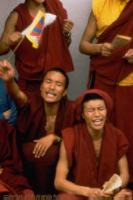
| mountains, only to be pushed back by Indian guards when they reached the border. "I pleaded with them, Shoot me, but don't send me back to the Chinese," Thupden, 35, recalled. Retreating from the border, the Tibetans hid behind a large boulder for two days. Thupden sprinkled sacred seeds around his famished family for safety, while his wife tried to keep the children from crying and alerting the guards. On the third day, they slipped into India through a different, un-guarded passage. Thupden told his story while huddling with his wife and three small children on the damp floor of a Tibetan refugee center in this north Indian town in the Himalayan foothills. More than 40 years after Tibet's spiritual leader, The Dalai Lama, fled and set up a Tibetan government-in-exile here, Tibetans stream in steadily, voting with their feet against Chinese rule. Thupden and his family are still recovering from their ordeal, and the children are cov-ered with sores, but they say what they left behind was far worse. Thupden said he spent six years in prison for arguing with the Chinese police against their occupation of Tibet and was beaten so badly he partially lost his hearing. After his release, he said, police harassed him by levying huge taxes on his farm animals and fining him each year for having had a third child - a violation of China's population control policies. "My Tibet is not free. I want to be with The Dalai Lama and start a new life here, until I can return to a free Tibet one day," said Thupden. He has enrolled his 6-year-old son in a Tibetan school here and hopes to find work as a wood carver. Thupden arrived as several thousand exiled Tibetans gathered in Dharamsala last week to celebrate the 50th anniversary of The Dalai Lama's leadership. At daybreak, ma-roon-robed Buddhist monks filled the steep, narrow alleys that wind up to the main Buddhist temple at daybreak. The temple's broad courtyard, lined with red and yellow prayer wheels, resonated with drumbeats and horns as thousands of Tibetan families waited patiently for a glimpse of their leader. The Dalai Lama, 65, revered by Tibetans as the 14th re-incarnation of the Buddha of Compassion, sat with folded hands under a large gold-plated Buddha, swaying to the gut-tural chants. From Dharamsala, he leads an international campaign against Chinese control of Tibet. "The more faith people show in me, the more morally responsible I feel," The Dalai Lama told journalists at the celebration. "At the age of 65 today, if my existence here seems to give some basis for hope for those inside Tibet, I am grateful." The Thupden family's recent flight was not as sensational as The Dalai Lama's escape 40 years ago from occupying Chinese troops, nor that of another leading Buddhist monk, the 14-year-old Karmapa Lama, who fled last year. But it was typi-cal of thousands of Tibetans who continue to flee religious and political persecution at the hands of China every year. About 2,900 Tibetans have arrived in India this year, and more than 35,000 since 1990, according to Tibetan officials here. Unlike those who fled decades ago and who are officially recognized as refugees, the new arrivals live in India il-legally and invisibly. "Legally, they don't exist," said Lhasang Tsering, 48, a former anti-Chinese guerrilla fighter who fled in 1959 with The Dalai Lama. "In addition to the trauma of exile, they have no emotional security. The grave risks they take are testimony to the fact that Tibetans do not want to live with China." More than half of the new refugees are Buddhist monks and nuns who have been expelled from monasteries for demonstrating against China, or in some cases for keeping The Dalai Lama's picture. Chonga Tsering, 20, a gaunt monk with a penetrating stare, said he was expelled from his monastery for refusing to denounce The Dalai Lama or accept Chinese rule. Last year, he joined a group of monks heading for the border, but they were spotted by Chinese guards when they tried to light a fire at night. "We were beaten with rifle butts as they insulted The Dalai Lama. I just felt so helpless," he recalled. Tsering said he was imprisoned for a month, beaten repeatedly, then taken to his village and paraded before his neighbors as a lesson to others who might try to escape. But a month ago, Tsering made a second attempt; he reached Dharamsala last week. According to the Tibetan Center for Human Rights and Democracy here, China holds about 600 Tibetan political pri-soners, most of whom have been tried without legal representation. "Anything that can define Tibetans as a distinct race is viewed as a direct threat to the unity of China and the Communist Party leadership," said Lobsang Nyandak, an official of the center. He said Tibetan prisoners are tortured with electric batons and dogs, and that some nuns had been |
| Escaping Chinese, Tibetans Join Leader in India (Dharamsala, India. Friday, December 15, 2000) Two months ago, a Tibetan yak herder named Sonam Thupden and his family fled their homeland, a remote Himalayan region ruled by China. For three weeks they braved icy winds and trudged through the rugged |
| sexually abused. The Chinese Embassy in New Delhi denied such allegations and said there are no detention centers in China. Lu Ping, a spokesman, said the world enjoys "demonizing China" and that The Dalai Lama's crusade has painted a false portrait of Tibetans' lives in China. He said he knew nothing about the thousands of refugees who flee to India each year. In Dharamsala, the Tibetan Health Department offers a counseling program for torture survivors that includes both Western and Buddhist therapy. Refugees are urged to talk about their experiences to come to terms with them, and also to understand, in Buddhist terms, how their karma has caused them suffering. "Many refugees bring with them deep psychological wounds," said Kalsang Phuntsok, who works at the program. "The common symptoms are nightmares, fear of the police, loss of memory, sleeplessness and a weak heart." He said the refugees are encouraged to "have com-passion for their tormentors, and [understand] that their suffering is for the good of the Tibetan cause." Soon after Thupden's ordeal ended with his arrival here, the yak herder was finally able to meet The Dalai Lama. He pressed the leader's hands to his forehead and began to cry. "I could |
 |
| � Ananda Apfelbaum |
| not say anything, I couldn't remember any words. My whole body was shaking," he recalled. "I felt a sudden peace. I was free." (Rama Lakshmi) |
 |
| Dharma Journey - State of Disunion - China's stranglehold onTibet tightens, even as dissenters in Beijing call for negotiation. Over the last 20 years, China has made important strides in economic and social progress. But looking at China's occu-pation of Tibet, it's impossible not to feel frustration and despair. In the past year, the Chinese government's "strike hard" policy has intensified. Not content to deprive adults of all religious and civil freedom, the authorities are even cracking down on children in a new wave of repression - a policy aimed at further undermining Tibetans' identity and culture. Last year, a 9-year-old was imprisoned for four months in eastern Tibet for having said at school that he was Tibetan, not Chinese. In May, three children were imprisoned for writing "Free Tibet" on their textbooks. In June, a group of 50 youngsters, ages 9 to 15, were returning to their families in Tibet after studying in Tibetan schools in India. They were arrested at the border, detained, and beaten for weeks before being sent to build roads in remote areas. And these are just a few examples. Of all the Chinese activity in Tibet, the most serious threat to the survival of Tibetan culture is population transfer. According to a report leaked in October, the Chinese government is planning to send 15 to 20 million Chinese into Tibet by 2020; this in addition to the 7 million Chinese who have already settled there. More-over, spontaneous immigration of Chinese Muslims into Amdo and Golok (now part of Quinhai and Szechuan provinces) continues to swell the non-Tibetan population. Immigrants now own practically all the shops, restaurants, and small workshops in villages and along main roads. Tens of thousands of Chinese Muslims are also searching for gold in the many rivers of these areas and living in the new government-built cities where they monopolize the local economies and relate poorly with local people. Giant infrastructure and road projects are literally paving the way for a growing influx of Chinese. The population-transfer strategy in Tibet resembles Chinese policy in Inner Mongolia after Beijing invaded. In 1959, Mongolia's population included only 10% Han Chinese. Today, there are between 18 to 20 million Han Chinese and only 2 to 3 million Mongols, whose hopes of cultural survival have vanished. In addition to the population question, the ecological situation is catastrophic. Before the arrival of the Chinese, more wild animals - antelope, gazelles, and wild asses - roamed the expanses of Tibet than people. Now, large wild animals are almost never seen. On the northern plains of Tibet, poachers hunt a few thousand remaining antelopes for high-priced shahtoosh shawls, which fetch thou-sands of dollars each in the West. Over 40% of Tibetan forests have been cut since 1960. The Chinese authorities have recently put a ban on logging, following catastrophic floods that affected China (the Yangtze and Yellow rivers both come down from Tibet). Yet the ban only applies where there are hardly any trees left, and logging continues unabated in parts of Tibet where the last forests are still standing. Language and education are two more fronts in the campaign to destroy the culture of Tibet. The literacy rate in Tibet is only 30%, compared with 95% in other areas of China. Textbooks are written in the cold style of ideological "education" and contain a distorted history of Tibet. Tibetan lan-guage is used less and less in schools, deemed an annoying element of a backward culture. If someone seeking employ-ment brings a document written in Tibetan to a local government agency, it is rejected outright, and the bearer is told to "bring something written in Chinese." Even letters with addresses written in Tibetan are not delivered by the post of-fice. The repression of religious freedom that has been a mainstay of the Chinese government's policy toward Tibet con-tinues. Nowadays, civilians are not allowed to pursue any religious activities at all. This includes a prohibition against keeping Buddhist images in their homes, not to mention the well-known ban on photographs of The Dalai Lama in pub-lic places, which has been extended to people's homes. Inspections are carried out any time of the day or night, and a telephone hotline has been set up by the authorities to encourage people to inform on others. Teachers have been di-rected to step up "atheism education." The extensive human rights violations, well documented over the 50 years of Chinese occupation of Tibet, continue at an appalling level. News recently surfaced of five Tibetan nuns who hanged themselves in jail because they could no longer endure the torture. Inmates of Drapchi Prison near Lhasa who refused to sing patriotic songs as the Chinese flag was raised, but shouted pro-independence slogans instead, have been submit-ted to severe beatings, electric shock, and rape. A Tibet Information Network report put the present number of prison-ers in central Tibet at 500. Of those, 80% of the women are believed to be Buddhist nuns and 66% of the men monks. With so much abuse and suffering, is there any hope for the Tibetan people? The European Parliament hopes so. This past July, it adopted a resolution on the future of Tibet, calling on its member states to help ensure that the People's Republic of China and The Dalai Lama negotiate a new status for Tibet. This new status would guarantee full autonomy for the Tibetan people (in all spheres other than defense and foreign policy). The resolution calls on member-state gov-ernments to consider "recognizing the Tibet government-in-exile as the legitimate representative of the Tibetan peo-ple" if the Chinese and the Tibetan government-in-exile have not reached agreement in three years. China, for its part, is insistent that The Dalai Lama must declare that Tibet has always been part of China before negotiations can proceed. Beyond that, all the Chinese seem ready to discuss is "the status of The Dalai Lama"- that is, whether or not The Dalai Lama will be allowed to return to Tibet. But for the last 15 years, The Dalai Lama has made it clear that his return is not the point. The real issue, he maintains, is the fate of the Tibetan people. He has stated over and over again that his government-in-exile is not seeking independence but a genuine autonomy within China - which would allow Tibetans and their culture to survive. The Dalai Lama has also officially declared that, in the event of his return to Tibet, he would hand over all his secular powers to democratically elected local authorities. "Whether the very institution of The Dalai Lama should even continue," he has often said, "is entirely up to the Tibetan people to decide." Signs of dissent against Beijing's Tibet policy often come from intellectuals in China. Wang Lixiong, a prominent Beijing-based writer, recently defied the official line on China's policy toward Tibet and has called for the Communist Party to sit down at the negotiating table with The Dalai Lama. It also seems that the removal of Chen Kuiyuan, a party hard-liner, from the top leadership post in Tibet has reinvigorated debates over the direction of China's Tibet policy. The fact that Wang Li-xiong, a well- known and respected writer, publicly took an unorthodox stand on an issue as volatile as Tibet - without being immediately thrown in jail - is a startling development. But will this new wrinkle in China's engagement with Ti-bet become an influential view within Communist leadership circles? The clock is ticking for Tibet. And the time has come for China to hear, and respect, her voice. (By Matthieu Richard / Courtesy Beliefnet) |
|
 |
| Courtesy Larry Sanborn |
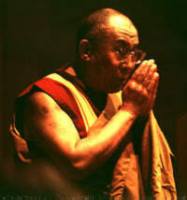
| "Right from the moment of our birth, we are under the care and kindness of our parents and then later on in our life when we are oppressed by sickness and become old, we are again dependent on the kindness of others. Since at the beginning and end of our lives we are so dependent on other's kindness, how can it be that in the middle we neglect kindness toward others? "I think religion, ideology, economy, and political systems are all man's creation. Since they are man's creation, they must relate with human feeling and the human spirit. If they are practiced with human feeling, they fulfill some basic human aspirations. The various religions and ideologies are meant for humanity and not the opposite. "Material progress alone is not sufficient to achieve an ideal society. Even in countries where great external progress has been made, mental problems have increased. No amount of legislation or coercion can accomplish the well-being of society, for this depends upon the internal attitude of the people who comprise it. Therefore, mental development, in harmony with material development, is very important. "To develop genuine devotion, you must know the meanings of teachings. The main emphasis in Buddhism is to transform the mind, and transformation depends on meditation. In order to meditate correctly, you must have knowledge, and communities, too, must be uplifted through knowledge. "Kindness is the key to peace and harmony in family life. Families in exile must educate their children. They should be their first lama." The Dalai Lama |
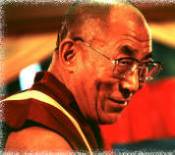
| "In our world, we need a clear awareness of the interdependent nature of nations, of humans and animals, and of humans, animals, and the world. Everything is of interdependent nature. I feel that many problems, especially man-made problems, are due to a lack of knowledge about this interdependent nature. "To be aware of a single shortcoming within oneself is more useful than to be aware of a thousand in somebody else. Rather than speaking badly about people and in ways that will produce friction and unrest in their lives, we should practice a purer perception of them, and when we speak of others, speak of their good qualities. If you find yourself slandering anybody, first imagine that your mouth is filled with excrement. It will break you of the habit quickly enough. "To foster inner awareness, introspection, and reasoning is more efficient than meditation and prayer. |
|
| Emotion is the chief source of all becoming consciousness. There can be no transforming of darkness into light or of apathy into movement without emotion. Carl Gustav Jung We need to have respect and love for all things and all people. Every person is special! I sincerely believe this. Each of us wants to feel good about himself or herself, but to me it is just as important to make others feel the same way. whenever I meet someone, I try to imagine him wearing an invisible sign that says: "MAKE ME FEEL IMPORTANT." To succeed, you have to do something and be bad at it for a while. You have to look bad before you can look really good. In the depth of winter, I finally learned that within me there lay an invincible summer. Albert Cames Do you imagine the universe is agitated? Go into the desert at night and look at the stars. This practice should answer the question. Lao-Tzu How seldom do we behold tranquility! Emerson Respect is appreciation of the separateness of the other person, of the ways in which he or she is unique. Annie Gottlieb The more he gives to others, the more he possesses of his own. Lao-Tzu We arrive at truth, not by reason only, but also by the heart. Blaise Pascal When I give, I give myself. Walt Whitman All, everything that I understand, I understand only because I love. Leo Tolstoy Love is not a higher power which descends upon man nor a duty which is imposed upon him; it is his own power by which he relates himself to the world and makes it truly his. Erich Fromm Everything has its wonders, even darkness and silence, and I learn, whatever state I may be in, therein to be content. Helen Keller |
 |
| Courtesy Larry Sanborn |
|
| Rinpoche came across the same man prostrating in front of a statue of the Buddha at the temple. The man was pleased to see the great teacher again, greeted him reverentially, and anxiously asked if he was prostrating correctly. Rinpoche smiled and answered, "What you are doing is very good, but it would be better if you tried to practice pure Dharma." The man felt confused and once again thought he was doing the wrong practice. So he reflected, "If prostrating is not the correct practice, maybe I should start reciting mantras." So he sat down in the temple and started to recite a par-ticular mantra. The next day Rinpoche passed by the temple and heard the man earnestly reciting the mantra. When the man saw Rinpoche he thought, "This time I must have got it right," and said to Dromton Rinpoche, "Now I am practicing pure Dharma." Rinpoche smiled compassionately at the man, then folded his hands together and replied: "I really appreciate your recitation of this mantra, but pure Dharma has to do with motivation. If your mind is still dom-inated by the desire for selfish material gain and fame, then whatever practice you choose to do cannot be the pure practice of Dharma. Please try to overcome this first by being aware of impermanence and death. Once you have at-tained a realization of death and impermanence, then all the practices you do will be pure Dharma." The man listened carefully to Rinpoche's teaching and took his advice to heart. He realized that his motivation had not been pure while he was circumambulating, prostrating, and reciting mantras. So this time he started to meditate with single-pointed concentration on death and impermanence and soon was able to achieve many high realizations without too much ef-fort. The Proper Motivation - This story is a good reminder to develop proper motivation before we start whichever Dharma practice we are thinking of doing. It is only too easy to fool ourselves in our Buddhist practice by thinking such things as: "If I generate a lot of good karma through this practice, then I might be rewarded with getting things that I want." As we can see from the story, accumulating merit is not sufficient to lead us toward Enlightenment. Unless we are constantly aware of death and impermanence we can easily be tempted by the desire for fame, even if this is just wanting people to think well of us, and for material gain, even if we think that extra wealth will give us more time for Buddhist practice. Both of these desires contain a subtly selfish, impure motivation. But if, like the man in the story, we meditate on death and impermanence first, our motivation will become pure. With this awareness we can really overcome the unhappiness and dissatisfaction caused by desire and attachment. Disclaimer: All articles and/or images retain the original copyrights of their original owners. |
| One day a great lama, Dromton Rinpoche, was giving teachings in a place near Lhasa, the capital of Tibet. During a beak he went for a walk in the woods nearby and saw a man con-scientiously circumambulating a stupa, a shrine symbolizing Buddha's inner qualities. Cir-cumambulating stupas, or other Buddhist shrines, is a traditional Buddhist practice to ac-cumulate merit. The man asked Rinpoche if this was the correct way to perform circum-ambulations. Rinpoche smiled and replied, "I rejoice in your actions, but I wish you would practice pure Dharma." The man was a little puzzled, but then thought, "Perhaps this is not the best practice, I had better try doing prostrations." The next day during his walk |
 |
 |
| April 18, 2004 |
 |
| Please visit our Main Site. More information, more images and NO pop-ups. |
 |