We need three basic ingredients to make a thunderstorm. The basic fuel is moisture (water vapor) in the lowest levels of the atmosphere. The air above the lowest levels has to cool off rapidly with height, so that 2-3 miles above the ground, it is very cold. Finally, we need something in the atmosphere to push that moist air from near the ground up to where the air around it is cold. This "something" could be a cold front or the boundary between where the cold air from one thunderstorm meets the air outside of the storm (called an outflow boundary) or anything else that forces the air at the ground together. When that happens the moist air is pushed up. What happens to a blob of moist air as it rises? It cools off and after a while, some of the water vapor turns into liquid drops (that we see as clouds). That warms up the rest of the air in the blob so that it doesn't cool off as fast as it would if the air was dry. When that blob of air gets to the part of the atmosphere where it is very cold, it will be warmer and less dense than the air around it. Since it is less dense, it will start to rise faster without being pushed, just like a balloon filled with helium does. Then more water vapor turns into liquid in the blob and the blob warms up more and rises even faster until all of water vapor is gone and the blob eventually reaches a part of the atmosphere where it isn�t warmer than the environment (typically 5-10 miles).
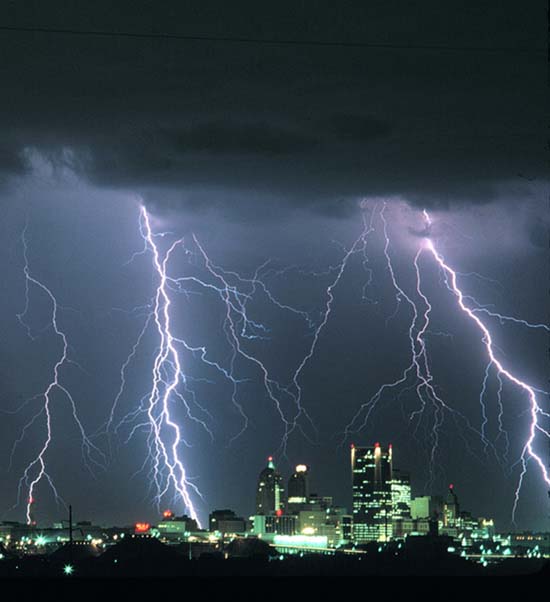
Many hazardous weather events are associated with thunderstorms. Fortunately, the area affected by any one of them is fairly small and, most of the time, the damage is fairly light. Lightning is responsible for many fires around the world each year, as well as causing deaths when people are struck. Under the right conditions, rainfall from thunderstorms causes flash flooding, which can change small creeks into raging torrents in a matter of minutes, washing away large boulders and most man-made structures. Hail up to the size of softballs damages cars and windows, and kills wildlife caught out in the open. Strong (up to more than 120 mph) straight-line winds associated with thunderstorms knock down trees and power lines. In one storm in Canada in 1991, an area of forest approximately 10 miles wide and 50 miles long was blown down. Tornados (with winds up to about 300 mph) can destroy all but the best-built man-made structures