
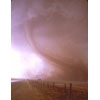
How do tornadoes form? The classic answer -- "warm moist Gulf air meets cold Canadian air and dry air from the Rockies" -- is a gross oversimplification. Many thunderstorms form under those conditions (near warm fronts, cold fronts and drylines respectively), which never even come close to producing tornadoes. Even when the large-scale environment is extremely favorable for tornadic thunderstorms, as in an SPC "High Risk" outlook, not every thunderstorm spawns a tornado. The truth is that we don't fully understand. The most destructive and deadly tornadoes occur from supercells -- which are rotating thunderstorms with a well-defined radar circulation called a mesocyclone. [Supercells can also produce damaging hail, severe non-tornadic winds, unusually frequent lightning, and flash floods.] Tornado formation is believed to be dictated mainly by things which happen on the storm scale, in and around the mesocyclone. Recent theories and results from the VORTEX program suggest that once a mesocyclone is underway, tornado development is related to the temperature differences across the edge of downdraft air wrapping around the mesocyclone (the occlusion downdraft). Mathematical modelling studies of tornado formation also indicate that it can happen without such temperature patterns; and in fact, very little temperature variation was observed near some of the most destructive tornadoes in history on 3 May 1999. The details behind these theories are given in several of the Scientific References accompanying this FAQ.
Does hail always come before the tornado? Rain? Lightning? Utter silence? Not necessarily, for any of those. Rain, wind, lightning, and hail characteristics vary from storm to storm, from one hour to the next, and even with the direction the storm is moving with respect to the observer. While large hail can indicate the presence of an unusually dangerous thunderstorm, and can happen before a tornado, don't depend on it. Hail, or any particular pattern of rain, lightning or calmness, is not a reliable predictor of tornado threat.
How long does a tornado last? Tornadoes can last from several seconds to more than an hour. The longest-lived tornado in history is really unknown, because so many of the long-lived tornadoes reported from the early 1900s and before are believed to be tornado series instead. Most tornadoes last less than 10 minutes.
Big fat tornadoes are the strongest ones, right? Not necessarily. There is a statistical trend (as documented by NSSL's Harold Brooks) toward wide tornadoes having higher F-scale damage. This can be out of more strength or out of greater opportunity for targets to damage -- or some blend of both. However, the size or shape of any particular tornado does not say anything conclusive about its strength. Some small "rope" tornadoes can still do violent damage of F4 or F5; and some very large tornadoes over a quarter-mile wide have produced only weak damage of F0 to F1.
F0----------WEAKEST
F1----------QUITE WEAK
F2----------MODERATE
F3----------STRONG
F4----------VERY STRONG
F5----------EXTREEMLY STRONG

true or false
a) Wind at sea
b) violent cylinder of wind
a) warm air meets cold air
b) when a storm is brewing there is always a tornado
True or false ?
True or false
(dont look till you have answered)
ANSWERS TO QUIZ <<< (click there)
