 |
|
|
|
|
|
|
|
|
|
|
|
|
|
|
|
|
|
|
|
|
|
|
|
|
|
|
|
|
|
|
|
|
|
|
|
|
|
|
|
|
|
|
|
|
|
|
|
|
|
|
|
|
|
|
|
|
|
|
|
|
|
June/July Newsletter |
|
June/July p. 2 |
|
June/July p. 3 |
|
|
H o m e |
|
|
|
|
|
|
|
|
|
June/July, 2005 - Page 3 |
|
|
|
On This Page: Science: Garden Battle |
|
|
|
 |
|
|
|
Science - Garden Battle |
|
|
|
 |
|
|
Our garden the first week in June. |
|
|
|
|
|
|
 |
|
|
|
 |
|
|
|
Our garden the third week in July! |
|
|
|
|
|
|
|
|
|
This year our flower and vegetable gardens are bigger and better than ever! In the flower garden we have impatiens, zinnias, nasturtiums, cosmos and sunflowers of all sizes. In the vegetable garden we have already started harvesting beans, lettuce, spinach, tomatoes, zucchini, carrots and sweet peppers. It won't be long before we our enjoying our cantaloupe, eggplant, watermelon and corn.
Even though our garden looks beautiful and peaceful, it's really a huge battle ground out there! When you look close you can see all kinds of bugs waging war on our plants and on each other! Before we started picking them off the plants, we had to learn which bugs were the "good guys" and which had to go!
Here are some some of the soldiers: |
|
|
|
The Bad Guys!! |
|
|
The Good Guys!! |
|
|
|
|
|
|
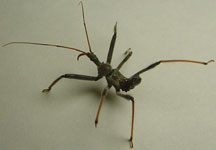
Assassin Bug |
|
|
|
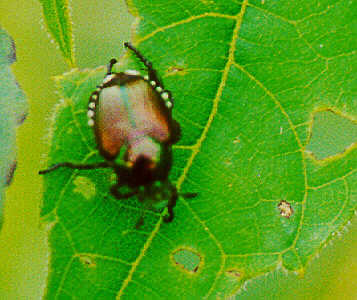
Japanese Beetle |
|
|
|
|
|
 |
|
|
|
 |
|
|
|
|
|
Nearly 3000 species of assassin bugs exist and can be found throughout most of the world. They can be as small as a few millimeters to as big as 3 or 4 centimeters. They come in many colors and shapes and most have two pairs of wings. All assassin bugs have a powerful, curved beak, that they use to pierce and suck out the tissues of their prey.
Assassin bugs get their name because of the speed that they have to grab and poison their prey. They are carnivorous, or meat eaters, and use their powerful, jack-knife forelegs to grab their prey. Assassin bugs feed by pushing their beak into their victim�s body and injecting a very poisonous liquid that affects the nerves and makes the muscles turn into liquid. Once the insides of the prey are turned into a liquid, the assassin bug uses its beak to suck out the liquified tissues in much the same way we use a straw to drink a milkshake!
Assassin bugs are helpful in the garden because they attack bugs that hurt the garden. But be careful! Although their bite isn�t poisonous to humans it sure does hurt! |
|
|
|
The Japanese beetle is a plant destroyer that came from Japan about 80 years ago. In Japan where the beetle has natural enemies to keep its populations in check, it is not a serious pest. In the United States, however, the beetle has no natural enemies and found a favorable climate and an abundant food supply. The Japanese beetle has become a serious problem to gardens and crops.
The Japanese beetle is destructive both as an adult and as a grub. Adult beetles feed on the leaves and fruits of hundreds of fruit trees, trees, shrubs, and vegetable crops. Adults leave behind skeletonized leaves and large holes in leaves. The grubs develop in the soil and eat the roots of various plants and grasses and can destroy grass in lawns, parks, golf courses, and pastures. |
|
|
|
|
|
Tomato and Tobacco Hornworm |
|
|
|
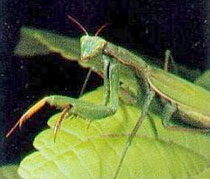
Praying Mantis |
|
|
|
 |
|
|
|
|
 |
|
|
|
|
|
|
Tomato/tobacco hornworms can measure up to 4 inches in length. The "horn" on the rear of both gives them their name. The tobacco hornworm larva is generally green with seven diagonal white lines on the sides and a curved red horn. The tomato hornworms have eight V-shaped marks on each side and their horn is straighter and blue-black in color. These "hornworms" are the larvae of hawk or sphinx moths, also known as hummingbird moths. They are a huge garden pest! Their size of lets them quickly eat tomatoes, potatoes, eggplants, and peppers. Occasionally, they may also feed on green fruit. They can ruin an entire crop of plants in the garden. Gardeners are most likely to see the damage at the top of a plant before they see the hornworm. They are often difficult to see because of their protective coloring. They do not like the heat of direct sunlight, so they tend to feed on the inside of the plant during the day and move to the outside of the plant at dawn and dusk, when it is easier to spot them. Hornworm damage usually starts in midsummer and continues until the fall. |
|
|
Praying mantises (or mantids) can be less than one inch to 12 inches long! They can be colors from light greens to pinks. Most mantids are pea green or brown. Camouflage is very important for the praying mantis' survival. They have so many enemies such as birds that they must have to blend in with their habitat to avoid being eaten. They have a triangular-shaped head with a large compound eye on each side. They have straight, leathery forewings and very powerful jaws used to eat their prey. Mantids have strong front legs that look like they are praying when they hold them together.
The praying mantis is a carnivorous insect. The front legs have rows of sharp spines used to grab its prey. When prey comes close enough, uses its front legs to catch it. The mantis bites the neck of its prey to paralyze it and begins to eat it. The mantis almost always starts eating the insect while it's still alive, and almost always starts eating from the insect's neck. This way, the mantis makes sure that the insect's struggle stops quickly. Praying mantises eat insects, beetles, butterflies, crickets, grasshoppers, and even spiders. Some praying mantises also eat vertebrates such as small tree frogs, lizards, mice and hummingbirds. |
|
|
|
|
|
|
H o m e |
|
June/July Newsletter |
|
June/July p. 2 |
|
June/July p. 3 |
|
|
|
|
|
|
|
|