 |
| homepage |
 |
 |
 |
| I began working in the gold business in 1981. At first, I knew next to nothing about it - only what I'd learned in Ore Deposits classes in graduate school. The things Iearned in class didn't seem to relate very closely to the work I was actually doing. I wrote to my professor and told him: "you should add classes in 'how to keep your feet dry in the winter' and 'practical methods for chaining tires' as part of your curriculum." Gold doesn't come in nuggets and veins in this part of the world. Instead, it's present in microscopic particles in pyrite, which is also quite tiny, disseminated throughout the host rock. We call this kind of gold deposit by a lot of names: Carlin type, Sediment Hosted Gold Deposit, Disseminated Gold, no-see-um gold. No-see-um is probably the best description. I've been working in this area - one of the top gold producing areas of the entire world - for over 25 years, and I can count the times I've seen gold large enough to be recognized with the naked eye on the fingers of one hand. 'High Grade' gold ore for a surface deposit - one mineable by open pit - has a tenth of an ounce of gold in it - per TON of rock. Underground 'high grade ore' has more: maybe a whole ounce of gold per ton of rock. It costs more to get, so it has to be worth more to get it. |
| My job, for over 20 years, has been to consider the signs, determine where gold might be, and design a program to drill to my target, to see if I am correct. If I am, then we congratulate ourselves, and drill more holes, to see if there is ENOUGH to make the gold worth mining. Engineers and accountants make the final decision. This type of gold deposit requires a huge amount of capital investment - we are talking numbers in the hundreds of millions of dollars, just to get started. The day of the independent prospector isn't quite over, but the day when that independent prospector could make a mine himself is. Nowadays, he (or she) will do the initial part (look for indications, stake open ground - federal land is open to 'claiming' for the mineral rights) and then, if it looks good, the prospector will bring the property to the attention of a major company, to take over the expensive game of testing the ground for a mineable deposit. |
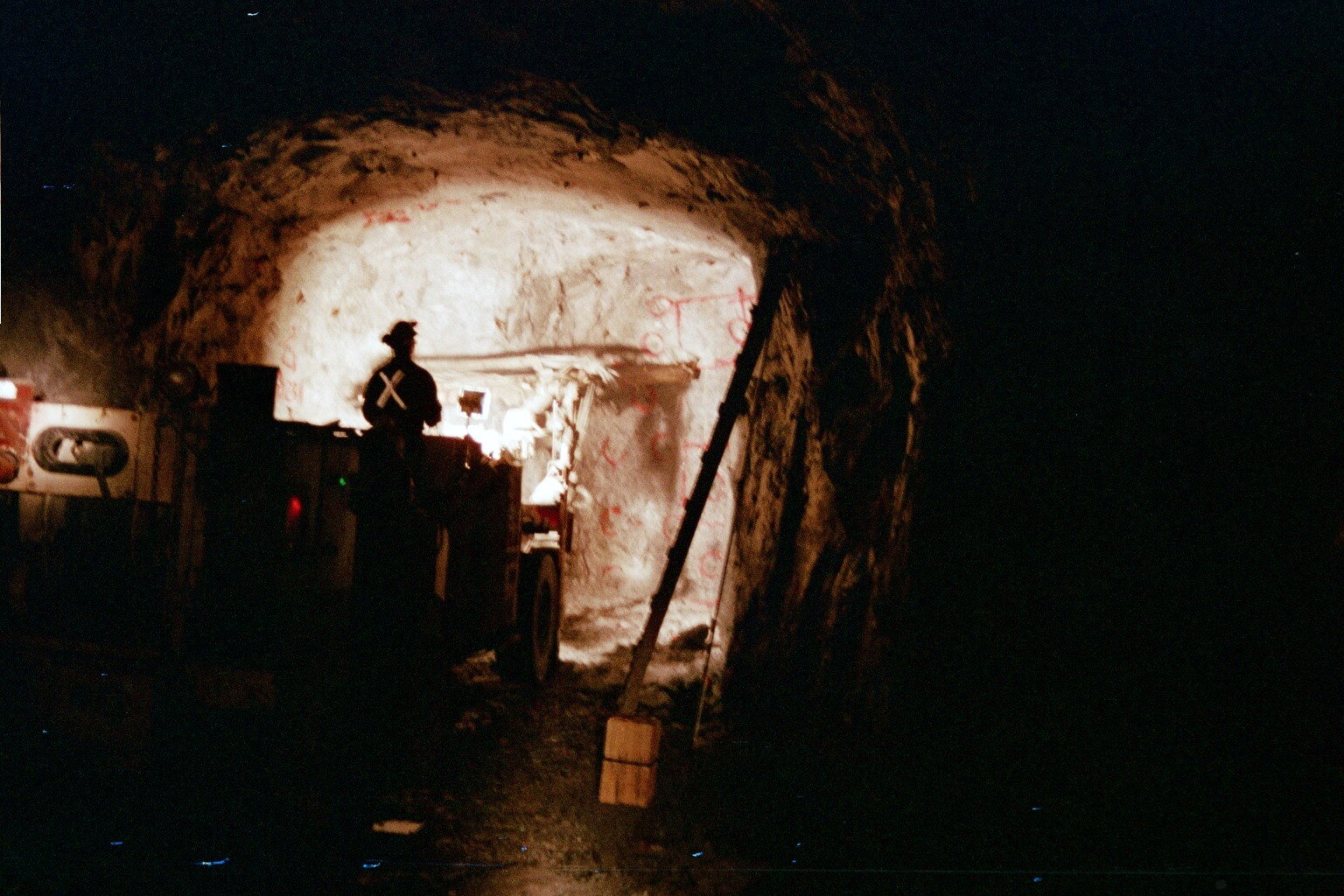
| exploration drilling in an underground mine |
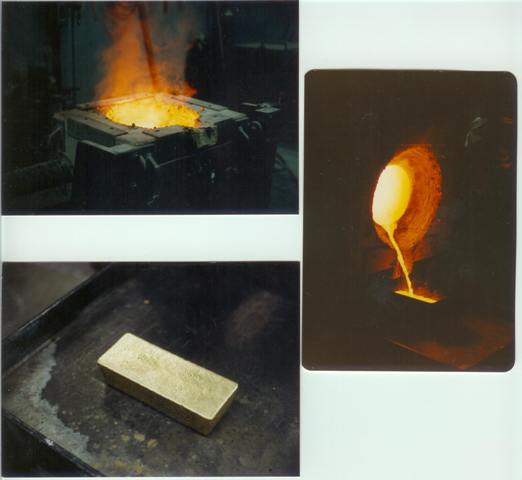
| A gold pour - the bar is called 'dore': it is about 90% gold, the rest is silver, copper, iron and other metals. From here, it is sent to a commercial refinery. |