| Visitors
can travel to Siem Reap either on regular domestic
flights, overland or by speedboat long the magnificent
Tonle Sap to explore new cultures, meeting local fisherman
in their floating villages and tasting ethnic food fares.
Angkor Temples are spread throughout the forest. Heading
north from Siem Reap , you first came to Angkor Wat,
then the walled city of angkor Thom. Further east are
temples including Ta Prohm North of Angkor Thom is Preah
Kahn and way beyond in the north-east, Banteay Srei
and Phnom Kulen. To the east of Siem Reap is the Rolous
group of early Angkor temples.
Angkor
Wat
 The
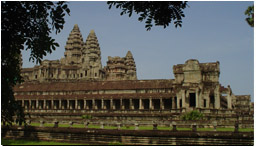
Angkor Wat Temple, the mysterious Hindu Temple built
by King Suryavarman II at the height of the Khmer Empire
in the 12th century is the world's largest temple complex.
onsists of many sandstone temples, chapels, causeways,
terraces and reservoirs, it is believed that the gods
assisted the architect whose identity remains a mystery
until today. The walls of the temple are covered with
thousands of carving depicting scenes of confrontations
between the gods and the demons of classical Hindu mythology.
Yet on some are genial-dancing ladies known as "Apsara"
and on The
Angkor Wat Temple, the mysterious Hindu Temple built
by King Suryavarman II at the height of the Khmer Empire
in the 12th century is the world's largest temple complex.
onsists of many sandstone temples, chapels, causeways,
terraces and reservoirs, it is believed that the gods
assisted the architect whose identity remains a mystery
until today. The walls of the temple are covered with
thousands of carving depicting scenes of confrontations
between the gods and the demons of classical Hindu mythology.
Yet on some are genial-dancing ladies known as "Apsara"
and on 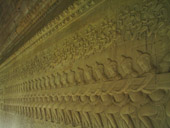 others
depicting royal processions with the king and other
royalties are riding on the elephant. Whatever it is,
the carvings are clearly masterpieces in the true sense.
There is much about Angkor Wat that is unique among
the temples of Angkor. The most significant point is
its westward orientation. West is symbolically the direction
of death, which once led many scholars to conclude that
Angkor Wat was primary a tomb. This was supported by
the fact that the magnificent bas-reliefs of Angkor
Wat were designed to view in an anticlockwise direction,
a practice, which has antecedents in Hindu funerary
rites. Vishnu, however, is often associated with the
west, and it is commonly accepted nowadays that Angkor
Wat was probably both a temple and a mausoleum for Suryavarman
II. Back to top others
depicting royal processions with the king and other
royalties are riding on the elephant. Whatever it is,
the carvings are clearly masterpieces in the true sense.
There is much about Angkor Wat that is unique among
the temples of Angkor. The most significant point is
its westward orientation. West is symbolically the direction
of death, which once led many scholars to conclude that
Angkor Wat was primary a tomb. This was supported by
the fact that the magnificent bas-reliefs of Angkor
Wat were designed to view in an anticlockwise direction,
a practice, which has antecedents in Hindu funerary
rites. Vishnu, however, is often associated with the
west, and it is commonly accepted nowadays that Angkor
Wat was probably both a temple and a mausoleum for Suryavarman
II. Back to top
Angkor
Thom
 The
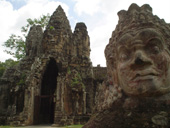
fortified city of Angkor Thom, some 10sq km in extent,
was built by Angkor's greatest King, JayavarmanVII (ruled
1181-1201). Centered on Baphuon, Angkor Thom is enclo
sed by a square wall 8m high and 12km in length and
encircled by moat 100m wide, said to have been inhabited
by fiece crocodiles. The city has five monumental gates,
one each in the north, west and south walls and two
in the east wall. In front of each gate stand giant
statues of 54 gods (to the left of the causeway) and
54 demons (to the right of the causeway), a motif taken
from the story of the Churning of the Ocean of Milk
illustrated in the famous bas-relief at Angkor Wat.
In the center of the walled enclosure are the city's
most important monuments, including the Bayon, the Baphuon,
the Royal Enclosure, Phimeanakas and the Terrace of
Elephants. Back to top The
fortified city of Angkor Thom, some 10sq km in extent,
was built by Angkor's greatest King, JayavarmanVII (ruled
1181-1201). Centered on Baphuon, Angkor Thom is enclo
sed by a square wall 8m high and 12km in length and
encircled by moat 100m wide, said to have been inhabited
by fiece crocodiles. The city has five monumental gates,
one each in the north, west and south walls and two
in the east wall. In front of each gate stand giant
statues of 54 gods (to the left of the causeway) and
54 demons (to the right of the causeway), a motif taken
from the story of the Churning of the Ocean of Milk
illustrated in the famous bas-relief at Angkor Wat.
In the center of the walled enclosure are the city's
most important monuments, including the Bayon, the Baphuon,
the Royal Enclosure, Phimeanakas and the Terrace of
Elephants. Back to top
Bayon
Temple
 The
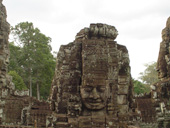
Bayon takes an easy second places after Angkor Wat .The
smile of the four-faced Bayon has become a world-recognized
symbol of Cambodia. The towering faces, reaching up
to four meters in height, adorn the Bayon Temple at
the exact center of Angkor Thom in Siem Reap. As many
as 216 faces on the 54 remaining towers, each represented
one province of Khmer empire in the ancient time. The
Bayon is now known to have been built by Jayavarman
VII . There is still much mystery associated with the
Bayon - its exact function and symbolism - and this
seems only appropriate for a monument whose signature
is an enigmatically smiling face. Back
to top The
Bayon takes an easy second places after Angkor Wat .The
smile of the four-faced Bayon has become a world-recognized
symbol of Cambodia. The towering faces, reaching up
to four meters in height, adorn the Bayon Temple at
the exact center of Angkor Thom in Siem Reap. As many
as 216 faces on the 54 remaining towers, each represented
one province of Khmer empire in the ancient time. The
Bayon is now known to have been built by Jayavarman
VII . There is still much mystery associated with the
Bayon - its exact function and symbolism - and this
seems only appropriate for a monument whose signature
is an enigmatically smiling face. Back
to top
Baphoun Temple
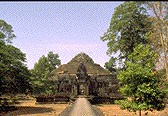 The
Baphuon, a pyramidal representation of mythical Mt Meru,
is 200m north - west of the Bayon. It was constructed
by Udayadityavarman II (reigned 1049-65) and marked
the center of the city that existed before the construction
of Angkor Thom. The Baphuon is in pretty poor shape
and at the time of writing it was being restored by
a French team, with much of the temple marked off-limits.
It is approached by a 200m elevated walkway made of
sandstone. The central structure is 43m high, but unfor-tunately
its submit has collapsed (it may be restored). On the
west side of the temple, the remaining wall of the second
level was fashioned -apparently in the 15th century
into a reclining Buddha 40m in length. Back
to top The
Baphuon, a pyramidal representation of mythical Mt Meru,
is 200m north - west of the Bayon. It was constructed
by Udayadityavarman II (reigned 1049-65) and marked
the center of the city that existed before the construction
of Angkor Thom. The Baphuon is in pretty poor shape
and at the time of writing it was being restored by
a French team, with much of the temple marked off-limits.
It is approached by a 200m elevated walkway made of
sandstone. The central structure is 43m high, but unfor-tunately
its submit has collapsed (it may be restored). On the
west side of the temple, the remaining wall of the second
level was fashioned -apparently in the 15th century
into a reclining Buddha 40m in length. Back
to top
Banteay Srei
Temple
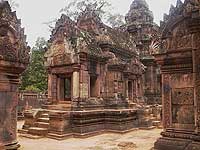 Banteay
Srei was built in the late 10th century and is a Hindu
temple dedicated to Shiva. The temple is square with
entrances at the east and west. Of chief inter-east
are the three central towers, which are decorated with
male and female divinities and beautiful filigree relief
work. Banteay Srei is 21km north-east of the Bayon and
8km west of Phnom Kulen. You can combine a visit here
with a trip to the sacred mountain of Phnom Kulen. Back
to top Banteay
Srei was built in the late 10th century and is a Hindu
temple dedicated to Shiva. The temple is square with
entrances at the east and west. Of chief inter-east
are the three central towers, which are decorated with
male and female divinities and beautiful filigree relief
work. Banteay Srei is 21km north-east of the Bayon and
8km west of Phnom Kulen. You can combine a visit here
with a trip to the sacred mountain of Phnom Kulen. Back
to top
Ta Prohm Temple
The temple of Ta Prohm rates
with Angkor Wat and the Bayon as one of the most popular
attractions of Angkor. Ta Prohm is a unique 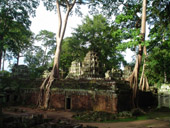 other
world experience. The temple is cloaked in dappled shadow,
its crumbling towers and walls locked in the slow muscular
embrace of other
world experience. The temple is cloaked in dappled shadow,
its crumbling towers and walls locked in the slow muscular
embrace of 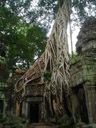 vast
root systems. If Angkor Wat , the Bayon and other temples
are testimony to the genius of the Angkor-period Khmers,
Ta Prohm reminds us equally of the awesome fecundity
and power of the jungle. Built in approximately 1186,
Ta Prohm was a Buddhist temple dedicated to the mother
of jayavarman VII. Ta Prohm is a temple of towers, close
courtyards and narrow corridors. Many of the corridors
are impassable, clogged with jumbled piles of delicately
carved stone blocks dislodged by the roots of long-decayed
trees. Bas-reliefs on building walls are carpeted by
lichens; moss, creeping plants and shrubs sprout from
the roofs of monumental porches. Trees, hundreds of
years old - some supported by flying buttresses - tower
overhead, their leaves filtering the sunlight and casting
a greenish pall over the whole scene. Back
to top vast
root systems. If Angkor Wat , the Bayon and other temples
are testimony to the genius of the Angkor-period Khmers,
Ta Prohm reminds us equally of the awesome fecundity
and power of the jungle. Built in approximately 1186,
Ta Prohm was a Buddhist temple dedicated to the mother
of jayavarman VII. Ta Prohm is a temple of towers, close
courtyards and narrow corridors. Many of the corridors
are impassable, clogged with jumbled piles of delicately
carved stone blocks dislodged by the roots of long-decayed
trees. Bas-reliefs on building walls are carpeted by
lichens; moss, creeping plants and shrubs sprout from
the roofs of monumental porches. Trees, hundreds of
years old - some supported by flying buttresses - tower
overhead, their leaves filtering the sunlight and casting
a greenish pall over the whole scene. Back
to top
Preah Khan Temple
The temple of Preah Khan (Sacred
Sword) is a good counterpoint to Ta Prohm, though it
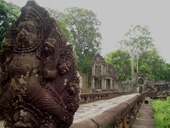 gets
far fewer visitors. Preah Khan was built by Jayavarman
VII(it may have served as his temporary residence while
Angkor Thom was being built), and like Ta Prohm it is
a place of towered enclosures and shoulder-hugging corridors.
The central sanctuary of the temple was dedicated in
1191, Preah Khan's role as a center for worship and
learning. Preah Khan covered a very large area, but
the temple itself is within a rectangular enclosing
wall of around 700m by 800m. Four processional walkways
approach the gates of the temple. These gates are flanked,
gods carrying a serpent, as in the approach to Angkor
Thom. From the central sanctuary, four long vaulted
galleries extend in the cardinal directions. Many of
the interior walls of Preah Khan were once coated with
plaster held in place by holes in the stone. Back
to top gets
far fewer visitors. Preah Khan was built by Jayavarman
VII(it may have served as his temporary residence while
Angkor Thom was being built), and like Ta Prohm it is
a place of towered enclosures and shoulder-hugging corridors.
The central sanctuary of the temple was dedicated in
1191, Preah Khan's role as a center for worship and
learning. Preah Khan covered a very large area, but
the temple itself is within a rectangular enclosing
wall of around 700m by 800m. Four processional walkways
approach the gates of the temple. These gates are flanked,
gods carrying a serpent, as in the approach to Angkor
Thom. From the central sanctuary, four long vaulted
galleries extend in the cardinal directions. Many of
the interior walls of Preah Khan were once coated with
plaster held in place by holes in the stone. Back
to top
Phnom Bakheng
Around 400m south of Angkor Thom,
the main attraction of Phnom Bakheng is the sunset 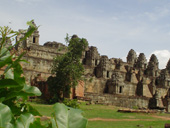 view
of Angkor Wat. Still, the sunset over the Tonle Sap
lake is very impressive from the hill. It is also now
possible to arrange an elephant ride up the hill and
the location certainly makes view
of Angkor Wat. Still, the sunset over the Tonle Sap
lake is very impressive from the hill. It is also now
possible to arrange an elephant ride up the hill and
the location certainly makes
for one of the more memorable journeys you will make.
Phnom Bakheng is also home to the first of the temple
mountain built in the near vicinity of Angkor. Yasovarman
I (rule 889 - 910) chose Phnom Bakheng over the Rolous
area, where previous temples have been built. Phnom
Bakheng is a five-tiered temple mountain with seven
levels. All of these numbers are of symbolic significance.
The seven levels, for example, represent the seven Hindu
heavens, while the total number of towers, excluding
the Central Sanctuary, is 108, a particularly auspicious
number and which co-relates to the lunar calendar. Back
to top
Phnom Kolen
Angkor Wat does not mark the
start of the Angkorean Empire begun by Jayavarman II
in the 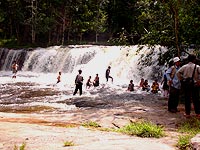 9th
century. At just about 42km north of Siem Reap Town,
many visitors combine a visit to Phnom Kulen with a
trip to the pink sandstone temple of Banteay Srei. But
Phnom Kulen is also a change of scenery for those who
have spent days looking at the impressive lowland temples
and wish to see a different, rural Cambodia, waterfalls
and forest. In 802 AD, the mysterious King Jayavarman
II proclaimed this place and its surroundings as his
empire and declared it free of the rule of Java, and
Phnom Kulen was born as the new dynasty's first capital.
The peak of Phnom Kulen opens out to a large flat plain.
On either side, tall waterfalls crash down the mountain;
clean, clear and cool water provide a wonderful place
for tourists. Carvings of Brahmin yonis and lingas can
be seen etched into the riverbed. A mountain peak temple
houses a huge reclining Buddha, gazing serenely out
from his peaceful mountain home. This is the largest
reclining Buddha in the Kingdom. It is an unforgettable
memory of this stunning and exotic Kingdom. Back
to top 9th
century. At just about 42km north of Siem Reap Town,
many visitors combine a visit to Phnom Kulen with a
trip to the pink sandstone temple of Banteay Srei. But
Phnom Kulen is also a change of scenery for those who
have spent days looking at the impressive lowland temples
and wish to see a different, rural Cambodia, waterfalls
and forest. In 802 AD, the mysterious King Jayavarman
II proclaimed this place and its surroundings as his
empire and declared it free of the rule of Java, and
Phnom Kulen was born as the new dynasty's first capital.
The peak of Phnom Kulen opens out to a large flat plain.
On either side, tall waterfalls crash down the mountain;
clean, clear and cool water provide a wonderful place
for tourists. Carvings of Brahmin yonis and lingas can
be seen etched into the riverbed. A mountain peak temple
houses a huge reclining Buddha, gazing serenely out
from his peaceful mountain home. This is the largest
reclining Buddha in the Kingdom. It is an unforgettable
memory of this stunning and exotic Kingdom. Back
to top
Tonle Sap
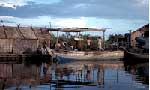 This
has become a popular excursion for visitors wanting
a break from the temples and is easy enough to arrange
yourself, get a preview as the floating village is near
Phnom Krom where the boat docks. It is very scenic in
the warm light of early morning or late afternoon. This
has become a popular excursion for visitors wanting
a break from the temples and is easy enough to arrange
yourself, get a preview as the floating village is near
Phnom Krom where the boat docks. It is very scenic in
the warm light of early morning or late afternoon.
On the Tonle Sap lake, there are 3 biospheres and an
establishment of the bird sanctuary there makes it the
most worthwhile and straight forward location to visit.
If you are able to visit during the dry season (December
to May), the concentration of birds is like something
out of a Hitchcock film as water starts to dry up elsewhere.
Back to top
Ta Som Temple
Ta Som (the ancestor Som)
Date: Late 12th century
King: Jayavarman VII
Cult: Buddhist
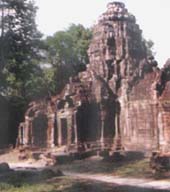 Located
east of Neak Pean, built by Jayavarman VII dedicated
to Buddha and his father. Ta Som is a single tower monument
on one level surrounded by three encl- osing walls with
entry small room on each sid connecting to laterite
wall, is yet another of the late XIIth century Buddhist
temples of Jayavarman VII. Much of Ta Som is in a ruined
state. Back to top Located
east of Neak Pean, built by Jayavarman VII dedicated
to Buddha and his father. Ta Som is a single tower monument
on one level surrounded by three encl- osing walls with
entry small room on each sid connecting to laterite
wall, is yet another of the late XIIth century Buddhist
temples of Jayavarman VII. Much of Ta Som is in a ruined
state. Back to top
Banteay
Kdei Temple
Banteay Kdei (the citadel of chambers
or the cells citadel)
Date: second half of the 12th to the beginning of the
13th century (1181)
King: Jayavarman VII
Cult: Buddhist
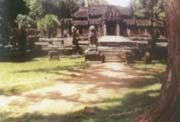 Banteay
Kdei or Parvatathagata, royal monastery and also Jayavarman
VII’s monument, was built in 1181, under the reign
of the king Jayavarman VII and dedicated to the Buddhist
cult. The externallaterite enclosure wall (fourth enclosure),
500m by 700m has four gopuras which are exactly the
same as those at Ta Prohm – an upper tower with
the four faces of Lokeshvara and corner motifs with
Garudas. They are evidently of the Bayon Period, like
the narrow cruciform terrace which, on the west side
at 200m from the entrance crosses the moat and is decorated
with lions and naga balustrades with straddling garudas.
The gopura of the third enclosure is cruciform in plan,
has internal pillars and is covered with a crossing
of vaults. It appears to be older and has three passageways
those at either extremity are independent and adjoin
the 300m by 320 laterite wall. Their wall are sculpted
quite crudely with foliated scrolls enlivened with small
figures and large devatas standing in niches. In the
internal courtyard is a frieze of Buddhas which have
been defaced by the iconoclasts. Back
to top Banteay
Kdei or Parvatathagata, royal monastery and also Jayavarman
VII’s monument, was built in 1181, under the reign
of the king Jayavarman VII and dedicated to the Buddhist
cult. The externallaterite enclosure wall (fourth enclosure),
500m by 700m has four gopuras which are exactly the
same as those at Ta Prohm – an upper tower with
the four faces of Lokeshvara and corner motifs with
Garudas. They are evidently of the Bayon Period, like
the narrow cruciform terrace which, on the west side
at 200m from the entrance crosses the moat and is decorated
with lions and naga balustrades with straddling garudas.
The gopura of the third enclosure is cruciform in plan,
has internal pillars and is covered with a crossing
of vaults. It appears to be older and has three passageways
those at either extremity are independent and adjoin
the 300m by 320 laterite wall. Their wall are sculpted
quite crudely with foliated scrolls enlivened with small
figures and large devatas standing in niches. In the
internal courtyard is a frieze of Buddhas which have
been defaced by the iconoclasts. Back
to top
Srah
Srang
Srah Srang (the royal bathing
pool)
Date: (embarkation terrace) Late 12th century
King: Jayavarman VII
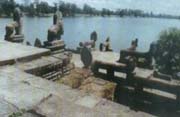 Across
the road from the east entrance of Banteay Kdei, Srah
Srang was built by Jayavarman VII at the end of 12th
century and dedicated to Buddhism. It is a large lake
measuring 700m by 300m with an elegant landing terrace
of superb proportion and scale. A majestic platform
with stairs leads to the pond. It is built of laterite
with sandstone molding. The platform is in the shape
of a cross with serpent balustrades flanked two lions.
At the front there is enormous Garudas riding a three
headed serpents. At the back there is mythical creature
comprising a three headed serpent, the lower portion
of a Garuda and stylized tail decorated with small serpent
head. The body of the serpent rests on a dais supported
by mythical monsters. Srah Srang always has water and
surrounded by greenery. According to one French archaeologist,
it offers at the last rays of the day one of the most
beautiful poit vie the park od Angkor. Back
to top Across
the road from the east entrance of Banteay Kdei, Srah
Srang was built by Jayavarman VII at the end of 12th
century and dedicated to Buddhism. It is a large lake
measuring 700m by 300m with an elegant landing terrace
of superb proportion and scale. A majestic platform
with stairs leads to the pond. It is built of laterite
with sandstone molding. The platform is in the shape
of a cross with serpent balustrades flanked two lions.
At the front there is enormous Garudas riding a three
headed serpents. At the back there is mythical creature
comprising a three headed serpent, the lower portion
of a Garuda and stylized tail decorated with small serpent
head. The body of the serpent rests on a dais supported
by mythical monsters. Srah Srang always has water and
surrounded by greenery. According to one French archaeologist,
it offers at the last rays of the day one of the most
beautiful poit vie the park od Angkor. Back
to top
Eastern
Mebon
Date: 952
King: Rajendravarman II
Cult: Bramanic (Shiva)
Located 500m north of Pre Rup.
The monument was built in the middle o the artificial
lake of the king Yashovarman I. It was an Island temple
as Lokei. Eastern Barrya which was excavated by Yashovarman
I (ruled 889-910), who marked its four corners with
steles. The Eastern Baray which was a large body of
lake(2km by 7km ) fed by the Siem Reap River and was
the most important of the public works of Yasodharapura,
Yasovarman I’s capital. The East Mebon is a temple
with five towers arranged like the numbers on a die
atop a base with three tiers. The whole is surrounded
by three enclosures. The towers represent the five peaks
of the mythical Mount Meru. This Hindu temple is very
similar in design though smallest in size to the Pre
Rup temple, which was built 15 to 20 years later and
lies immediately to the south. Back to
top
Terrace
of Elephants
Date: late 12th century
King: Jayavarman VII
Cult: Buddhist
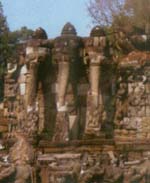 Clearing
by de Mecquenem in 1911 and H.Marchal in 1916 The terrace
of the Elephants in its present form extends in length
for over 300m – from the Baphoun to the terrace
of the Leper King – thought the two extremities
remain imprecise in their layout and the Clearing
by de Mecquenem in 1911 and H.Marchal in 1916 The terrace
of the Elephants in its present form extends in length
for over 300m – from the Baphoun to the terrace
of the Leper King – thought the two extremities
remain imprecise in their layout and the
terrace itself shows evidence of additions and alterations.
The terrace faces on the Royal Square of the city of
Angkor Thom. This area was the Royal Palace but the
actual buildings were built of wood and havenot survived.
The 350m long terrace which extend from Baphoun to the
Terrace of Leper King, the Elephants Terrace was used
as a giant reviewing stand for public ceremonies and
served as a base for the king’s grand audience
hall. As you stand here, try to imagin the pomp and
grandeur of the Khmer empire at its height with infantry,
cavalry, horse-drawn chariots and elephants parading
across the Central Square in a colorful procession,
pennants and standards aloft. Looking on is the god-king,
crowned with a gold diadem, shaded by multiplied parasols
and attended by mandarins and handmaidens bearing gold
and silver utensils. Back to top
Terrace
of Leper King
Date: late 12th century
King: Jayavarman VII
Cult: Buddhist
The terrace of the leper king
lies just to the north of the Terrace of Elephants,
aligned with it but standing separate. A mound of masonry
about 25m across by 6 high, it is formed as a bastion
with side that are lined in sandstone and entirely sculpted
with figures in a high relief, juxtaposed and separated
in seven registers – the uppermost of which has
almost entirely disappeared. Although now standing isolated
– joined only at its north and south by the start
of some returning walls – it is probable that
this motif was previously but one element in a vast
composition, perhaps complemented with pools, that has
evidently undergone alteration. The Terrace of the Leper
King is a platform 7m high. On top of the platform stand
a nude, though sexless statue. Legend has it that at
least two of the Angkor kings had leprosy, and the statue
may represent one of them. A more likely explanation
is that the statue is of Yam, the god of death, and
that the Terrace of the Leper King housed the royal
crematorium. Back to top
Takeo
Date: till 1000
King: Jayavarman V and Suryavarman I
Cult: Brahmanic (Shiva)
Located east of Thammanon and
Chau Say Tevoda, the absence of the decoration of the
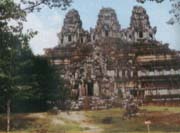 monument
shows us the very unfinished temple of Takeo, according
to the inscription, there was a lightning that hit on
it – it was a bad omen and the monument was abandoned.
It is an imposing sight, scaling 22m to the sky, and
give an impression of power. Takeo was the first Angkorian
monument built entirely in sandstone and such serves
as a milestone. Enormous blocks of stone were cut to
a regular size and place in position. the absence of
decoration at Takeo gives its simplicity of design that
separates from the other monuments. The summit of the
central tower, which is surrounded by four lower towers,
is 10m high. This quincunx arrangement with four towers
at the corners of a square and a fifth tower in the
center is typical of many Angkor temple mountains. Back
to top monument
shows us the very unfinished temple of Takeo, according
to the inscription, there was a lightning that hit on
it – it was a bad omen and the monument was abandoned.
It is an imposing sight, scaling 22m to the sky, and
give an impression of power. Takeo was the first Angkorian
monument built entirely in sandstone and such serves
as a milestone. Enormous blocks of stone were cut to
a regular size and place in position. the absence of
decoration at Takeo gives its simplicity of design that
separates from the other monuments. The summit of the
central tower, which is surrounded by four lower towers,
is 10m high. This quincunx arrangement with four towers
at the corners of a square and a fifth tower in the
center is typical of many Angkor temple mountains. Back
to top
Chau Say Tevoda
Date: late of 11th century to
first half of 12th century
King: Suryavarman II
Cult: Brahmanic
Chau Say Tevoda and Thommanon
are two small monuments close together(located on the
lest and right sides of the road) and similar in plan
and style. Although the precise dates of these monuments
are unknown, they belong to the best period of “classic
art” stylistically and represent two variations
of a single theme of composition. Built by King Suryavarman
II from the end of the 11th to the first half of the
12th century and dedicated to Brahmanism. Walking toward
the temple you can see traces of a moat and vestiges
of rectangular laterite base of an enclosing wall. Currently
is under restoration. Back to top
Thommanon
Located east of the Gate of
Victory of Angkor Thom, across the road (north) from
Chau 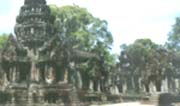 Say
Tevoda, Thommanon is rectangular in plan with a sanctuary
opening the east, a moat and an enclosing wall with
two entry towers, one on the east and another on the
west, and one library near the southeast side of the
wall. Only trace of laterite base of the wall remains.
Thommanon is a gem an should not be missed. It is similar
in plan and style to Chau Sya Tevoda, which is close
by. Built by King Suryavarman II from the end of the
11the to the first half of the 12the century and dedicated
to Brahmanism. Back to top Say
Tevoda, Thommanon is rectangular in plan with a sanctuary
opening the east, a moat and an enclosing wall with
two entry towers, one on the east and another on the
west, and one library near the southeast side of the
wall. Only trace of laterite base of the wall remains.
Thommanon is a gem an should not be missed. It is similar
in plan and style to Chau Sya Tevoda, which is close
by. Built by King Suryavarman II from the end of the
11the to the first half of the 12the century and dedicated
to Brahmanism. Back to top
Neak Pean
Date: second half of the 12th
century
King: Jayavarman VII
Cult: Buddhist
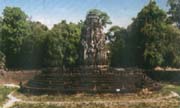 Located
east of Preah Khan; 300m from the road, Neak Pean is
a large square man made pond 70m each side bordered
by steps and surrounded by four smaller square ponds.
A small circular island with a stepped base of seven
laterite tiers is in the center of the large square
pond. Small elephants sculpted in the round originally
stood on the four corners. Although Neak Pean is small
and a collection of five ponds, it is worth a visit
for its unique features. Most photogenic in the wet
season when the pools are full. Back
to top Located
east of Preah Khan; 300m from the road, Neak Pean is
a large square man made pond 70m each side bordered
by steps and surrounded by four smaller square ponds.
A small circular island with a stepped base of seven
laterite tiers is in the center of the large square
pond. Small elephants sculpted in the round originally
stood on the four corners. Although Neak Pean is small
and a collection of five ponds, it is worth a visit
for its unique features. Most photogenic in the wet
season when the pools are full. Back
to top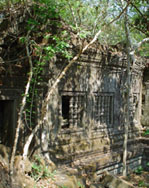
Beng Mealea
Beng Mealea is one of the most
interesting of Angkor's many temples, but was also one
of the hardest to reach. Since the road has improved
recently makes this site becoming very popular. This
12th century temple is enclosed by a moat measuring
1200m by 900m. It is nearly the size of Angkor Wat,
but utterly subsumed by jungle. Many of the carvings
have recently been plundered due to the temple's isolation,
but that doesn't detract from the atmosphere. Back
to top |