Rumbero Salsaboy
Caribbean Dances
Salsa: The word Salsa which means “sauce” in spanish, also explains the structure of the dance. The dance was founded by merge of Afro,Cuban and Jazz rhythms and can be danced by its 8 rhythm music and 3 beat steps. Most popular Salsa styles are Salsa Cubana and Salsa Puerto Ricana. Lately new styles like L.A., N.Y. Night Club style, Miami have been founded.
… The music, whatever its quality is, played by Colon and singer Hector Lavoe was stick to its roots and contains the identity of the people who found themselves in it. What else should be wanted? Freely and violently played trombone became a symbol of new Latin music in New York in a short amount time. Colon and Lavoe brought the Caribbean music which was alienated because of his development with big bands, back to his home, Barrio. They were right: The Birth and Development of Salsa
… Salsa may go to any direction because it is unsystematic and free. It gives his tribute to all gods but yield to none of them because his main aim is to give something to each age and each pleasure.
Merengue: Merengue means a kind of dessert and is a native dance of Dominics and Haiti. Because of his hot, sexy and easy nature, merengue is a highly popular among dancers. With his 8 rhythm music and 2 beat steps merengue can be danced in couples as well as in group.
…After the erotic salsa, Merengue came to the scene. Some people suggested this Dominic Republic originated dance is nothing but salsa. Some others took it to close to salsa so salsa bands added merengue songs to their repertoire. Actually merengue had an easy, dance oriented and a more diverse style with his one-two rhythm. Therefore recently it appeared as an opponent to salsa.
...Merengue took advantage of loss of salsas charm. After the mid of 1980’s, it was a fact that more and more people, especially who wants to dance, begin to listen merengue.
Bachata: Bachata, mostly danced by poor and rural people of Dominic and Haiti, begin to step into the scene in 1960s. This romantic dance can be danced by her 4 rhythm music and her 4 beat steps. Well known bands and singers are Monchy y Alexandra, Aventura, Alex Bueno and doubtless with his unique voice the pupil of Dominics Juan Luis Guerra.
Cha Cha: This dance was founded in Cuba in 1950s by developing of mambo rhythms and danced by two slow and three fast sweeping steps. Cuban style is more different with his close, sexy, joyful and fast movements from Ballroom Cha Cha which is more distant and more rigid,
…In 1940s famous Mambo was founded via the return of Danzon back to its old instrumental form and digestion of other rhythms. In 1948, a young violonist who played in the Havana club “Prado y Neptuno”, made a composition with the name “Engañadora”( The Cheat). Enrique Jorrin added a son part to the danzon music as the band played a montuno. Jorrin himself said the name of the dance comes from the “Cha Cha Cha” sound of dancers feet while they are dancing. So “Engañadora” became the first played chachacha. The first record was in 1953 and the impact was in an instant. Suddenly everyone wanted to dance this new dance.
…We, Cuban musicians who are trying to earn our life as best as we can, continued to create countless new rhythms. Mambos more slow version Cha Cha was founded because of this. It played more in dance clubs which were converted from garages by young people who cannot go to mambo playing big clubs because of short of money.
|
Oyeme mamá Qué sabroso está Este nuevo ritmo que se llama Chachachá Unisono se canta Se dice Chachachá Con unos pasitos Para aqui, para allá
|
Listen mama To this nice music The name of this new rhythm is Chachacha Like you said in the song You call it Chachacha A couple steps here A couple steps there Oyeme Mamá composed by Machito band |
Mambo: This new rhythm founded in 1940s and it blowed like a storm with its 8 rhythm music, fast, rapid and hot style. Like its Cha Cha cousin Cuban mambo is faster,sexier and more free than Ballroom mambo.
…Jazz music had effects on Latin music. And it didn’t stopped there. In the end of 1940s Juan de Dios, my friend from Panama, organize a party for his sons baptism. During the party, he stopped the performing band and told us that he going to play the latest madness of New York. What was that and who sang it? Everybody was curious about it. This was an unknown rhythm performed by Jose Curbelo from Cuba and its name was mambo. I swear it; it was neither the effect of drinks or the heat of party. But this mambo was a perfect mixture of melody and sound, which cannot be identified in any instrument and rhythms. It was a rhythm against a rhythm.
Samba: Samba is a Brasilian originated carnaval dance and it enters until Broadway in beginning of 20th century. With the effect of Europe, it transformed into a Ballroom dance. It danced by bouncing on 3 beat steps. Traditional Brasil samba varies from Ballroom samba by its agility and fast rhythm variety.
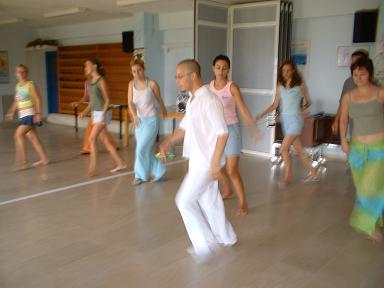
La Rueda: La Rueda de Casino became popular in Cuba with the rise of salsa in 1950s. The word means circle and dance in shape of circle. It uses salsa basic steps and movements and can grow or shrink according the number of dancers and size of dance floor. The leader leads the group, the dance and movements by hand signs or by commands. Every movement has a specific hand sign or command word. It is very enjoying dance for both dancer and audience.
Blue parts were taken from the book of Hernando Calve Ospinas’s SALSA –The Fire of Havana
About Dance
...As Fidel Castro and his guerilla army entered Havana in 1959, some Cuban musicians fled to Mexico or USA. Beny More was one of the strict people against this escape. He said: ” No one can force me to leave Cuba!” “I am not interested in dollars. I want to walk in streets of Cuba and to hear people saying “ Hey Wild Man1 How is going?” and to reply them “ It is my flesh and my blood”. So says the best musician of all times.
(1): Beny More’s nickname was The Wild Man of Rhythm.
...For the people like me who goes to dance only weekends, the whole week was a torture.But on saturday I will iron my shirt, have a good bath, smear myself on perfume and deodrant and polish my shoes, Palladium was waiting for me
The parts above were taken from the book of Hernando Calve Ospinas’s SALSA – The Fire of Havana