Goju Ryu Meibukan -- Sydney University
News:
Training times have changed! Now it's Wednesday 4pm-6pm, either at Adrian Tan's place OR in the park next to the Main Quad. Please contact Adrian Tan by for further info.
Introduction
History
Joining
Joining form
Training times
Grading
Kata
Japanese
Thoughts
Newsletters
Links and further information
Contact
Introduction
Karate is usually thought to be a combination of Chinese and native
Okinawan styles of fighting. It has developed on Okinawa since the sixteenth or seventeenth
century, partly as a response to a ban on weapons. Many of the weapons used in Okinawan
styles were originally farming implements. Karate particularly flourished in the regions of
Shuri-Tomari and Naha. Modern karate is
divided into about half a dozen main styles (such as Goju Ryu), and these are
further divided into schools (such as Meibukan).
In contrast with other types of martial art, karate as a whole emphasises strength and
precise movements. About equal weight is placed on punches and kicks. There's often an
element of body conditioning. Also, karate teaching inevitably involves a lot of formality.
The Goju style is characterized by breathing techniques, circular movements, a variety of hand
techniques, powerful attacks, moderate body conditioning. It is unflowery and functional. There's
nothing mystical about it and there are no real secrets; you just practise and practise.
It's taught as self-defence, not
as a sport. The repertoire includes strikes,
blocks, releases, joint breaks, and takedowns. There is little grappling, traps
or submission holds.
A normal Meibukan class will involve: stretching and warm up,
kihon (basic punches, kicks, blocks),
partner exercises,
pre-arranged sparring, and kata (set patterns of movement). If the dojo is
equipped, then there's also practice with equipment. There is almost
no free sparring. It's a moderate to heavy workout, depending on how hard you push
yourself.
History
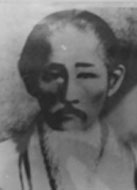
Goju Ryu came from "Naha Te", as practised by Kanryo
Higaonna (1853-1910). Naha Te was an aggressive style with heavy conditioning.
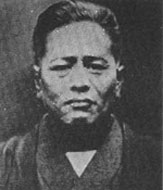
Goju Ryu Karate, originally "Goju Ryu Karate Kempo", was founded by Chojun
Miyagi (1888-1953), Higaonna Sensei's successor. The word "goju" translates as
"hard and soft", and on one account is said to be taken from a quote in an old Chinese
book, Wu Pei Chin:
"The successful method requires both give and take." Goju has broken into a number of
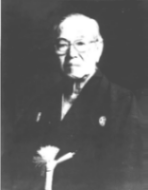
different schools, and was particularly popularized by Gogen Yamaguchi.
After Chojun Miyagi's death, the Miyagi family passed his obi and gi
to Meitoku Yagi (1912-2003). Dai Sensei Yagi, during his lifetime, was presented by the
emperor with the Fourth Order of Merit for his contributions to karate. He also had
interests outside karate: in 1988 he was
Japanese national champion in the game of Chinese chess, and in
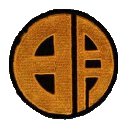
1989 he was world champion. The crest at the top of this page is the symbol of the Yagi
family. "Meibukan" translates as "hall of the pure-minded warrior".
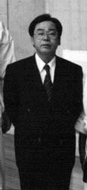
Masaaki Ikemiyagi (1953-) is one of Meitoku Yagi's oldest students and holds the rank
of eighth dan. He is currently Vice-President
of the Okinawan Goju Ryu association. He is based in Okinawa, and has travelled widely
to study other martial
art styles.
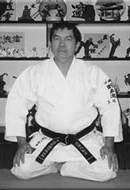
Johanes Wong is a sixth dan in Goju
Ryu and chief instructor of Meibukan in Australia. He has studied Naha Te, judo, jujitsu, tae kwon do, kung fu and hapkido. He has
been teaching in Australia since 1974.
And my name is Adrian Tan. I've been a student of Kancho Wong's for nine years. I'm
currently nidan (second degree) black belt in karate and nidan
in kobudo.
Kaicho Ikemiyagi in action
Joining
Click here for a PDF copy of the application form. (If it doesn't work, save it to disk then open with Adobe Acrobat directly.)
All levels of martial arts experience are welcome, especially
beginners. All levels of fitness are welcome.
It's a serious self-defence style. There's also the
capacity for
students to learn kobudo (weapons). There's usually a visit to Okinawa once every
two years. Kaicho Masaaki Ikemiyagi, and the kobudo teacher, Kaicho Takashi Kinjo, will
usually visit every
alternate year. Other karate masters are frequently
invited from Japan to hold seminars. And there are branches of Meibukan in many other
countries if ever you go overseas and want to train.
You can't be a member of
two karate schools at once (though you can be a member of karate + kung fu, say).
If you're currently studying another karate style, it's fine if you want to
train with us; it's just
that you can't grade.
A requirement of students is that they be of good character -- if you're a thug,
we're not going to teach you how to thug more efficiently.
If you're not a thug, feel free to drop by whenever you like. You're very welcome
to just sit and watch. You won't know
whether you take to the style or the
teacher until you've jumped in and tried it. Different martial arts suit different people.
If you'd like to see how Meibukan holds up against everything else, there's plenty
of martial arts taught at Sydney Uni (capoeira, tae kwon do, judo, kempo, aikido,
boxing, fencing, wrestling, archery, SCA fighting), and there
are other karate styles taught in Newtown and Redfern
(see, for instance, http://www.seidojuku.com.au,
which has a very well-outfitted dojo about 15 minutes walk
from the university on Abercrombie Street). There are also many well-organized kung fu schools
in the city.
Costs
Click here for a PDF copy of the application form. (If it doesn't work, save it to disk then open with Adobe Acrobat directly.)
The Sydney Uni class is currently free.
Most other classes (at other dojos in the school) involve a $45 joining fee and are $7-$12 for one-and-a-half or two hours training. They don't have a monthly or an annual payment system; it's just on a class-by-class basis.
Belt and uniform you supply yourself (see below). There's also two badges to sew on your uniform; I think they come to around $15.
There's a cost each time you grade (I'll have to check, but I think it's $25). You don't have to grade at all if you like; it's what you learn that matters, not your belt colour.
If you want to train in kobudo, you also purchase the weapons yourself, but have a
quick chat to your sensei about what to look for.
Uniform
There are plenty of places that sell karate uniforms. The two places I had recommended to me were:
|
Sensei's Martial Arts Store
Shop 4, Barker Street, Rooty Hill NSW 2766 (02) 9832-1389 |
|
Zoe's Martial Arts and Boxing Supplies
http://www.zoes.com.au/ 810 Princes Highway, Tempe NSW 2044 Phone: 02 9558 8518 Fax: 02 9559 3507 E-mail: [email protected] |
Basically, call up and get a price quote, or actually visit the stores, because you'll only be able to tell the quality of the uniform when you examine it yourself.
For a normal cotton gi, I think the cost is in the range of $30-$50. But it's better to get a tougher canvas type, though these might be $80-$100+. I'm told "Tokaido"/"Toukaido" is a good brand.
If price is no object, perhaps the world's best is a Japanese brand called Shureido, but I'm not sure if Sensei's or Zoe's sells it. They might be able to import it specially, or you can contact the Shureido company in Japan yourself and have it shipped out. I think this is their website.
The belt probably costs in the range of $10-$20.
Training times
| Sydney University | Times: Wednesday afternoons 5pm-6.30pm
Location: Sydney University campus; Adrian Tan's place OR in the park next to the main quad's great hall (go up Holme Road, with the Holme Building on your left, towards the front lawns and Fisher library; we'll be training in the park on the left just before you reach the front lawns) Training cost: Classes are free, unless we move indoors Outline: See Introduction for a description of what a normal Meibukan class is like. Teacher: Sensei Adrian Tan (second dan) Contact: [email protected] |
| Main class (Honbu dojo -- Toongabbie) |
Times: Monday evening 6.30pm - 8.30pm (karate); Tuesday evening 7pm - 9pm (kobudo);
Wednesday evening 6pm - 8pm (karate); Friday (not sure what time; kobudo)
Location: 82 Binalong Road, Toongabbie (next to Pendle Hill High School; half an hour's walk from Pendle Hill station; look for the house with the karate signs outside it; go down side of house to dojo at the back) Training cost: $7 per lesson Outline: Karate on Monday and Wednesday; kobudo on Tuesday and Friday. Nice dojo; lots of toys. Teacher: Kancho Johanes Wong (sixth dan) Contact: [email protected] or 9636-4608 Website: http://www.wongsdojo.com |
| Albury | [To come] |
| Armidale (Not sure if this dojo is still going) |
Teacher: Sensei Philip Pisanu
Contact: 067-722-587 |
| Concord |
Teacher: Sensei Patrick Tsang (third dan?)
Contact: 0419-230-774 |
| Kearn | Teacher: Sensei Robert McHuchison (fourth dan?)
Contact: 0438-656-635 |
| Kingsford | Times: Friday evening 7pm - 9.30pm
Location: St Michael's convent school, 1 Haig Ave, Kingsford (school hall near St Michael's church and Nine Ways roundabout) Training cost: $12 per lesson Outline: Karate for the first half, then kobudo (weapons). Range of levels, from white belt to black belt. Teacher: Sensei Desmond Wong (second dan) Contact: [email protected] |
| Old Toongabbie | Teacher: Sensei Adam Ankrett (third dan?)
Contact: 9631-2293 |
| Sensei Jim Bishop | [To come] |
| Sensei Iwan Wijono (Have to check the location, but it's western suburbs) |
Teacher: Sensei Iwan Wijono (third dan)
Contact: [email protected] Website: http://www.members.optusnet.com.au/~iwijono/menugoju.htm |
| Other classes | [To come] |
Grading
Usually you can grade every three or four months. You can grade more than one level at once if you're competent. But you should not be in a hurry to grade.
Grading consists of the kata listed below + basic kihon + knowledge of all the previous kata (so if you're going for orange, you still have to be competent at chun chi).
For
shodan, you have to hold provisional black for a year, and
you should also go to Okinawa to grade or should wait until Kaicho Ikemiyagi visits
Australia.
The black belt kata, and sanchin, came from Kanryo Higaonna. The colour belt kata
were developed as preparation for the more advanced kata.
For a more detailed explanation of some of the kata, click here.
| White to yellow | Chun chi (old Naha Te
kata) Geki sai ich (developed by Chojun Miyagi) |
| Yellow to yellow two | Sanchin (basic breathing
kata) Ippon kumite -- jodan (one-strike sparring) |
| Yellow two to orange | Geki sai ni (developed by Chojun
Miyagi) Ippon kumite -- chudan |
| Orange to orange two | Shujaku ("red sparrow",
developed by Meitoku Yagi) Fukyugata Ich (Adrian's class only) |
| Orange two to green | Tai chi jo ju ge (also called "taikyoku"; not sure where it
came from) Tensho ich (breathing kata performed at start of class, developed by Chojun Miyagi) |
Green to green two | Seiryu ("blue dragon", developed by Meitoku Yagi) |
| Green two to blue | Tensho ni (breathing kata performed at end of class, developed by Chojun Miyagi) |
| Blue to blue two | Byakkho ("white tiger", developed by Meitoku Yagi) |
| Blue two to brown | Shuto jo (also called "chu shuto ge"; unsure where this came from) Kihon geri (also called "chu geri ge"; unsure where this came from) |
| Brown to brown two | Tenchi no ("heaven and earth", developed by Meitoku
Yagi) Ippon kumite -- gedan |
| Brown two to provisional black | Genbu ("black turtle", developed by Meitoku Yagi) |
| Provisional black to provisional black two | Saifa Sanchin test |
| Provisional black two to shodan | Saifa Sanchin test Shisochin Sanseiryu Seienchin |
| Shodan to nidan | Seisan |
| Nidan to sandan | Seipai |
Japanese
Warning: Truly awful Japanese transliterations follow. Will try to verify spelling, etc,
when I get a chance.
If you're completely new to karate, you can get some sort of idea
of what it involves by reading through this list.
Click here for some general notes on
etiquette.
| General | Movements |
| Arigato gozai mashita: Most polite "thank you"; if you just want to say "Thanks", use
"arigato" or "domo arigato" or "domo"
Bunkai: Application ("Sensei, what's the bunkai of this move?") Chui/Kyotsuke: Attention Counting: Ich, ni, san, shi/yon, go, roku, shichi, hachi, kyu, ju Dojo: Training hall Dozo: Please (as in "Please take this seat", "Please accept this gift") Dozo yuroshiku: Pleased to meet you -en: Suffix you attach to verbs to indicate negative. "Wakarimasen" = "I don't understand" Gi: Uniform Hai: Yes Hajime: Begin Heishu kata: Closed hand form Hidari: Left Hojo undo: Warm up Iie: No Kaicho: Big boss Kaishu kata: Open hand form Kancho: Branch boss Kihon renshu: Basic practice Kihon waza: Basic technique Ko: Wrist Koshi: Waist Kotekitai: Body conditioning Kumite: Sparring Ippon kumite: One point sparring -ka: Suffix you attach to verbs to indicate question. "Wakarimaska?" = "Do you understand?" Migi: Right Miru: Look Moikai: Again Mokuso: Meditation Mote/Hante: Change sides Ni: Preposition indicating direction towards; in Japanese prepositions follow the noun rather than precede it Obi: Belt Onegaishimasu: Please (asking for something) Osu: General expression of respect; don't use outside a martial arts context or you'll get funny looks Otagaini: Towards each other Rei: Bow Ren shu: Prearranged sparring Seiretsu: Line up Seiza: Kneel Sempai: Senior student Shinzen: Small shrine in dojo Shotei: Palm heel Shoumen ni: Towards the front Yakusoko kumite: Prearranged sparring (don't ask me what the difference is with the other names that prearranged sparring goes by) Yame: Finish Yoi: Ready; the basic Goju yoi position is left hand on the back of right hand, left hand open and right hand a fist (symbolizes hard and soft); the yoi position for the Meibukan kata is with both hands raised, left hand against the contact area of the right hand Zanchin: Awareness |
Age tsuki: Uppercut
Age uke: Rising block Atama ate: Head smash (ie a headbutt) Chudan: Middle Dachi: Stance Gedan: Lower Gedan barai: Lower avoid Geri: Kick Gyaku: Reverse Haito: Reverse knife-hand strike Heiko dachi: Standing stance Hiji ate: Elbow smash Hiki uke: Hook block Hiza geri: Knee kick Hizami tsuki: Jab punch Ipponken tsuki: Knuckle punch Jodan: Upper Juji uke: X block Kakie: Pushing exercise Kata ate: Shoulder smash Kensetsu geri: Stamping kneecap kick Kiai: Shout Kiba dachi: Horse stance Kin geri: Groin kick Kokutsu dachi: Back lunge stance Kosa uke: Cross block Koshi ate: Hip smash Mae geri keage: Front snap kick Mae geri kekomi: Front thrust kick Mae tobi geri: Jump kick Mawashi geri: Round kick Mawashi hiji ate: Circular elbow strike Mawashi uke/tora guchi: Double block (last move of sanchin) Morote tsuki: U punch with both hands Neko ashi dachi: Cat stance Nukite uchi: Spear-hand strike Osae uke: Pressing block Otoshi hiji ate: Downward elbow strike Sanbon tsuki: Triple punch Shotei uke: Palm heel block Shuto: Knife-hand strike Soto ude uke: Outside middle block Suri ashi: Sliding foot step Taisho: Palm strike Tate hiji ate: Upward elbow strike Tsuki: Punch Ude uke: Middle block Ude tandran: Basic blocking and conditioning exercise Uke: Block Uraken: Backfist Ushiro geri: Back kick Ushiro hiji ate: Rear elbow strike Yoko geri: Side kick Yoko kekomi: Side thrust Yoko hiji ate: Side elbow strike Zenkutsu dachi: Front lunge stance |
Thoughts
- Notes on visits by masters.
- Personal thoughts on kumite in training.
- Notes from the classic text, The Life-Giving Sword, by Yagyu Munenori.
- Notes from Zen in the art of archery, by Eugen Herrigel.
- In training, you should visualize your opponent with every strike. You're wasting your time if you just go through the motions.
- 75% of your skill as a martial artist is your basic style. It trains you in some techniques, and teaches you bodily mechanics, teaches you how to move. 25% is what you pick up from other styles (other techniques, tactics). 25% is your own genius.
- A technique that requires a little strength is often more effective than a technique that requires none.
- In a real fight, you're going to get hit.
- About repetition... It's boring, but I think it's rather unavoidable. Karate is mainly a striking art, so you need to practise striking. I don't see how punches and kicks are so different from getting to the perfect golf swing or backhand -- you need to repeat the movement over and over to develop the muscles and the body mechanics and the reflex, and every repetition makes it easier, while, on the other hand, every time you're slack in training you lose a little edge. How else do you develop power and speed and ease of movement other than by repetition?
- In kata you practise the sheer movement, aiming for increased strength and speed and ease, for instance. But these aren't the whole story. You also practise visualisation, and you practise transitions. Kata can be understood as a series of transitions; you're conditioning yourself to make that movement next, and you're also developing the transition for its own sake, the body mechanics involved in changing from A to B.
- Really good technique is a combination of getting a lot of little things right.
- Hip movement: In general, if you're striking or blocking forwards, the same hip should be forward as the arm or leg that's performing the technique. If you're blocking gedan barai, the hip that's forward is the opposite to the arm that's performing the technique. In a punch, on impact, move your waist back a little to absorb the shock.
- Stances: Holding the position is part of the training. For instance, holding a cat stance position develops your calf muscles, holding a horse stance develops your thighs...
- Punches: Usually, you punch with just two knuckles (not four). Your elbow should be slightly flexed on impact. Wrist should be in line with forearm, not bent up or down; feel the strength of the punch travelling in a straight line across the top of your arm. Shoulder should not lift as you punch. If you can, you should punch with both sides of the body -- for instance, one hand swinging back and the other swinging forward. Use your waist to get more power. Twist your fist as you strike: if your target is close, hit it with palm supine; otherwise hit it with palm prone. Alternatively, twist on impact. Aim behind your target. Relax your arm as you're punching (it's not like you're doing a sanchin punch -- free your movement up) -- but you clench your fist and tense on impact. Keep your elbow close to your body as you punch -- if you do a yob punch with a swinging elbow, not only do you lose power, but the lateral momentum can be used against you to spin you off balance; elbow strikes in general have this vulnerability. In practice, you chamber fists before you punch, but in bunkai you potentially telegraph your moves by doing so (so instead you do a lot of jab punches, or you find some way to conceal a chambering).
- Blocks: Ude uke and soto ude uke are deflections, not hits. They're also practised finishing with a pull inwards (hard to describe; easier to demonstrate). Blocks should use the waist to power them. This might seem obvious, but it's difficult to anticipate and to block without seeing the attack coming; a normal block has to wait for the opponent to make the first move. Closed hand blocks protect the fingers and tense the forearms; open hand blocks allow the possibility of grabs.
- Kicks: The danger with any kick is that the opponent will catch it. Okinawan kicks are generally ribs or below, and the intent is to break something with each strike. Kicks should also be powered from the waist. When blocking a kick, it is often more dangerous to move away from the kick than to move towards it (where you can stop it before it develops power). Kicks that require you to spin around always expose you for a moment as you spin.
- Kata are a series of stopped positions, but in application the movement is fluid. The interpretation of kata is up to the practitioner; the moves will always have multiple possible applications. And the more you think about them, the more you'll find that every little detail matters.
- All attacks can be used as stop-hits. Most strikes can serve double work as blocks. All blocks can be modified into attacks.
- You have to be able to execute a move perfectly at slow speeds. Do you really think the inaccuracies and fumbles will iron themselves out at high speeds? When you learn anything, you learn it slow before you learn it fast. Have patience.
Newsletters
Newsletters for the honbu dojo. These are prepared by Tricia Nunez. Please contact Tricia at [email protected] if you have anything to add.
Links and further information
For more info, check out Kancho Johanes Wong's
website,
Kaicho Ikemiyagi's website, and
this article by Wade
Chroniger about Kaicho Ikemiyagi.
Some interviews: with Dai Sensei Meitoku
Yagi, Sensei Morio
Higaonna and Sensei
Anthony Mirakian.
If you just type "Goju" or "Meibukan" or any of the masters'
names into a search engine, you're going to get a few hundred hits. And, of course,
there's endless information, online and offline, on karate in general. Try something along
the lines of "history of karate" or "martial arts styles" if you'd like to compare karate to
other styles.
The best book about Meibukan is Yagi, Wheeler, Vickerson, Okinawan Karate-Do
Gojyu-Ryu Meibu-Kan, first published 1998, revised edition 2000, LT Designs Ltd.
There are also a number of videotape series for Goju Ryu. The ones produced by
Morio Higaonna are the best I've seen. You should be able to find these at any
martial arts store, or from numerous online stores.
And there's quite a lot of online karate videos you can download for free. I'll post
links up here as I find them:
- http://www.shorinryu.dk/html/Framese_index.htm -- some very good vids (in my opinion at any rate) for Shorin Ryu, the classic Okinawan style from the Shuri Te strand. The vids are all around 20MB. I don't know anything about Shorin Ryu, but, in terms of the performance, I thought the actual moves and overall form were impressive, except that the guy has a tendency to lean forward in his stance. Note also the yakusoku kumite (prearranged sparring) at the bottom of the page.
- http://www.spek.co.uk/karate/media.php -- some Shotokan kata from a tape made in the 1960s. Many of the kata derive from Shorin Ryu. Don't know if you can download the files, or can only watch them in your browser, but it probably won't take long to load. The performances are okay, some better than others, but the video quality is dodge.
- http://www.ninpo.org/ninpotechniques/ninpotechniques.html -- basic ninjutsu training; small files inn Quicktime format; interesting to see all the different ways they do push-ups to strengthen various parts of the hand.
- http://www.all-karate.com/how_to_learn_karate.php and http://www.lyon-karate.com/blocks_movies.php -- Lyon karate -- a Goju style; the instruuctor was graded by Morio Higaonna. Lots of basic kihon Quicktime movies, fairly fast loading.
- http://luraygojudojo.tripod.com/Goju_Ryu_in_Luray_Virginia.htm -- some Goju kata, different from my stylee (if you're in my class, don't copy what you see here). Files might be undownloadable and only watchable in your browser. For my taste the performances had not enough Go and too much Ju, but each to their own.
- http://www.susumuryu.com/syllabus.php -- variations on Goju kata, and some kihonn routines. I like the elbow routine. Files are in Quicktime format and are all around 1MB.
- http://www.gkrkarate.org/pages/Kata/kataidxf.html -- a British website for Go Kan Ryu karate, a style developed by an Australian in the 1980s. Comprehensive footwork charts and discussions here, some bunkai vids (around 2MB each), and kata vids (around 10MB each). Go Kan Ryu draws from a number of styles, including Goju and Shotokan.
To find out about ninjas, click here.
Contact
For any enquiries, please contact me at [email protected].
Or, just drop in to a class.
Last updated: Wednesday 6 April 2005
