Digital models and computer simulations
are used to represent systems, host platforms, other friendly players,
the combat environment, and threat systems. They can be used to help design
and define EW systems and testing with threat simulations and missile flyout
models.
Due to the relatively low cost of exercising
these models, this type of activity can be run many times to check "what
ifs" and explore the widest possible range of system parameters without
concern for flight safety. These models, like the ones used in the Test
& Evaluation Modeling and Simulation (TEMS) facility, may
run interactively in real or simulated time and space domains, along with
other factors of a combat environment, to support the entire T&E process.
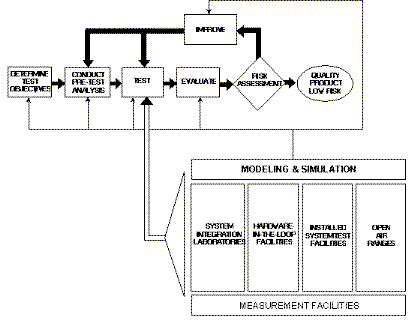
The EW T&E Process uses computer-aided
simulations and analysis prior to testing to help design tests and predict
test results, and after testing, to extrapolate test results to other conditions.
In this way M&S is part of all six resource categories (see
Fig 1). M&S should also be used to provide constant feedback for
system development/improvement.
|
| Modeling & Simulation Capabilities |
What Makes
M&S Unique |
Only way to do T&E without hardware
Only way to evaluate operational effectiveness at campaign level |
What M&S
Can Do |
Allows a system to be analyzed before any hardware is built |
| Provides audit trail from operational requirements to test criteria |
| Allows evaluation in complex scenarios/environments that could not
be simulated in a ground test facility or open air range |
M&S
Limitations |
Prediction of absolute performance/effectiveness with high confidence |
| Achieving the same degree of fidelity as an RF simulator for certain
complex functions |
The modeling and simulation capabilities
within the Air Force are distributed, specialized and application specific.
No common architecture currently exists, although several efforts are under
way to provide collaboration among the Services and reduce duplication
of effort.
Current capabilities include six degree-of-freedom
models of missiles, AAA projectiles, RCS prediction, survivability, flare
trajectory, radar operator consoles, acquisition radars, target and missile
tracking radars, guidance computers, seekers, autopilots, and fire control
systems. They also include digital simulations of aircraft flight controls,
cockpit and weapons displays, integrated air defense systems and command
and control systems.
For compatibility analyses there are electromagnetic
interference, electromagnetic compatibility, and electromagnetic performance
models. The primary OSD activity in common architecture development is
the Joint Modeling and Simulation System
(J-MASS) program.
See
TEMS
|