
"La Bella Luna"-- The Moon
Here are some rather detailed sketches of the moon I've drawn since 1992. These are done when observing the moon through a telescope, with a sketchpad and pencil on my lap. Normally, I find some small area of the moon that looks intriguing, crank up the magnification, and begin sketching. Later I study maps of the moon to identify the specific features I've drawn.
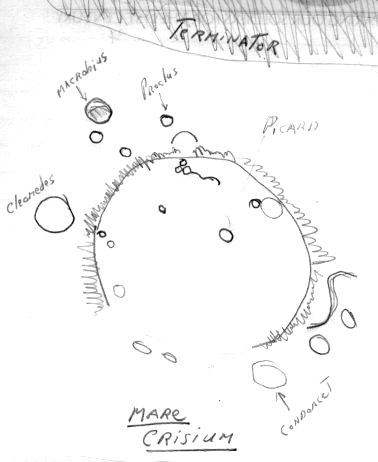
Mare Crisium -- June 17, 1999
When this drawing was made, the moon was in the waxing crescent. The large circle is the Mare Crisium, a so-called "sea" named by the ancients, but actually a huge basin of solidified lava. The major craters are named. At the top of the circle are three small craters in a triangle, with a wavy line extending to the right. This is a "rill," one of the serpentine markings often located on the mare. Rills may be buckles or cracks in the lava caused by the cooling. To the lower right of the Mare Crisium is a mysterious s-shaped canyon. It looks as if it were carved through the mountainous rock. I have no idea what it is. The terminator is the darkness of shadow, and features as drawn here look much more 3-D and defined when near the terminator because of the shadows that accentuate their shapes.
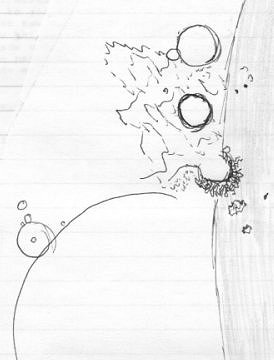
Waxing Moon-- 5 October 1992
The large craters at the right, from the top, are Aristoteles (87 km. dia.), Eudoxus (67 km. dia.), and Calippus. The "spikes" or "hair" on Calippus are the Montes Caucasus, mountains which are partly lit even in the shadow of the terminator. The circular plain only partly shown is the Mare Serenitatis (Sea of Serenity). The big crater to the left is Posidonius (100 km. dia.). This sketch was made using a simple 60 mm refractor telescope which only cost me $99.95. My present telescope, an 8-inch, could get much "closer" and render more detail. As always, the telescope gives a mirror image. Comparing the sketch to the actual map of the moon requires that one "reverse" everything. As always, the proximity of the terminator creates shadows that render a 3-D effect and make drawings more revealing.
See text below--
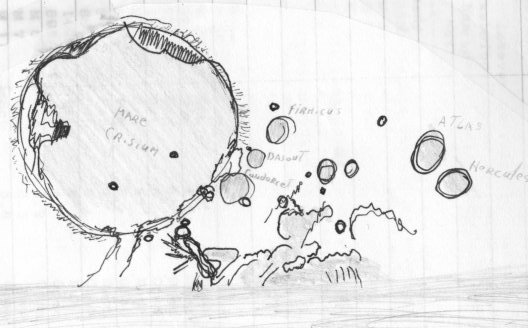
Mare Crisium Area-- October 1, 1992
Some of the large craters drawn are described as follows:
Atlas-- 55 miles diameter, terraced walls rising to 11,000 feet.
Hercules-- 45 miles diameter, terraced walls.
Firminicus-- 35 miles diameter, dark floor.
My records show the sketch took me 45 minutes to draw. I was using approx. 200X magnification.
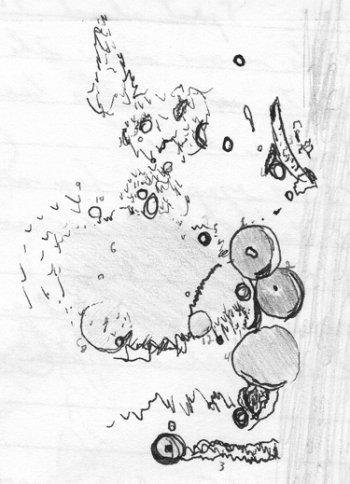
Mare Nectaris Area-- 1 October 92
This is one of the most interesting areas of the moon. The terrain includes mountains, scarps, craters, faulting features, and others. Fracastorius at the edge of the Mare is an ancient crater flooded by the lava flow which created the Mare. The ancient asteroid impacts were so severe, they actually punched through the moon's crust and released floods of lava, which flooded the plains and created the Mare features. Today the interior of the moon has cooled and no longer contains molten lava. Some of these features are 1.5 billion years old. The numbered features are as follows:
1. Theophilus (Crater)
2. Cyrillus (Crater)
3. Altai Scarp (Mountain)
4. Catharina (Crater)
5. Madler (Crater)
6. Mare Nectaris (Sea of Nectar)
7. Pavlov (Crater)
8. Fracastorius (Crater)
9. Pyrenees (Mountains)
10. Gaudibert (Crater)
11. Capella & Isidorus (Craters)
12. Beaumont (Crater)
Remember, this was all done with a little $99.95 telescope of 60mm