
The language is Portuguese, which my family speaks. Below is a sketch showing the Mare Imbrium, with some of the moon's more interesting craters, mountains, and other features.
The location is the Mare Imbrium, and the sketch was drawn on 22 June, using a Meade 8-inch LX-10, a Schmidt-Cassegrain design telescope. Eyepiece was the Vixen 8-24mm Lanthinum Zoom. Power was set around 180X. The features, numbered on the drawing, are as follows--
1. Archimedes (crater)
2. Autolychus (crater)
3. Aristillis (crater)
4. Montes Archimedes (mountains)
5. Montes Alpes (mountains)
6. Montes Appeninus (mountains)
7. Cassini (crater)
8. Eratosthenes (crater)
9. Montes Spitzbergen (mountains)
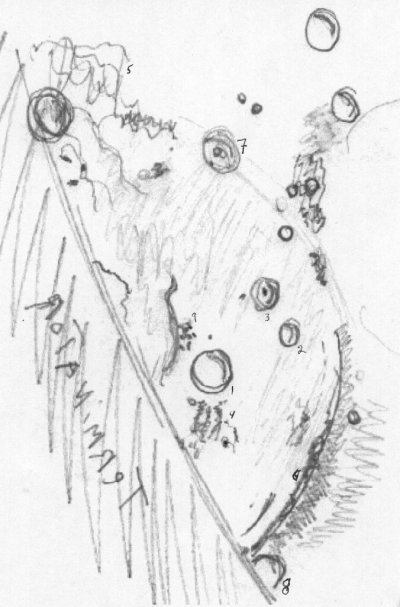
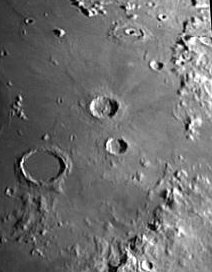
Presenting this picture has not been real easy. For one thing, the telescope delivers an upside-down mirror image of the moon. So after drawing the picture, I used the "mirror" feature in Paintshop Pro to reverse the diagram. That's why the word "terminator" is in mirror image.
With the "terminator" or shadow-line so close to these features, the rills stand out very clearly. These are the wavy or s-shaped lines that crawl across the Mare Imbrium. They may have been "buckling" which occurred when the mare cooled. There's also a strange slot-like line which appears in the lower right just inside the mountain range on the mare. I don't know what this is. It may be a lava dike which oozed through a crack in the mare.
What is a mare? There are many on the moon, the Mare Imbrium being just one. Remember, 3 billion years ago when a major asterod hit this part of the moon, the moon still had a hot, lava-filled core. We are talking something very big here-- an asteroid perhaps 20 miles across. The impacting asteroid punched through the crust, allowing an out-gush of great quantities of lava, or magma. This huge cooling pool of lava forms the mare. Craters on the mare are other substantial impacts which occurred in the millenia since. Archimedes was probably formed by something very large in size.
When I made this sketch, the craters were filled with pools of shadow, and I tried to suggest this as I sketched.