Alphabet
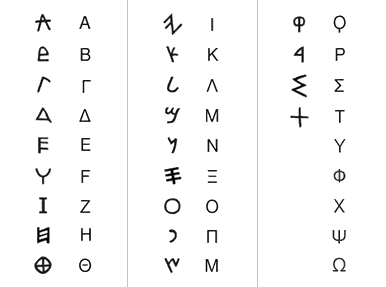 The Greeks were the first Europeans to learn to write with an alphabet, and from them writing was brought to the rest of Europe, eventually leading down to all modern European alphabets.
From the shape of the letters, it is clear that the Greeks adopted the alphabet the Phoenician script, mostly like during the late 9th century BCE. In fact, Greek historian Herotodus 5th century BCE called the Greek letters "phoinikeia grammata" foinichia grammata, which means Phoenician letters.You can see the comparision chart at the Proto-Sinaitic page. Unlike Greek, the Phoenician alphabet only had letters for consonants. When the Greeks adopted the alphabet, they found letters representing sounds not found in Greek. Instead of throwing them away, they modified the extraneous letters to represent vowels. For example, the Phoenician letter 'aleph which stood for a glottal stop became the Greek letter alpha which stands for a sound.
There were many variants of the early Greek alphabet, each suited to a local dialect. Eventually the Ionian alphabet was adopted in all Greek-speaking states, but before that happened, the Euboean variant was carried to the Italic peninsula and adopted by Etruscan and eventually the Romans.
The Greeks were the first Europeans to learn to write with an alphabet, and from them writing was brought to the rest of Europe, eventually leading down to all modern European alphabets.
From the shape of the letters, it is clear that the Greeks adopted the alphabet the Phoenician script, mostly like during the late 9th century BCE. In fact, Greek historian Herotodus 5th century BCE called the Greek letters "phoinikeia grammata" foinichia grammata, which means Phoenician letters.You can see the comparision chart at the Proto-Sinaitic page. Unlike Greek, the Phoenician alphabet only had letters for consonants. When the Greeks adopted the alphabet, they found letters representing sounds not found in Greek. Instead of throwing them away, they modified the extraneous letters to represent vowels. For example, the Phoenician letter 'aleph which stood for a glottal stop became the Greek letter alpha which stands for a sound.
There were many variants of the early Greek alphabet, each suited to a local dialect. Eventually the Ionian alphabet was adopted in all Greek-speaking states, but before that happened, the Euboean variant was carried to the Italic peninsula and adopted by Etruscan and eventually the Romans.
alpha
beta
gamma
delta
epsilon
digamma
zeta
eta
heta
theta
iota
kappa
lambda
mu
nu
xi
omicron
pi
san
koppa
rho
sigma
tau
upsilon
phi
khi
psi
omega
Early Greek was written right-to-left, just like Phoenician. However, eventually its direction changed to boustrophedon which means ox-turning, where the direction of writing changes every line. For instance, you start on the right of the tablet and writes leftward, and when you reach the leftmost end, you reverse your direction and starting writing toward the right. Even more confusing is that the orientation of the letter themselves is dependent on the direction of writing as well. In the above chart, the letters are drawn as if they were being written from left-to-right. If I were to write right-to-left, I would horizontally flip the letters like in a mirror.
Boustrophedon was an intermediate stage, and by the 5th century BCE, left-to-right was the de-facto direction of writing.
The Greek alphabet was also the basis for Glagolitic, Cyrillic, and Coptic scripts among others.
Strangely, the Greeks tried writing once before. Between 1500 and 1200 BCE, the Mycenaeans, an early tribe of Greeks, has adapted the Minoan syllabary as Linear B to write an early form of Greek. However, the syllabary was not well suited to write Greek, and leaves many modern scholars scratching their heads trying to figure out the exact pronunciation of Mycenaean words. The alphabet, on the other hand, allowed more precise record of the sounds in the language
NEXT
PREVIEW
Back to the index page