The Parthenon, which stands on a rocky hill looking down on the city of Athens, is one of the world's most famous buildings. It was built almost 2,500 years ago as a temple to Athena, godess of the arts and guardian of Athens. The entire building was carved from sparkling white marble, and it was decorated with magnificent sculptures painted in bright colors. Inside stood an immense statue of Athena that stood over 12 meters high in the very center of the building, with ivory skin and clothes, and armor of solid gold. Every four years a great festival was held, and a beautiful robe, made by expert weavers, was brought to the temple as a gift to Athen's favorite goddess. Such was the wealth on this statue (it cost as much to create as the Parthenon itself) it had the dual role of providing an emergency treasury for Athens if money run low.
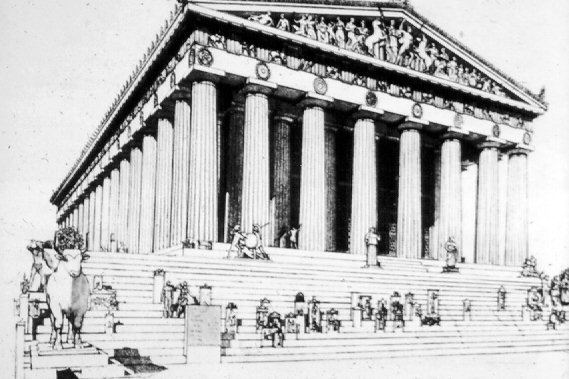
When work began on the Parthenon in 447 BC, the Athenian Empire was at the height of its power. Work on the temple continued until 432; the Parthenon, then, represents the tangible and visible efflorescence of Athenian imperial power, unencumbered by the depradations of the Peloponnesian War. Likewise, it symbolizes the power and influence of the Athenian politician, Perikles, who took the personal responsability for the whole project.
Some historians believe that Athens concluded a peace treaty with Persia in 449, two years before work began on the Parthenon. The significance of this peace treaty would be that the Delian League/Athenian Empire continued to exist, even after the reason for its existence (a mutual defense league against the Persians) had ceased to be valid. In other words it was now openly acknowledged that Athens was not just the head of the Greek defense league but actually an imperial master over other Greek states. The decision by the Athenians in 454 BC to move the League treasury from the Panhellenic sanctuary at Delos to the Athenian acropolis points in the same direction. Because the Parthenon was built with League funds, the building may be read as an expression of the confidence of the Athenians in this newly naked imperialism. But the piety of this undertaking should not be underestimated; the Persians had sacked the temples on the Athenian acropolis in 480, and rebuilding them fulfilled, in Bury's words, the Athenians' "debt of gratitude to heaven for the defeat of the Mede."
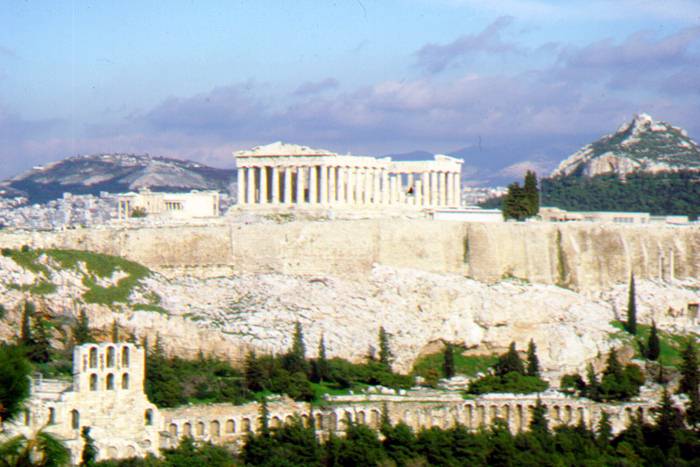
The Parthenon is a Doric peripteral temple, which means that it consists of a rectangular floor plan with a series of low steps on every side, and a colonnade(8 x 17) of Doric columns extending around the periphery of the entire structure.It features many architectural innovations, and sat on a base 70 meters long and 26 meters wide. It had 17 columns along its length and eight columns along its width, each of which was over 10 meters high and 2 meters in diameter. Each entrance has an additional six columns in front of it. The larger of the two interior rooms, the naos, housed the cult statue. The smaller room (the opisthodomos) was used as a treasury. We know the names of the architects (Iktinos and Kallikrates) and also of the sculptor (Pheidias) who made the massive chryselephantine cult the statue of the goddess, Athena.
Right-angled buildings tend to create an optical illusion that can make them look top heavy. To compensate for this effect, the Parthenon's columns utilise an architectural effect called entasis, and get gradually thinner from the middle up.
The magnificent figures carved into the space between the top of the columns and the rooftop are some of the finest ever example of ancient sculpture. Lord Elgin, a British diplomat, removed many of these from the ruins in 1801. Shipped back to Britain, they are now housed in the British Museum, whose ownership of them has been disputed ever since.
Other striking parts of the temples that have survived include the Parthenon Frieze. Only two and a half inches thick at its maximum depth it depicts a procession of 360 noble Athenians, as well as numerous animals and gods. A pinnacle of art, barely visible in its original position, the Parthenon Frieze stood 1 meter tall and would have encircled almost the whole building's upper walls, making its total length 160 meters.
The Parthenon was completed around 438 BC, well ahead of schedule. Despite this Pericles' opponents tried to prosecute Phidias for embezzlement of funds, and he was later forced into exile. The charge does not appear to have blighted his later career: he went on to build an even greater statue in the same style as his Athena. Although it too has been lost to history, Phidias' Statue of Zeus at Olympia was even more glorious, that it's been made one of the Seven Wonders of the Ancient World.
Click to go to previous page