 One great legacy of ancient Greeks is athletics. The Greeks held athletic contests as part of their religious festivals. The most important festival was in the honor of Zeus, held every four years in Olympia, the Olympian Games. Tens of housands of men traveled from all parts of the Greek world to watch the Olympic Games and to take part. The athletes competed to win fame and honor for themselves and for their cities. The Olympic Games were so important that warfare between Greek states was halted while they took place This was one time when Greek men could celebrate their common culture and the great god Zeus, whom they all workshiped.
The opening event at the Olympic games was the chariot race. This was an ancient sport going back to the Bronze Age, when Greek warriors still used chariots to ride to battle. The race was extremely dangerous, for the horses ran at great speed and accidents were common.
In a stadium the athletes entered the Olympian stadium, or running track, through a long, dark tunnel. At the far end, when they walked out into the bright sunlight, they were greeted by the cheers of thousand of excited spectators.
 The games included several running events. The short sprint of 200 meters was just one length of the stadium. The long-distance race of three miles took 24 lenghts.
Wrestling was a knockout event, in which the winners fought each other until only one victor remained. A wrestler won by making his opponent touch the ground with his knees three times. There were few rules, and wresters often tried to break each other's fingers.
The only prize given to Olympic victors was a wreath of olive leaves. Yet victory brought enormous prestige and fame. Winning athletes brought honor to their states. They enjoyed celebrity status, poems proclaimed their deeds, and statues were put up in their honor.
Throwing a discuss was part of the pentathlon(five contests0, which also included jumping, wrestling, running, and throwing a jaelin. The discus sport was forgotten for thousands of years until it was revived in 1896, when the first modern Olympic Games were held in Athens.
The two great Homeric poems, composed in the Geometric period (8th and early 7th century BC), give a full description of all athletic contests, as these are known in the historical period: chariot racing, boxing, wrestling, running, armed combat, discus, archery and javelin. Although reflecting customs of the Mycenean period which had been been preserved by tradition, these poems also describe the practices and the values of the elites of the following Geometric era.
In the Iliad, we are given long descriptions of the funeral games, organized by Achilles in honor of his beloved dead friend, Patroclus. In the Odyssey, the games are practiced in a totally different atmosphere: they form part of an entertaining spectacle organized by the Phaiakians in honor of their guest, Odysseus, upon his arrival on their island.
In the Homeric society, athletic competition is the means for a hero to demonstrate his virtue (arete) and gain communal recognition. By exercising and competing, the athlete demonstrates not only his physical strength, but his bravity and intelligence, therefore, his virtue. "I say that you know nothing of games, stranger", says Eyryalos to Odysseus, "you are not an athlete", and Odysseus, receiving his word as a great insult and dishonor against his arete, demonstrates his excellence in discus throwing. In many ways, the athletic spirit is equivalent to heroic spirit. "Athlos" means the great achievement. Every hero is like an athlete who tries to surpass the others and win.
The heroic society of Homer places high esteem on athletes who practice for superiority, and thus, the Phaiakians award Odysseus for his excellence, by acknowledging in public his superiority. The athlete's virtue (arete) and the communal acknowledgement of the athlete's status comprise two inextricably linked aspects of the athletic identity in the Homeric era.
From the 8th century onwards, the emergence of the first city-states (poleis) caused rapid developments in athletism. Various systems of gymnastics were set up in each city-state, including gymnastic exercises, musical training, reading and writing. As long as aristocrats were in power, training aimed at the supremacy of the young members of the noble families, by enhancing their physical strength and intellectual virtues. The education of the young people aimed at helping them to develop both their body and mind and achieve harmony. Physical exercise was accompanied by music. Music, dance and ahtletics, all helped to achieve the harmonious balance of the body and the mind.
A plethora of local festivals were organized by the emergent city-states in the 8th century BC. They provided a variety of competitive contexts in which most of the citizens of the city-states had the opportunity to demonstrate openly their virtues and fight for excellence. Gradually, music and athletic contests evolved into organized regional festivals of a repetitive nature. Such contests were directly connected to the cults of the gods or heroes and had religious character.
In these religious festivals, athletic competition became a formal vehicle for the members of the community to demonstrate their abilities. The athlete's victory was celebrated by making offerings to the local god. Various types of offerings, such as tripods and figurines indicate how significant this victory was for the athlete and his homeland.
For centuries, the Olympic Games were considered the most important and prestigious celebration of all Panhellenic festivals. The various myths associated with the first Olympic games create a difficult effort in identifying any historical evidence. Archaeology's role is crucial in clarifying these issues.
By the 10th century BC Olympia was a cult place, known to the elites of the western Peloponnese, who dedicated a lot of offerings in honor of its cult(s). The original character of the earlier dedications (animal figurines) reveal agricultural and pastoral interests, whereas horse and chariot figurines reflect the pursuits of more wealthy people. Obviously, Olympia came to be a regional cult place for people of different interests and status. In a region divided into small-scale local territorial units, neutral religious centers functioned as meeting places of local elites.
A broadening of the cult activities held in Olympia came by late 8th century BC, when participation was expanded to include a larger number of city-states. The region of Elis, where Olympia lies, was resettled again (ca. 750-700 BC) and several dispersed settlements were formed in the area. From this period and on, Olympia becomes a site that attracted a lot of visitors from different areas of Greece.
What is certain is that Olympia developed gradually to a major festival site that came to be respected and continued to attract visitors from all places of Greece throughout antiquity. The Olympic festival was the most important and ancient of all other Greek festivals. It was the greater religious festival among others. The sanctuary of Olympia imposed its authority throughout the Greek world, whereas soon the Olympic games became the symbol of Panhellenic unity.
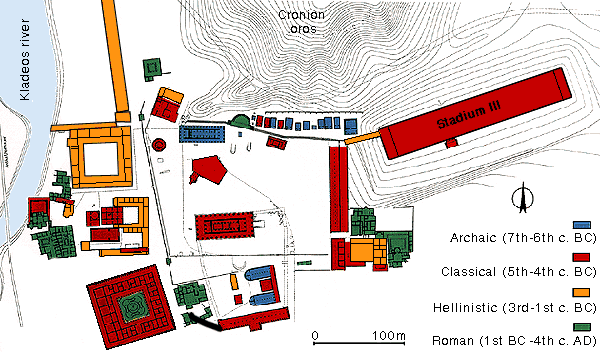 The site and the sanctuary of Olympia gradually developed through time. From a simple cult place, it evolved to an elaborated sanctuary adorned with temples, the greatest among them being the Temple of Zeus, secular buildings and statues. New games were added in the festival and new athletic facilities were built in order to facilitate the athletes who participated in the games.
A series of athletic contests were held in the stadium, the hippodrome and other areas of the site in front of thousands of spectators from all cities of the known-Greek world.
Those who participated in the contests followed common rules and conventions, established for the better organization of the games. First, all cities had to cease hostilities during the days of the games. Secondly, all Greeks were allowed to participate, except barbarians, women and slaves. Thirdly, a number of specific rules regulated the training procedures and the performance of the games.
Olympia is located 10km inland in the territory of Elis in the northwestern Peloponnese, just near the confluence of Alpheios with the river Kladeos. Peloponnese, where Olympia lies, was considered to be the island of Pelops, the mythical figure whose life was traditionally linked to the site of Olympia. Olymmpia developed from a local cult center to a Panhellenic sanctuary throughout the course of the centuries.
In the Geometric and Archaic periods (10th-6th centuries BC), the site was reorganized to meet the increasing needs created by the visitors of the site. In the early 6th century BC, the first temple, dedicated to Hera, was erected. A series of structures with votive offerings were dedicated to the sanctuary by various Greek cities, in of which many were wealthy Greek colonies.
In the Classical era (5th and 4th centuries BC), the sanctuary complex was reorganized to accommodate the most magnificent temple of the site: the temple of Zeus, containing the most famous cult statue of Zeus, made by the famous sculptor Pheidias. The site was supplied with a number of new secular buildings and athletic facilities.
In the late Classical (4th century BC) and Hellenistic periods the site was decorated with buildings dedicated by Philip II of Macedonia, father of Alexander the Great, and other wealthy donors. New elaborated practice areas, such as the Gymnasium and the Palaistra, were erected.
In the Roman period the sanctuary acquired an international fame and enjoyed imperial benefits. Following the political crisis in the late Roman period, the decline of Olympia was accelerated. In AD 393, Theodosios I, the emperor of east Roman empire, put an end to the Olympic games.
The site and the sanctuary of Olympia gradually developed through time. From a simple cult place, it evolved to an elaborated sanctuary adorned with temples, the greatest among them being the Temple of Zeus, secular buildings and statues. New games were added in the festival and new athletic facilities were built in order to facilitate the athletes who participated in the games.
A series of athletic contests were held in the stadium, the hippodrome and other areas of the site in front of thousands of spectators from all cities of the known-Greek world.
Those who participated in the contests followed common rules and conventions, established for the better organization of the games. First, all cities had to cease hostilities during the days of the games. Secondly, all Greeks were allowed to participate, except barbarians, women and slaves. Thirdly, a number of specific rules regulated the training procedures and the performance of the games.
Olympia is located 10km inland in the territory of Elis in the northwestern Peloponnese, just near the confluence of Alpheios with the river Kladeos. Peloponnese, where Olympia lies, was considered to be the island of Pelops, the mythical figure whose life was traditionally linked to the site of Olympia. Olymmpia developed from a local cult center to a Panhellenic sanctuary throughout the course of the centuries.
In the Geometric and Archaic periods (10th-6th centuries BC), the site was reorganized to meet the increasing needs created by the visitors of the site. In the early 6th century BC, the first temple, dedicated to Hera, was erected. A series of structures with votive offerings were dedicated to the sanctuary by various Greek cities, in of which many were wealthy Greek colonies.
In the Classical era (5th and 4th centuries BC), the sanctuary complex was reorganized to accommodate the most magnificent temple of the site: the temple of Zeus, containing the most famous cult statue of Zeus, made by the famous sculptor Pheidias. The site was supplied with a number of new secular buildings and athletic facilities.
In the late Classical (4th century BC) and Hellenistic periods the site was decorated with buildings dedicated by Philip II of Macedonia, father of Alexander the Great, and other wealthy donors. New elaborated practice areas, such as the Gymnasium and the Palaistra, were erected.
In the Roman period the sanctuary acquired an international fame and enjoyed imperial benefits. Following the political crisis in the late Roman period, the decline of Olympia was accelerated. In AD 393, Theodosios I, the emperor of east Roman empire, put an end to the Olympic games.
The ideal of the Olympic Games absolutely captivated the modern nation-states. In symbolic terms, these Games were the celebration of modern societes, which faced the new era with optimism and faith for the future. It was also the reassurance of the heritage of the Greek classical culture. The atmosphere of these days proves the effort put in identifing the two cultures, classical and modern. The original album of Charles Beck, Oi Olympiakoi Agones, 776 p.X. - 1896 (The Olympic Games, 776 BC - 1896), published in 1896, takes us back to the feeling of the festivities. 19th century Athens illustrates the transformation of the Hellenic society. Athens became the pole of attraction of various groups of people and the field of cultural and political confrontations and changes. Thus, it became the melting pot of different cultures. By 1896, it possessed a fully realized urban environment fashioned in genuine neoclassical style. In symbolical terms, this new center of power constituted the point of entrance of western patterns of life in the modern Hellenic society.
Click to go to previous page
Click to go to next page
Click to go to Home Page