Wildlife
Links to Birds Mammals Reptiles Flora

One of the most striking things about Trinidad and Tobago, is the richness of its wildlife. The reason is that unlike the other islands of the Carribean, the islands were joined to mainland South America in relatively recent geological times - perhaps as recently as 10,000 years ago. Even now the North-West tip of Trinidad is only seven miles from the closest point of the mountainous Paria Peninsula of Venezuela. The hills of the Northern Range of Trinidad are simply an extension of that geological feature. Before the sea cut through the range, making the Bocas, the plants and animals of South America simply spread across what is now an island chain.

It surprised me to notice that very many of the BBC's excellent wildlife documentaries over the years (such as many of those with David Attenborough), feature some aspect of Trinidad's plants or animals. There is a remarkable diversity of habitats both on land and in the sea, for a relatively small place.

Birds
With more than 400 species of birds recorded, this is a top place for Twitchers. The sanctuary where the Scarlet Ibis roost, is spectacular, world renowned, and easily accessible by daily tourist boat excursions. Trinidad and Tobago has dozens of species of hummingbirds, parrots, toucan, spectacular sea birds, such as frigate birds and pelicans, and an air force of "cobo", the South American black vultures.

The Asa Wright Nature Centre, in the heart of the Northern Range is a Mecca for birds and bird watchers alike. It is centred on an old plantation house around which all manner of feeding stations, are established for the birds (the bird watchers eat inside). This is the place to see many varieties of tiny hummingbirds at close quarters, as well as a dazzling array of honeycreepers, tanagers, and elusive forest dwelling species. The oilbirds are a rare and unique nocturnal cave-dwelling and fruit-eating species. Take a look at some of the bird pictures on this web-site. The link takes you to some of the best bird and humming bird still photographs I have seen
Return to top

Mammals
The local names will be unfamiliar to a visitor, who would probably recognise the animals by other names, for example a quenk is a wild pig, tatoo is an armadillo, and manicou is an opossum. There are reputed to be more than 100 species of wild mammals to be found, though most are elusive and hard to spot because of hunting. There are a few large rodents, like the agouti, paca or lappe, as well as deer, much sought after for the pot, and otters, ocelot and monkeys.

The bats are well represented, with large sea fishing species, vampires, and many more. Manatees lurk in the Nariva Swamp.
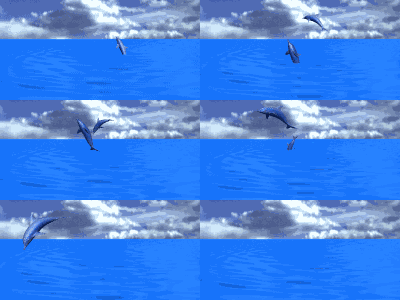
In the surrounding seas, dolphins and porpoises are common, and will jump ahead of your boat at sunset. Dolphins
I have seen a school of pilot whales in the First Boca at dawn. In the 19 th century there was a whaling station nearby at Point Baleine, on Gasparee Island.
Return to top

Reptiles
As with mammals, the local names will be unfamiliar. There are macajuel (anacondas), cayman (a kind of alligator), almost 50 different snakes (4 are poisonous, the mapepire, and coral snakes), morocoy (land turtle), large lizards, and iguanas. Geckos, like the one on the left, patrol on the walls in the houses, and hide in the curtains.

Amphibians such as crapaud (bull frogs) and tree frogs, make a lot of noise especially at night and after rain!
Return to top

Flora Pink and yellow flowering poui trees are spectacular on the hills around
Port of Spain, in the dry season. The blue and orange bird of paradise flowers resemble a crested bird's head. Forest trees are festooned with orchids and lichens. Scarlet bracts of chaconia punctuate the vivid green canopy. In the undergrowth the heliconias known as balisier astonish with their colour and form, and provide nectar for the pollinating birds.

Return to top
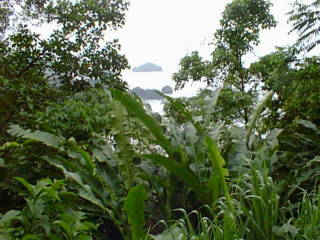
View through the Trinidad forest © Steve Mason
Hosted by www.Geocities.ws

1