|
|
Alliance
Jiu-Jitsu
By Roberto Pedreira
I left Brazil and returned to Japan, stopping off for a month in Thailand, thinking that the two months I had spent on the tatames in São Paulo and Rio de Janeiro would suffice. I couldn't have been more wrong.
By the time I
returned to Brazil, five months later, Master Jiu-Jitsu was gone. Not
gone, just moved, moved up the street and around a corner on the fifth
floor of a small building overlooking a big park in the center of Ipanema,
Praça N.S. da Paz, on Rua J. Angelica
Training was
in progress. Someone asked what I wanted. I said I was looking for Malibu.
A guy who looked like John Cassavetes in the Dirty Dozen came over
and introduced himself. He was Romero Cavalcanti—better known as Jacare,
the owner of the school and one of only five guys to earn black belts
under Rolls still teaching, and something of a legend himself.
Jacare not only looked like John
Cassavetes, he talked like him too, in very good English (as good as John
Cassavetes at least). No wonder. He went to high school in Manhattan.
Jacare had heard about me from Malibu’s assistant Eduardo. I was the
American writer. Jacare invited me to train.
I came back
the next day for the iniciantes (beginners) class. But jiu-jitsu
schools don’t really have beginner’s classes. Apart from the
Infantil and Juvenil classes, what happens depends on who is
there. Adulto classes
are for anyone who isn’t more comfortable in a juvenil class, 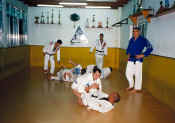 in other words, anyone about 16 years or older and not
too small. In the first beginners�Eclass I attended, the majority of the
guys were blue and purple belts. From time to time there would be brown
and even black belts. As a white belt, I was in a small minority. Most
days, I was the only white belt there. There was a certain demographic
pattern though. Anyone at any age could begin learning jiu-jitsu and would
of course be a white belt. But in Rio, most start in their teens, and they
keep their blue belts for a long time. I met people who had started when
they were kids and had been blue belts for six years. In one case, I met
someone who had been a yellow belt for 8 years before receiving a blue
belt.
in other words, anyone about 16 years or older and not
too small. In the first beginners�Eclass I attended, the majority of the
guys were blue and purple belts. From time to time there would be brown
and even black belts. As a white belt, I was in a small minority. Most
days, I was the only white belt there. There was a certain demographic
pattern though. Anyone at any age could begin learning jiu-jitsu and would
of course be a white belt. But in Rio, most start in their teens, and they
keep their blue belts for a long time. I met people who had started when
they were kids and had been blue belts for six years. In one case, I met
someone who had been a yellow belt for 8 years before receiving a blue
belt.
Young guys go to school (if their parents
have the money to pay for jiu-jitsu lessons, they have enough to put them
through a private school). For the same reasons, they don’t work. Unlike
typical middle-class Americans, Brazilians don’t think a part-time
after-school job is a good character-building experience. (If they are
poor Brazilians, it’s either a necessity or impossibility, assuming that
they are lucky enough to be able to go to school at all.) Older guys tend
to have jobs (if they don’t, they can’t afford jiu-jitsu), and they
generally aren’t free to train during the afternoons. So, the brown and
black blacks tend to be older and train in the evening, while the blue and
most of the purple belts tend to be young and train in the afternoon. This
is just a generalization of course. Younger guys, and blue belts of all
ages are perfectly free to train at night. But you’ll see many black belts
in the evening, few during the day. One reason may be that the black belts
come when they expect other black belts to come.
I went to the beginners�Eclass because I
was in fact a beginner. Also because it was less crowded and I thought it
would be good to roll with people who were better than me, but not so much
better that they would be too bored even to try. Since white belts were
scarce, blue belts were best. I doubted I could tap any of them, but at
least I had a reasonable chance of successfully defending myself. Against
an average size purple belt, and any brown or black belt, only in my
dreams would I not have to tap.
Now, there’s nothing wrong with tapping,
as Jacare explained. In fact, it’s the key to getting better. It’s what
lets you practice realistically without getting too hurt to continue
practicing. (If you practice Muay Thai with total realism, you are going
to be too injured to be able to practice long enough ever to become good.)
At the same time, doing nothing but tapping won’t help you very much
either. What we need is a balance. It’s good to roll with people who are
light years ahead, from time to time, if for nothing more than to keep
your ego in check. But you have to crawl before you can walk. For routine
training, it’s best to have an assortment of guys, some a bit better and
some a bit worse. Then you’ll be able to—have to in fact—work on both
offense and defense. It’s good also to have a few guys who are clueless,
so you can succeed with a new technique once or twice before trying it on
a more wary and dangerous opponent, one who will make you pay if you miss
with it (which is most likely to happen the first time you try it).
In my case, there were no guys that
clueless. I had to pay every time I tried a new technique.
This was a rare opportunity. Jacare was
in fact living in the United States but was in Rio for Christmas. I would
be able to learn personally from someone who had been one of Rolls
Gracie’s top students, and also to talk about jiu-jitsu’s history with
someone who had been there to witness a substantial part of it.
Since the
boom began, tournament activity has increased. Before there might be a
tournament once every several years. Now there are big tournaments every
few months, and since 1996, a world championship every summer in July. But
Jacare has been involved in jiu-jitsu since before the boom, when
jiu-jitsu was fundamentally a form of auto-defesa (self defense),
as it had traditionally been. (It was primarily Jacare’s teacher Rolls who
had been responsible, almost single handedly, for giving jiu-jitsu its
sport form).
Jacare believed everyone should have a
solid foundation in self-defense before delving too deeply into the
intricacies of sport jiu-jitsu. His classes typically began with two or
three defenses against various types of attacks, such as a bear hug from
behind, over or under the intended victim’s arms, a headlock while
standing, and most of the other standard “common�Eattacks. However, I
never saw a defense against a wrist grab. Maybe Brazilians don’t grab
wrists. (I fact, I once saw a student demonstrating a hapkido counter to a
wrist grab on another student; others quickly gathered around to watch,
and were impressed. They all wanted to learn how to do it
themselves.)
The self-defense segment was short. “We
don’t practice auto-defesea as much as before�E Jacare admitted,
“because we don’t need to�E He elaborated: “We think rolling is the best
preparation for self- defense. You develop the conditioning, the
endurance, the resistance to pain, the sensitivity to an opponent’s moves,
and the other elements you need for good self-defense�E
It’s more fun too.
Jacare explained that jiu-jitsu was
originally designed for self-defense, but many guys found it too tedious
to endlessly repeat moves against attacks that never happened anyway. They
liked rolling. There weren’t exactly what you could call rules in those
early days (actually, the days of Rolls—the middle 60’s to 1982), but it
was recognized that passing the guard is better than not, mounting is
better than being mounted, and so on, and obviously, making your opponent
tap is best. So there were sort of unofficial but generally understood and
accepted rules. It was the competition that made everyone get better, that
and the open-mindedness about incorporating new techniques into jiu-jitsu
from where ever they could be found. “Rolls was the one who did
both�E
There are
some Brazilians who resent Rorion for monopolizing the family name, his
uncles Carlson and Carley to mention just two. Jacare, like others, had a
more pragmatic view. Rorion may be getting richer than everyone else, but
everyone is making money, with lessons, videos, fights, endorsements, and
Rorion is the reason. “Rorion made it happen�E Jacare said. "Não se
pode tapar o sol com a paneira", he added (you can’t block the sun
with a sieve). I had no idea what that meant.
The next day,
I came early to watch the various classes. The infantil class was
taught by Rodrigo Medeiros and Ricardo Vieira, both purple belts (Rodrigo
had been a blue belt at the old Master location when I was there six
months before, and would be a brown belt by the time I left the new school
two months later). 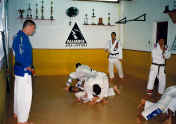 The Brazilians are
realistic about what kids can and want to do. Their attention span is
short and they aren’t really very concerned about self-defense at that
age. Most of the class is spent letting them burn off energy, running
around in a semi-organized way, kicking a soccer ball, wrestling, just
primarily getting used to being in an academy and absorbing the way things
are done and what they mean. The class begins and ends at a set time.
Rodrigo or Ricardo would call them to attention from time to time to
organize a new activity. Rodrigo did teach one technique that day that
looked interesting, an escape (or as they say, an exit), from the mount.
It wouldn’t work on an aware adult opponent but for a kid, it probably
would, and if you did it from the guard, it would be a workable sweep.
Even at that age, they are learning useful skills.
The Brazilians are
realistic about what kids can and want to do. Their attention span is
short and they aren’t really very concerned about self-defense at that
age. Most of the class is spent letting them burn off energy, running
around in a semi-organized way, kicking a soccer ball, wrestling, just
primarily getting used to being in an academy and absorbing the way things
are done and what they mean. The class begins and ends at a set time.
Rodrigo or Ricardo would call them to attention from time to time to
organize a new activity. Rodrigo did teach one technique that day that
looked interesting, an escape (or as they say, an exit), from the mount.
It wouldn’t work on an aware adult opponent but for a kid, it probably
would, and if you did it from the guard, it would be a workable sweep.
Even at that age, they are learning useful skills.
The next class was for juvenils,
which Rodrigo and Ricardo also taught. Burning energy was also a part of
this class. I’ve never seen an adult class do anything remotely
approaching this degree of “warming up�E Only guys this age could have
energy left over to actually continue training. But the warm-up was
combined with skills training. First, they practiced takedowns, both guys
attempting to take the other down, while defending strenuously. Next, they
practiced passing the guard. Finally, a clinch drill with a variation that
makes a lot of sense. One guy actually tried to slap the other hard on the
face. He would either clinch or get slapped. Only a few guys got slapped
and even then not more than once, but the possibility made their clinching
more emphatic. I would have liked to have done this myself, but I’ve never
seen it done in an adult class. After this, they did a regular class of
positions and rolling. I was exhausted just watching the class.
The afternoon adulto class was
next. As mentioned earlier, most people in the afternoon classes, are
younger guys with blue belts. There are more blue belts than white in
every academy I saw in Brazil (not so in Los Angeles, where the blue and
white belts tend to go to different classes, and definitely not so in
Tokyo at Gracie Japan). One reason is that jiu-jitsu is now well
established and there are few newcomers in relation to veterans. Another
reason is that it is relatively easy to get a blue belt in Rio (compared
to anywhere else I’ve trained). Most agree that about six months of steady
training three days a week is sufficient to get a blue belt.
Jacare taught this class. He seemed to be
in a stand-up frame of mind that day. The techniques were good, solid,
basic defenses against punches. Against a wide swing, Jacare recommended
an overhook; that would block the punch and then trap the arm for a
takedown or throw. Don’t assume the first punch is the only one, Jacare
cautioned. Be ready to overhook the other arm if it comes. Then you can
lean him to either side, and toss him over your hip. If the punch hasn’t
come yet, you can simply reach out and check it (the way Silatists
do).
A tight, straight punch is a different
matter, Jacare said. You can’t overhook a punch that is “inside�E(to
borrow a kali concept). Instead, you need to parry it, which will put you
outside his arm and close to his back—a nice place to be. Once you’ve done
this, it’s easy to clinch and follow up with a takedown of your choice.
One point to remember, he added, if you get behind him, put one foot back,
to avoid his counter throw. Always assume he has a back-up plan, and
accordingly, have one or more of your own.
The next technique caught my attention
because I recalled it from a Goju-ryu kata. Although I studied Goju karate
for five years (1972-1977), at no time was any self-defense move
explicitly taught. In fact, the sensei (a Black Belt magazine hall
of famer) frequently warned us not to try to use karate for self-defense
(he recommended running away—I give him high marks for candor). Possibly,
the moves were contained in the “advanced�Ekata Possibly, we were expected to
realize that they were in the kata and that we were expected to extract
them. On the contrary, we were too busy memorizing the kata for promotion
to think about what most of the movements were supposed to be
(occasionally the sensei would explain that a particular movement could be
used as either a block or a punch for example; this tended to happen in
cases where it was obvious anyway). What I gathered was that the
techniques were hidden in katas and that it would take many years to
understand their application. Moreover, I gathered that neither the sensei
nor my seniors would tell me this.
Mind-reading of this variety is taken for
granted in Japan. Explicitness is not a virtue, ever, and the Japanese
believe that anything that is easy to learn is not worth knowing. The
Brazilians don’t have a problem with explicitness. They tend to prefer it.
And whether something is worth knowing depends on what it is and what the
person who knows it wants and needs, not how difficult it was to learn.
The Japanese believe that doing difficult things both develops and
demonstrates good character. The Brazilians believe doing difficult things
demonstrates that you couldn’t find an easier way to do something (which
any sensible person would prefer, because they’d then have more time to go
to the beach), or are too unimportant to have the necessary connections to
have someone else to do it for you. The Brazilian emphasis is on the function rather than the
form, the result rather than the process. Now obviously, function and
form, and result and process are related. Sometimes it yields better
results overall to emphasize the process. The Japanese think so. If you
are dealing with huge numbers of very well organized, and very similar
people, who have been specifically educated to be good at and to value
following instructions, then the Japanese way works well. But these
conditions have never existed in Brazil and the Brazilians have not
adopted this assembly-line model of education. (Brazilians find certain
aspects of Japanese culture appealing, but the regimentation—so it seems
to them—of most parts of Japanese life and human relations isn’t one of
them)
There was a
break of several hours before the adulto class. Fernando Gurgel,
Fabio's older brother, was
leading the class. Fernando’s apelido (nickname) is Magrão, which
means “skinny�E Magrão might have been skinny when he first got the
apelido, but at 6�E”” and about 185 lbs, with enormous hands and
forearms, he’s hardly skinny. Almost everyone in the class had either a
black belt or a faded brown belt. There was a smattering of purple, blue,
and even white belts too. Jacare was there too, to be with his old
friends, and do some training himself.
Jacare is 45, about 6�E(183 c.) and 165
lbs. (75 kilos). The downside to being really good is that it’s hard to
find people to push you. But if you are a good teacher, your students
become good too, maybe as good as you. Maybe better. Jacare must have been
a good teacher, because he had a lot of good students—Fabio Gurgel,
Roberto Traven, Alexandre Paiva, Rodrigo “Comprido�EMedeiros, all Mundial
champions, to name only four.
Jacare called a huge brown belt to roll.
This brown belt had enough strength and skill—and the benefit of excellent
teaching—that he might be able to make his teacher tap. If not tap, then
at least to make him lose face by not being able to defeat his younger and
bigger by about 60 lbs. student effortlessly. Now a karate teacher can
finesse getting scored on by a student just by saying “nice shot�E The
fact that he’s the one judging the quality of the technique shows that he
is still the top dog (imagine the student saying “nice shot�Ewhen the
teacher scores). And he and everyone else can say that the shot wasn’t
hard enough to do damage, or that the teacher wasn’t really trying.
A
jiu-jitsu instructor doesn’t have that way out. Despite everyone
saying it’s ok to tap, most guys would almost rather have their arm broken
than tap to a lower belt. (The ones who usually say it’s ok to tap are the
ones who are so good that they personally never do. 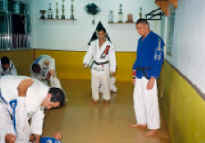 But the fact that it has to be repeatedly said that
it’s ok to tap indicates how strong the reluctance to tap can be. I have
never witnessed anyone voluntarily tapping to a lower belt or not being
visibly embarrassed or upset if it did happen). If you tap, it’s because
you had to, which means your opponent did the technique correctly enough
to shatter your joint or put you to sleep or asphyxiate you if you hadn’t
tapped. And you were trying to avoid tapping. No one would ever
believe otherwise.
But the fact that it has to be repeatedly said that
it’s ok to tap indicates how strong the reluctance to tap can be. I have
never witnessed anyone voluntarily tapping to a lower belt or not being
visibly embarrassed or upset if it did happen). If you tap, it’s because
you had to, which means your opponent did the technique correctly enough
to shatter your joint or put you to sleep or asphyxiate you if you hadn’t
tapped. And you were trying to avoid tapping. No one would ever
believe otherwise.
The brown belt student was actually going
all out trying to tap his instructor. This was not regarded as
disrespectful. It was simply the reality of rolling. If a karate student
is invited to spar with his sensei in front of a class, it is generally
for the purpose of staging a demonstration, whether the student is aware
of this or not (if the student is advanced enough, he will know what is
expected; otherwise, he will be used as a mere prop). If you are called to
roll with a jiu-jitsu instructor, rolling means rolling. He may toy with
you. He may decline to tap you. But he expects you to do your best to
defend yourself and to attack him. (Once I heard a blue belt, after
rolling with Rickson, tell the others (after Rickson had left, of course)
that he had almost tapped Rickson, but let him go. Everyone laughed at
him). When an instructor’s body can no longer do what his mind tells it
to, then he does not roll with students in this way, but provides wisdom
and leadership appropriate to his rank and age.
Tapping
people isn’t the end-all of rolling. Brazilians have plenty of common
sense. Jiu-jitsu is designed to permit a small person to survive against
or possibly subdue a larger one. That doesn’t mean a 120 lb. black belt is
going to have an easy time with a 240 lb. purple belt. Royler may be
better at jiu-jitsu than Mario Sperry, but not enough to compensate for a
sixty lb. plus weight disadvantage. Skill is important but so is size.
Which is more important in a particular instance depends on more things
than can be specified in advance. Sometimes no one taps because both
players are equally good on both offense and defense. Other times, it is
because one or both are practicing something other than finishes, for
example, getting and keeping, or escaping or regaining a particular
position, or possibly simply setting up a finishing technique without
executing it.
The adulto class was scheduled for
7:30, but people wandered in as late as 8:45. Everyone was lying around,
looking relaxed, chatting. Most were stretching lightly, no one doing
anything strenuous. At about 7:45, Magrão stood up and started leading the
class through some light warm-ups. The black and brown belts remained
where they were. Perfunctory warm-up completed, Magrão demonstrated two
techniques, both variations on the omoplata shoulder lock. Most of
the older guys there seemed familiar with both and didn’t bother to
practice them. This also out of the way, the rolling started. Sergio
Malibu had mentioned to me that most of the techniques of jiu-jitsu are
learned before going to brown belt; after that, it’s a question of
perfecting them rather than learning more. This seemed to be true. The
brown and black belts had come to roll. The rolling in the
adulto evening class was less structured than in other classes. In
fact, the only structure provided was that someone, in this case, Rodrigo,
who seemed to live in the academy, called �E#060;I>vai�Eto begin and
�E#060;I>tempo�Eabout ten minutes later. This was for the benefit of those
who wanted to roll with time limits. Most guys began when they felt like
it, although most ended on �E#060;I>tempo�E It seldom happens that guys
roll with the same opponent twice during the same class, especially not in
a row, but in this class everyone did what they wanted to do. The class is
scheduled to finish at 9:00, but some leave sooner and some continue to
train. One or two show up after 9:00. The brown and black belts don’t
appear to want or need a rigidly structured class, but rather a place to
roll and people to roll with. Most of them have been training together for
a long time and they have a lot in common. Jiu-jitsu has been a big part
of their lives and thanks to the Gracie revolution, they are part of an
elite. Guys frequently show up at the academy simply to see their
friends.
Jacare stayed
for about four weeks and then the Christmas and New Year holidays started.
When the academy reopened, Jacare was back in Atlanta, teaching at his new
school. Rodrigo took over Jacare’s class. Magrão taught in the evenings and
occasionally supervised open-mat sessions and taught privates on
Saturday. I rolled often with
Rodrigo and once with Magrão. Rodrigo seemed to be working on his
omoplata shoulderlocks. Every time I thought I had passed his guard
I’d end up in an omoplata. He had just gotten his brown belt, after
wearing a purple for less than a year. For all I knew he might have had a
blue belt for the ten years before that, or Jacare might have been right
that he was simply a “natural�Ejiu-jitsu fighter. Of course, he spent all
day five days a week in the academy. That couldn’t have hurt.
I often had the feeling that I had almost
pulled off a brilliant move, possibly even come close to tapping Rodrigo.
But it was an illusion. He knew how close he could afford to let me get to
his back or neck before working on what he had been planning to work on
all along. Deception ruled the day. Traps were everywhere
I didn’t have that problem with Magrão.
He didn’t see me often enough to know what I could do. True, my belt was
white and his was black. There’s a lot of belts between white and black,
as someone else said. But sometimes someone who is clueless in general can
do one thing well and can give a much better guy a hard time for a while.
Maybe he has a wrestling or sambo or judo background. Maybe he’s
abnormally flexible. Magrão didn’t take any chances. He avoided me to put
him in my guard, established a cem kilos position, and finished
with—something. I don’t remember. What does it matter? But he was nice
enough about it. “It takes time to get accustomed to the positions�E he
said.
Many people told me that tapping a lot when you are a white belt is the key to getting better. (And appreciate your freedom to tap while you can, because as you advance there will be fewer and fewer guys you can tap to without feeling embarrassed and being laughed at.) If that was true, I must have been getting damn good. But it didn't seem like it to me. I wasn't tapping to get better. I was tapping because my arm hurt. I kept getting caught in arm locks from the guard.
During the summer (which in Brazil is December to March), we trained sem kimono (without gi). This had two interesting effects. One was that without my kimono to hang on to, big guys, like 220 lb. Fabio Duarte, recently promoted to blue belt, could pry my arm up into a kimura even when I had gotten a half mount. Even from what seems like a superior position, danger abounds. At the same time, I found it easier to avoid getting my arm locked out by the small flexible guys while in their guard. It was also easier to pass their guard (or rather possible to occasionally pass their guard.) They in turn had an easier time exiting my cem kilos holddowns.
The other effect was that when unfamiliar guys showed up to roll, which happened everyday, you wouldn't know what belt they had, because we didn't wear belts. I tried to infer their belts indirectly, by observing their interactions with Rodrigo and guessing how long they had been around. Their size and facial expressions didn't provide useful information, but the guys who later turned out to have the heavy belts were generally the ones who seemed the most relaxed before the rolling started.
This one guy came in, about my size, and called me to roll. I tried to put him in my guard using a tricky move taught to me previously by Sergio Malibu. The move failed utterly. He immediately took my side and mounted. My attempts to reverse him with the uupah exit also failed. He grabbed my throat with both hands and began squeezing. I swam my arms through to break his grip, but after having done that, my uupah again failed and he merely returned his hands to their previous position and resumed squeezing. I did the same move, again, and so did he, again and again, until finally it seemed easier to be choked out than to continue struggling in vain. I tapped.
This was pretty discouraging, because his attack was so crude. Any clown could do it. I had never seen anyone attempt anything so artless in any academy. It reminded me of my boyhood in one of the rougher regions of the nation, at one time murder capital of the country. There, people did things like this. This choke actually had a name in Rio though. Rodrigo called it a "Copacabana choke". He elaborated that the Copacabana choke is just for "brincar" (joking around) because, obviously, it's too easy to escape for it to actually work. That made me feel even more discouraged, for the obvious reason that I hadn't known how to escape it. My defense was one of the two Rodrigo later taught (my execution of it failed because I wasn't able to reverse the guy, who turned out to be a purple belt). But Rodrigo's other defense was better. Instead of swimming your arms through from inside to outside, you do the reverse, dropping your forearms on his inner elbows, and trapping them there. That will leave him with no arm to post with when you do the uupah. And if for some reason the uupah still doesn't work, at least he won't be able to choke (or punch) you.
When I first arrived in Brazil, my top priority was to train jiu-jitsu as much as possible. Accordingly, I trained at least five days a week, sometimes six. My second priority was to not get injured while training. Anywhere else, one of the minor injuries that keep you off the mat for a week or two are not major disasters--the downtime gives all of your stressed but not yet quite broken body parts a chance to heal. But when you've flown halfway around the world and are living in a hotel and basically don't have a hella lot else to do there anyway, well, two weeks or even one, can be a long time.
So when the inevitable happened--a minor knee injury that restricted my mobility, but, as it turned out, healed up in exactly two weeks--I decided it was probably time to head back. The fact that I was out of cash and had maxed out my Visa card influenced my decision too.
Was this the end of Roberto's jiu-jitsu odyssey? Not hardly. It was a mere intermission.

A Arte Suave index
GTR index
©2000, R.A. Pedreira. All rights
reserved
Revised December 2001
Revised April 23, 2004
Revised Novembre 29, 2005
.
Note: In fact, my first stop in Brazil was São Paulo where I trained at Rick Kowarick's Top Form Academy. Training there was all good too. I wrote about it in the July 1998 issue of Black Belt magazine. It was Rick who told me, "if you want to see the best and the most jiu-jitsu, go to Rio." So I did.
 |
 |
|
Two views of Lovely Sao Paulo Brazil taken from the roof of Roberto Pedreira's apartment on Av Paulista. | |


