The Mojave Hatchery |
||
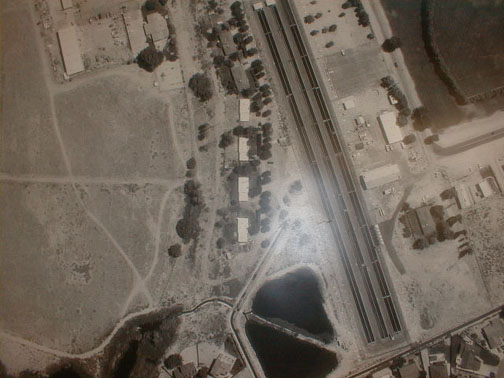 This is a photo from the air of the Mojave Hatchery. 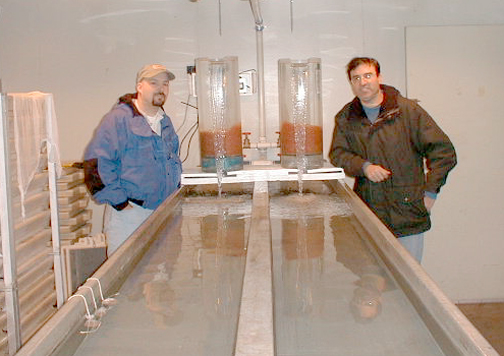 Chris and Steve get a look at the brand new egg tumblers. These tumblers sort out the non-fertile eggs and was them down into a reclaiming basin. 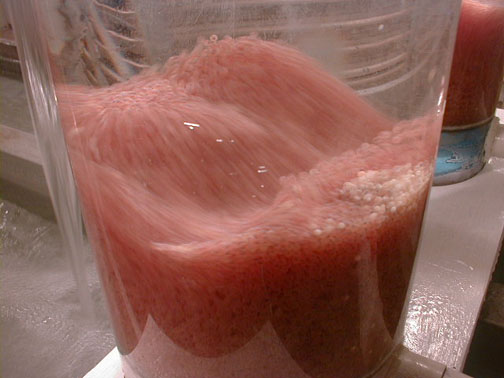 A close up of one tumbler show some of the non-fertile egss bunching up on top. 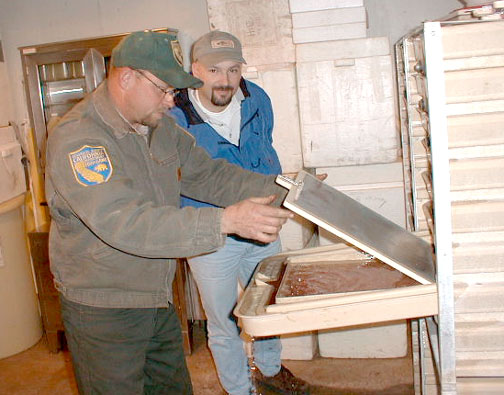 Dave Hawks of the DFG shows Chris some of the older incubating egg trays. 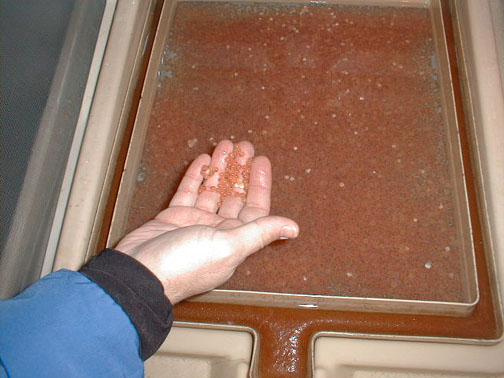 Notice all of the white eggs... In the old style incubators each egg has to be hand picked out. By the way, you can feel the heartbeats in the fertile eggs just before they are ready to hatch! This is the stage that we get the eggs for TIC. 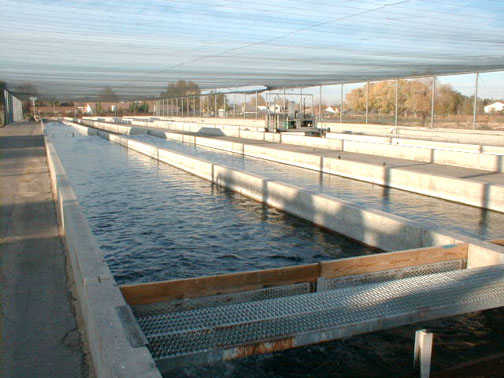 The trout troughs. Each size fish is maintained and grows with others of the same size group. The fry grow in stages that can be seen on the "Trout In The Classroom" page. 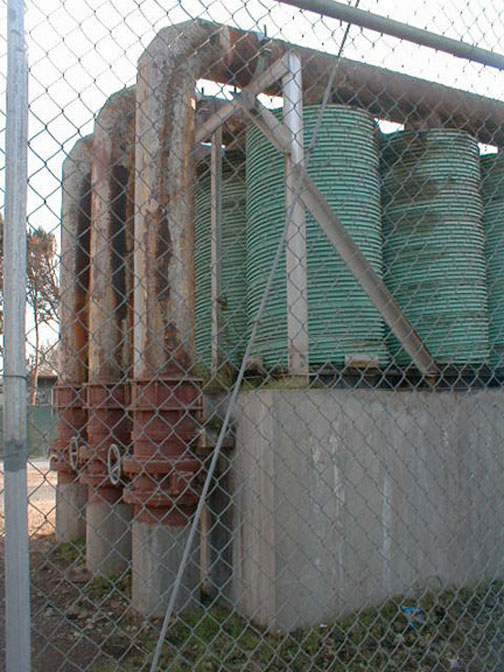 The water is re-oxygenated at 500' (center of the troughs) to maintain healthy fish. At the end of the trout troughs, the water is recycled and sent to a settling basin
where it is redistributed locally to water agriculture.
|
California trout hatcheries are among the most
modern and efficient in the world today. They are capable of producing 13,000,000
fingerling, 200,000 subcatchable, and 14,000,000 catchable-sized trout annually. Trout hatcheries must be located near an abundant source of good, cool water. Nearness to the streams planted is desirable but not essential in these days of modern transportation. The chain of life passing through the hatcheries and into the state's lakes and streams begins with the egg-taking process. Most California trout eggs are taken from brood fish reared at Mt. Whitney, Hot Creek, and Mt. Shasta hatcheries. Although most of the fish produced are rainbows, several different strains are maintained to provide eggs at different times of the year, as required by the production hatcheries. Eggs taken from these strains in the fall become 8-inch trout ready to stock in the next summer, eight or nine months later. Egss expelled from "rip" females by air pressure into a salt solution and then the milt from the male is added to fertilize them. 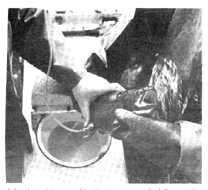 They are hatched in
incubator cabinets or in wire mesh baskets submerged in troughs of cold running water. The
fry are retained in the incubators until the yolk sac, which is their only food during
this period, is nearly absorbed. At this stage they are ready to swim and begin to eat.
They are released into troughs or rearing ponds and fed finely powdered dry food. As the
trout grow, they are sorted for size to minimize cannibalism and the size of their food is
increased to pellets of dry food. They are hatched in
incubator cabinets or in wire mesh baskets submerged in troughs of cold running water. The
fry are retained in the incubators until the yolk sac, which is their only food during
this period, is nearly absorbed. At this stage they are ready to swim and begin to eat.
They are released into troughs or rearing ponds and fed finely powdered dry food. As the
trout grow, they are sorted for size to minimize cannibalism and the size of their food is
increased to pellets of dry food.The nearly 13,000,000 fingerlings stocked each year are planted mainly by airplane in wilderness lakes and steams. The following are the most popular Californai trout. All of these are propagated to some extent in Dapartment of Fish and Game hatcheries: Rainbow trout (Native of California, found in nearly all lakes and streams where water temperatures do not exceed 70 F for any length of time), Brook trout (Native of Atlantic coastal areas, found in many mountain lakes and spring-fed streams), Brown trout (A native of Europe, generally the hardest of California inland trouts to catch), Cutthroat trout (A native of California, one subspecies found in coastal streams from Eel River in Humboldt County Northward , and the other in the lakes and streams of the central Sierra eastern slopes), Golden trout ( State fish of California, the golden trout is native to the high country of the Kern River watershed, and now is found in many lakes and streams in the Sierra from Mt. Whitneyh north to Alpine County). 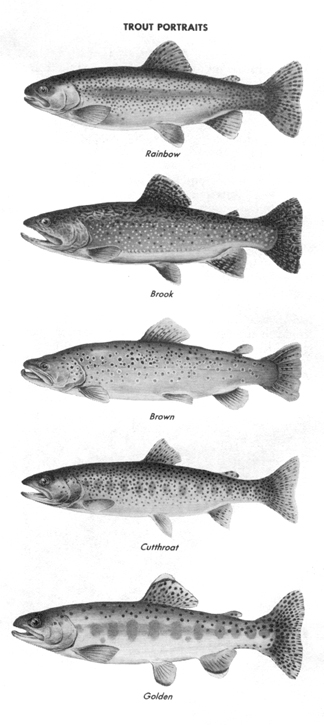 |
|