Glenbeigh Legends
Pat Griffin
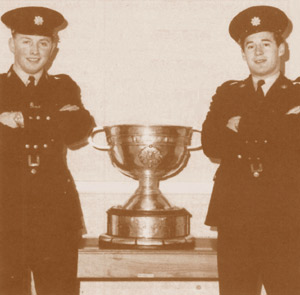
The swinging sixties were not the greatest for Kerry... but Pat Griffin was one of their brightest stars. He never knew it, but Pat Griffin WAS God! Back in the Autumn of 1962 when this football enthusiast was starting off in secondary school, Pat Griffin was God...at least in Belcamp OMI, just off Dublin's Malahide Road. Belcamp didn't have the greatest of football traditions and were generally regarded as minnows, not only in the world of Leinster Colleges football but even in Dublin competitions. There were few students who went on to play inter-county football and fewer still, who managed to make it to All-Ireland Final day. Jack Cummins, who was Meath's full-forward in the 1939 All-Ireland against Kerry, learned his football in Belcamp, but he was the exception.
 |
Fr. Tom
Scully, later to become one of the key figures in his native Offaly's
breakthrough, was the 'football' man and he was assisted by Limerickman Fr. Colm
Connellan. In the early '60s they believed they were on the verge of a
breakthrough. The principal reason for their optimism was Pat Griffin. A native
of Glenbeigh, Griffin was a gifted young footballer and was the man who was
going to bring the Hogan Cup to Belcamp. There were other top-class footballers
on the team...Louis McDermott from Garristown, Willie McGrellis from Derry and
Paddy O Connor from Dublin.
But the dreams were cruelly punctured in the Dublin final in Parnell Park when
arch-enemies O Connell Schools came out on top by a narrow margin. It was
Griffin's last year and for Fr. Scully, the breakthrough seemed as far away as
ever, It wasn't. The immediate post-Griffin era turned out to be Belcamp's
Golden Era with three Leinster championship successes, 1965, '67 and '68, and
two All-Ireland final appearances, albeit unsuccessful. A host of good young
footballers arrived on the scene...Tommy Carew of Kildare, Oliver Kilmurray of
Offaly, Seamus O Dowd of Mayo and John McGee of Longford were the main men
behind the '65 breakthrough and there is little doubt that had Pat Griffin been
available, they would have got their hands on the Hogan Cup. Instead, they were
beaten by a point, in a replay, by St. Columbs of Derry.
It was only natural that we kept a close eye on the subsequent career of Pat
Griffin. After all, he had been the greatest in Belcamp...there was no doubt
that he would eventually become a Kerry star.
Ironically, the first time that I saw him playing at county level was with the
Kildare minors against Meath in the 1962 Leinster championship. He had strong
Kildare connections and was living there at the time.
His progress to adult inter-county fame can only be described as
rapid...genuinely the stuff of schoolboys' dreams. He was centre-half forward on
the Kerry team that was beaten by Galway in the 1964 All-Ireland final and he
helped to make history by lining out in the same position on the team that won
the inaugural All-Ireland Under-21 championship by beating Laois in the final.
The disappointment of the senior final defeat appeared to be just a blip on the
upward curve of Griffin's career and with the likes of Mick O Connell, Mick O
Dwyer, Seamus Murphy and Mick Fleming in the team, it looked to be only a matter
of time before an All-Ireland SFC medal would find it's way to Glenbeigh.
But Galway were no flash in the pans and, in 1965 they repeated their '64
success much to the disappointment of Kerry supporters. Worse was to follow as
Cork emerged to win the Munster titles of 1966 and '67. The cry went out that
Kerry football was finished and Pat Griffin's once promising career was in
serious danger of not attaining fulfilment.
His performances in Croke Park were not quite as good as in Munster games and in
a county where success is expected, patience was wearing a little thin.
He was captain in 1968 and the Munster title was regained. Longford were the
surprise opponents in the All-Ireland semi-final and Griffin at last turned on
the style as he led his team to a hard-earned two point victory against a
genuinely talented Longford outfit. Griffin scored Kerry's first goal...a superb
effort after an incisive run through the middle of the Longford defence.
He had every reason to look forward to leading out his team against Down in the
final, especially with his Croke Park confidence boosted by a fine semi-final
display. He was also Kerry's top scorer going into the final. But disappointment
was again the lot of Pat and Kerry as Down maintained their 100% championship
record against the Kingdom.
The defeat by Down had Kerry supporters talking in terms of a crisis...the team
had now been beaten in three All-Ireland finals since they were last successful
in 1962 and this despite having a decent number of top quality players on the
team. Hope, however, springs eternal, and nowhere more so than in the Kingdom.
Glory came at last in 1969 when Offaly were beaten in the All-Ireland final with
Griffin playing an influential role on the '40. He was the first former Belcamp
player to win an All-Ireland SFC medal and it was just reward for the trials and
tribulations he had experienced since arriving on the Kerry team.
Based as a Garda deep in the 'enemy' territory of Clonakilty, Pat continued to
star for Kerry and collected his second All-Ireland medal a year later when the
Kingdom defeated Meath in the. final.
His last All-Ireland final appearances were both as a substitute in the 1972
draw and replay against Offaly.
While he won two All-Ireland medals, there are many who believe that he should
have finished his career with more. But just as in his schooldays at Belcamp,
Pat was a couple of years ahead of the all-conquering team of the 1970's. He
wore the No. 11 jersey in five All-Ireland finals...a worthy example to his
successor 'Ogie' Moran.
Following his departure from the inter-county scene, Pat became deeply involved
with the Clonakilty club and his son Padraig was a key figure when the Cork SF
title was captured in 1996...their first success since 1952.
There is no doubt that Pat Griffin was one of the country's top footballers
throughout the 1960's...he was tremendously stylish, had two great feet and was
a genuine team player. The Kerry team of that era may not have dominated in
proportion to the talent available but they still provided us with some great
memories...especially their superb centre-half-forward.
Reproduced with kind
permission from Hogan Stand magazine
October 2000