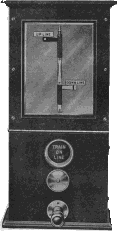
-A) Signalmen must be careful to notice each train as it passes to ascertain whether there is any apparent necessity for having it stopped at the next signalbox for examination.
�If a signalman observe or become aware of anything unusual in a train during its passage, such as signals of alarm, goods falling off, vehicle on fire, a hot axle-box, or other mishap (except a tail lamp missing, tail light out, or a train divided, for which see Regulations 19 and 20), he must send to the signalman in advance the �Stop and Examine Train� signal. The signalman in advance must also, where practical, be advised of the reason for sending the �Stop and examine Train� signal.
�The signalman in advance must immediately exhibit his signals to stop the train coming from the signalbox from which the signal was received. The train for which the signal is received, when stopped, must be carefully examined and dealt with as occasion may require.
�Should the signalman who receives the �Stop and Examine Train� signal be unable to ascertain from the trainmen, after examination of the train, why the signal was sent, he must, if the next train is travelling in the opposite direction, inform the driver of that train of the circumstances, and instruct him to proceed cautiously to the next signalbox. He must also communicate with the signalman who sent the signal in order that the latter may, if necessary, caution the driver of the next following train.
�Should either signalman become aware or have reason to believe that the permanent way is fouled or damaged, he must immediately advise the signalman at the opposite end of the section or sections affected, and no train must be allowed to proceed through such section or sections, until the line has been examined and is safe for the passage of the train; an engine may, however, be allowed to enter the section or sections affected in the same or opposite direction in accordance with Regulation 14(b).
-C) The �Stop and Examine Train� signal must always be sent in any of the circumstances named, even in short sections a train may have passed into the forward section or through one or more sections.
�The signalman receiving the �Stop and Examine Train� signal must, if he cannot stop the train, immediately pass on the same signal to the signalman in advance.
�Should it be necessary to cancel the �Is Line Clear?� or �Train Entering Section� signal, the �Cancelling� signal must be forwarded, and the signalman receiving the signal must, after acknowledging it, place or maintain the block indicator in its normal position, except under the circumstances named in clause (e) in Regulation 12, and an entry must be made in the Train Register books recording the fact of the signal having been cancelled. The �Cancelling� signal must only be used when the �Is Line Clear?� signal has been accepted, or the �Train Entering Section� signal has been acknowledged, by the signalman in advance and it is found and it is found that the train concerned will not proceed in the usual course.
-A) Signalmen must carefully watch each train as it passes, and satisfy themselves that it is complete with tail lamp attached before giving the �Train Out of Section� signal.
-B) Should a train pass without a tail lamp, or the signalman be unable to satisfy himself whether or not the tail lamp is on the train, he must immediately send the �Train Passed Without Tail Lamp� signal (9 consecutive beats) to the signalbox in advance and must not allow any train to approach from the signalbox in rear or proceed towards that box until he is satisfied that the line is clear. He must not give the �Train out of Section� signal to the box in rear, but must send the �Train Passed Without Tail Lamp� signal (4�5) and maintain the block indicator on �Train on Line.� Should he afterwards receive the �Train out of Section� signal from the signalbox in advance or be advised by the signalman at that box that the train is complete, he must give the �Train out of Section� signal to the box in rear, but should it be ascertained that the train is divided the provisions of Regulation 20 (so far as they apply), must be carried out.
-C) The signalman in advance on receiving the �Train Passed Without Tail Lamp� signal must immediately place or maintain his signals at danger to stop the approaching train, and ascertain whether or not the train is complete. If the train is complete he must so advise the signalman in rear, unless he is in a position to give the �Train Out of Section� signal. If the train is incomplete, he must advise the signalman in rear accordingly.
-D) IF A TRAIN SHOULD PASS WITH A TAILLIGHT OUT WHEN IT SHOULD BE BURNING, THE SIGNALMAN MUST ACT IN PRECISELY THE SAME MANNER AS IN THE CASE OF A TRAIN PASSING WITHOUT A TAIL LAMP.
-E) Should a freight train pass without a tail lamp and also without side lamps, the signalman must assume that the train has become divided and carry out Regulation 20. If a line is on a rising gradient from the box in rear and the train is not assisted by an engine in rear, the signalman must also carry out the provisions of Regulation 22.
-A) The Train Divided signal must be sent to the signalbox in advance whenever at train which is entering, or is about to enter, the section in advance in two or more portions.
-B) If the divided train is assisted by an engine in rear, or is running on a falling gradient, or where the line is level, or between short sections, where the stoppage of the first portion would risk collision with the second portion, the signalman, provided permission has been obtained from the box in advance for the train to proceed, must not exhibit the Danger signal to stop the first portion, but must exhibit to the driver a green hand signal waved slowly from side to side.
-C) If permission has not been obtained from the box in advance for the train to proceed, or if the train is running on a rising gradient, the signalman must exhibit the Danger signal to stop the first portion, but a green hand signal must not be exhibited. The first portion when stopped must be shunted into a siding as expeditiously as circumstances will permit, or otherwise dealt with as may be necessary to prevent the second portion coming into collision with it.
-D) In the circumstances described in clauses -B) and -C) the signalman must, as soon as the first portion of the train has passed or otherwise been dealt with, place or maintain his signals at Danger and take the proper measures for dealing with the second portion, placing detonators on the rail and exhibiting a red hand signal to attract the attention of the trainmen.
-E) Should a train become divided in starting, and the driver run forward with the first portion and leave the second portion stationary, the �Stop and Examine Train� signal must be sent to signalbox in advance, not the �Train Divided� signal.
�Should the second portion of a train which has become divided in running come to a stand before entering the section in advance, the �Stop and Examine Train� signal must be sent provided the �Train Divided� signal has not already been forwarded. In either case the signalman must inform the signalman at the box in advance of the circumstances (also if necessary the signalman at the box in rear) and arrange for the first portion to be stopped.
-F) When the rear portion of a divided train requires to be removed from a section the provisions of Regulation 14 must be observed.
-G) If it is necessary for a train to proceed into a section through which the first portion only of a divided train has travelled, such train must not be allowed to enter the section until the signalman at each end is satisfied that the section is clear. The signalman in rear must then advise the signalman in advance of the train that is ready to enter the section and give the �Train Entering Section� signal. When this signal has been acknowledged he must inform the driver of what has occurred, and instruct him to proceed cautiously, PASSING AT DANGER THE SIGNAL CONTROLLING THE ENTRANCE TO THE SECTION AHEAD IN ACCORDANCE WITH RULE 38 (B)(X). On the train passing the signalbox in advance with tail lamp attached, the �Train Out of Section� signal must be given. The same course must be adopted in the event of the second portion of the divided train following the first portion through the section ahead.
�This signal must only be used to prevent more important trains being delayed by less important trains. When, before the �Train Out of Section� signal has been received from the signalbox in advance for the last train, the signalman receives a signal from the signalbox in rear of a more important train, the �Shunt Train for following Train to Pass� signal must be sent to the signalbox in advance, and the signalman there, on receiving this signal, must take the necessary measures to clear the line to prevent delay to the second train. He must use his discretion as to the best means of affecting the object in view, and if he is unable, from any cause, to shunt the train, or if he thinks inexpedient to do so, he must allow the train to proceed, and send forward the �Shunt Train for Following Train to Pass� signal to the signalbox in advance. (See �Working of Signals,� clause (b), page 60).
�THE SIGNALMEN FORWARDING AND RECEIVING THE �SHUNT TRAIN FOR FOLLOWING TRAIN TO PASS� SIGNAL MUST MAKE A NOTE OF IT IN THEIR TRAIN REGISTER BOOKS.