-A) Should the signalman receive information about a disabled train, or from the signalman at the box in advance, that a second train is required to enter the section to assist the disabled train, or should it be necessary for the breakdown train to enter a section obstructed by section or otherwise, the second train or the breakdown van train, as the case may be, may, after having been brought to a stand and the driver informed of the circumstances, be allowed to enter the section under the following arrangements provided the driver is in possession of the train staff, except as shown in Regulation 18, clause (B), paragraph (ii), of the regulations for working on Single Lines By the Train Staff Ticket.
�If the assisting train or breakdown van train is to proceed from the signal box in advance of the obstruction the signalman there must so advise the signalman in rear.
�The signalman must instruct the driver to pass at danger the signal controlling the entrance to the section ahead as provided for in Rule 38, clause (b).
�The signalmen concerned must note the circumstances in their train register books.
�If the disabled train is taken through to the signal box in advance, the �Train Out of Section� signal must not be given until both trains have arrived, but if the disabled train returns to the box in rear, the signalman there must, after he has assured himself that the section is clear, advise the signalman in advance of the circumstances and give the �Cancelling� signal.
(ii) It will not be necessary for the signalman in rear of the obstruction to detain the assisting train until the arrival of the guard or fireman of the disabled train at his box if information has been received from the signalman in advance that the guard or fireman is coming back. On receipt of this information the signalman in rear may allow the assisting train to enter the obstructed section after the driver has been informed that the guard or fireman of the disabled train is coming back, and has been instructed to keep a look-out for such guard or fireman. The guard or fireman of the disabled train, when picked up, will ride on the engine of the assisting train, and pilot it to the rear of the disabled train.
(iii) If there is a tunnel in the obstructed section the driver of the assisting train or breakdown van train, unless he is accompanied by the fireman of the disabled train, must not enter such tunnel until he has met the guard or fireman of the disabled train or it has been ascertained that the tunnel is clear. The driver of the assisting train, or breakdown van train, must be instructed accordingly by the signalman.
�When the line is clear again and permission has been obtained for another train to proceed, such train must be stopped and the driver instructed to proceed cautiously.
-C) Should it be necessary for the assisting train to continue in rear of the disabled train through any block section or sections in advance of the section obstructed, the signalman in rear, when forwarding the �Is Line Clear?� signal for the disabled train, or if this signal has already been sent, must inform the signalman in advance that the approaching train is being assisted in rear. The circumstances must be noted in the train register books at both signal boxes and the �Train Out of Section� signal not given until both trains have arrived.
-D) In the event of both loops at a crossing place being obstructed by accident, or other exceptional cause, inside the respective home signals but within the authorised clearing point, the signalman at the box on each side must be advised of the circumstances, and if it is necessary for the trains to be worked to and from the point of obstruction, such trains approaching the obstruction must be accepted under Regulation 5. The driver of each train allowed to go forward under this Regulation must be verbally informed by the signalman of the circumstances.
-A) When it is necessary in accordance with Regulation 17 to ascertain if the line is clear, and speaking communication exists between the two signalboxes which will admit a proper understanding being arrived between the two signalmen, an engine may be allowed to enter the section provided the �Train Out of Section� signal has been sent or received, as the case may be, for the previous train. The circumstances must be explained to the driver who must be in possession of the train staff, and he must be instructed to pass at danger the signal controlling the entrance to the section ahead as provided for in Rule 38, clause (b), and proceed cautiously through the section, prepared to stop short of any obstruction. Where practical, the engine must be accompanied by the Station Master or other competent person. After sunset, during fog or falling snow, or where a tunnel intervenes the section, the engine must always be so accompanied.
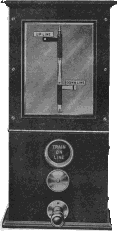
-B) The signalman at the box at which the engine enters the section must not forward the �Is Line Clear� signal but must inform the signalman at the opposite end of the section of the circumstances under which the engine is entering the section, after which the �Train Entering Section� signal must be given and acknowledged and the block indicator must be placed to �Train on Line.� It must be maintained in that position until the engine has arrived at the box in advance or has returned to the box in rear and the person in charge or driver, as the case may be, has reported that the line on which the engine has travelled is safe for the passage of trains. Should the engine return to the box in rear and the line is safe for the passage of trains the �Cancelling� signal must be sent.
�After arrangements have been made for an engine to enter a section in accordance with this clause, the signalman in advance may occupy the line ahead of the home signal.
-C) The circumstances must be noted by both signalmen in the train register books.
-A) To prevent delays, a breakdown van train when proceeding to clear the line, it must be signalled as an express passenger train, and, when necessary, preceding trains must be shunted for the breakdown van train to pass.
-B) The same course must be adopted in the case of one engine proceeding to take the place of another that has failed, or of an engine, with or without a train, when sent forward to render assistance in case of failure or disabled train.
-A) Except in the case of a ballast train working in the section and which has to return to the signal box in rear, (see Regulation 15 (d) Regulations for on single lines by the Train Staff and Ticket), permission must not be given for a train to approach on the single line when there is any obstruction outside the home signal, nor must the single line be fouled outside the home signal after permission has been given for a train to approach.
-B) Except as shown in paragraphs (I) and (II), a train must not be allowed to foul the single line outside the home signal, unless the driver is in possession of the train staff for the section so fouled.
(i) The signalman may, if necessary, and provided permission has not been given for a train to approach from the opposite end of the section, allow the single line to be fouled outside the home signal, but before doing so he must send the �Blocking Back� signal (3�3) in accordance with Regulation 13 and until this signal has been acknowledged the line outside the home signal must not be occupied.
�The single line may, if necessary, for shunting purposes, be occupied outside the home signal at both ends of the same section at the same time, provided no train is approaching in the section, and that the �Blocking Back� signal (3�3) has been given to, and acknowledged by, the signalman at the opposite end of the section.
(ii) If a train is travelling in the section away from which shunting operations are being performed, and it is necessary to occupy the line outside the home signal, this may be done without first giving the �Blocking Back� signal (3�3) to the signal box at the opposite end of the section, but immediately the �Train Out Of Section� signal has been received for that train, the signalman must, if the single line is still occupied outside the home signal, give the �Blocking Back� signal (3�3) to the signalbox at the opposite end of the section, which signal must be acknowledged.