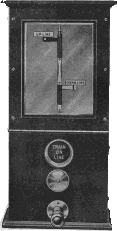
-A) Should it be necessary, in consequence of obstruction or other cause, to prevent the approach of a train from the signalbox in rear, the �Obstruction Danger� signal must be sent to that box, whether the �Is Line Clear?� signal or �Train Entering Section� signals have been received form that box or not. The �Obstruction Danger� signal must also be sent to the signalbox in rear when a signalman observes a train approaching his box for which he has not accepted the �Is Line Clear?� signal, or received the �Train Entering Section� signal, or for which he has not received the �Train or Vehicles Running Away� signal (2�5�5) from the signalbox in rear.
-B) The signalman sending the �Obstruction Danger� signal; must place the block indicator for the line or lines affected to �Train On Line�, if not already in that position, and must also place or maintain his signals at Danger to protect the obstruction.
�The block indicator must be maintained at the �Train on Line� position until the obstruction has been removed except as provided for in Regulation 14(b).
-C) If necessary, the signalman must send the �Obstruction Danger� signal in both directions.
-D) The signalman receiving the �Obstruction Danger� signal must immediately place or maintain his signals at Danger to prevent any train going towards the signalbox from which the �Obstruction Danger� signal was received, and place3 detonators, 10 yards apart (10 cm apart on GHLR), on the obstructed line or lines in such a position as to prevent any train entering the obstructed section without passing over the detonators. No train must be allowed to proceed towards the signalbox from which the �Obstruction Danger� signal was received until the �Obstruction Removed� signal has been received and the �Is Line Clear?� signal has been accepted by the signalman in advance, or it has become necessary to allow a breakdown van train or other train going to render assistance. Such breakdown van train or other train going to render assistance must be signalled and dealt with in accordance with Regulation 14.
-E) Should a signalman receiving the �Obstruction Danger� signal succeed in stopping a train for which the �Is Line Clear?� signal has been accepted by the signalman at the box in advance, he must at once advise the signalman at that box by sending the �Cancelling� signal. This signal must be acknowledged, but the block indicator must be maintained at the �Train On Line� position until the obstruction has been removed, except as provided for in Regulation 14(b).
-F) Should a signalman receiving the �Obstruction Danger� signal not be able to stop a train for which the �Is Line Clear� signal has been accepted by the signalman in advance, he must, instead of acknowledging the �Obstruction Danger� signal, at once and without giving the �Call Attention� signal, give the �Train or Vehicles Running Away� signal. The signalman receiving the latter signal must immediately take all possible measures to stop the approaching train, and afterwards acknowledge the signal.
-G) Wen the obstruction has been removed and the line or lines are again clear, the �Obstruction Removed� signal must be given to the signalbox in rear and the block indicator placed on its normal position. Should, however, the signalman in rear be unable to stop a train, for which the �Is Line Clear� has been accepted, the �Obstruction Removed� signal must not be sent until the train is clear of the section.
-A) Should a signalman become aware that cattle, horses or other animals are on the line and likely to cause an obstruction he must at once inform the signalman at the opposite end of the section affected of the circumstances on the speaking instrument, and take the necessary steps to have the line cleared. Until it has been ascertained that the line is clear, all trains allowed to proceed must be brought to a stand and the driver verbally informed of the circumstances and instructed to proceed cautiously.
-B) Should there be a tunnel in the obstructed section, the signalmen at either end of the section must verbally explain the circumstances to the driver and guard of each train entering the section and instruct them that although the train may proceed into the section it must not enter the tunnel until they have ascertained that the tunnel is clear.
-C) When either signalman has ascertained that the line is clear, he must advise the signalman at the opposite end of the section, and ordinary working must be resumed.
-A) When, after the �Train Out Of Section� signal has been given, the line inside the home signal is about to be obstructed by any shunting or other movement which has to stand on a running line within a quarter of a mile in advance of the home signal (outermost home signal where more than one is provided), or within any other point to which the line must be clear before a train may be accepted under Regulation 4, or when the line within that distance is about to be obstructed by a rail being taken out, relaying operations or any stationary obstruction (except a trolley) being placed on the line, the �Blocking Back� signal (2�4) must, unless instructions are given to the contrary, be sent to the signalbox in rear. After the �Blocking Back� signal (2�4) has been acknowledged, the block indicator for the line affected must be placed at the �Train On Line� position.
When a train has been brought to a stand in advance of a junction but within the authorised clearing point and the facing points have been set in another direction to allow the �Train Out Of Section� signal to be given, such points must not be again reversed towards the standing train until the signalman has protected the obstruction by giving the �Blocking Back� signal (2�4) to the signalbox in rear.
�WHERE THE �WARNING� SIGNAL IS AUTHORISED IT WILL NOT BE NECESSARY TO SEND THE �BLOCKING BACK� SIGNAL (2�4) IN THOSE INSTANCES WHERE, AFTER HAVING GIVEN THE �TRAIN OUT OF SECTION� ANOTHER TRAIN OR ENGINE HAS TO BE BROUGHT TO A STAND ON THE RUNNING LINE TO THE REAR OF THE CLEARING POINT.
�[THE �BLOCKING BACK� SIGNAL (2�4) WILL ALSO BE USED IN THE CIRCUMSTANCES SHOWN IN REGULATION 24, �SWITCHING OUT� CLAUSE 5]
-B) When the signalman asks permission to occupy the line outside his home signal (or outermost home signal if there is more than one provided), he must give the �Blocking Back� signal (3�3) to the signalman at the box in rear and the latter must, before acknowledging the �Blocking Back� signal (3�3), satisfy himself that he can with safety give such permission, and that he has not allowed a train to approach his box from the box in rear under Regulation 4 (UNWARNED), unless there is a distance of at least half a mile between his home signal (outermost home signal where more than one is provided) applicable to such train and the home signal for the box from which he received the �Blocking Back� signal, or, if at a junction, he has set his facing points for another line, and that line is clear according to these Regulations. After the �Blocking Back� signal (3�3) has been acknowledged the block indicator for the line intended must be placed at the �Train On Line� position.
�SHOULD IT BE NECESSARY TO MAKE A SHUNT OUTSIDE THE HOME SIGNAL BEFORE THE �TRAIN OUT OF SECTION� SIGNAL HAS BEEN GIVEN, A SPECIAL BELL SIGNAL (1�2�3) INDICATING �BLOCKING BACK OUTSIDE HOME SIGNAL FOR TRAIN ALREADY IN SECTION� MUST BE SENT TO THE BOX IN THE REAR INSTEAD OF THE USUAL BELL SIGNAL (3�3).
Unless special permission is given by THE DIVISIONAL SUPERINTENDENT OR DISTRICT TRAFFIC MANAGER, no train or vehicle is to be placed outside the home signal on a falling gradient towards the signalbox in rear, AND THEN ONLY IF THERE IS A BRAKE VAN AT THE REAR AND A MAN WITH IT.
-C) If, when a signalman gives the �Blocking Back� signal (2�4) or (3�3) for the purpose of asking permission to occupy the line, the signalman at the box in rear is not in a position to give such permission, he must not repeat the �Blocking Back� signal or acknowledge it in any way.
-D) When the obstruction has been removed and the line is again clear, the �Obstruction Removed� signal must be given to the signalbox in rear, and the block indicator placed in its normal position.
-E) The signalman sending and receiving the �Blocking Back� signal must make a note of the circumstances in the train register books.
-A) Should the signalman receive information about a disabled train, or from the signalman at the box in advance, that a second train is required to enter the section to assist the disabled train, or should it be necessary for the breakdown train to enter a section obstructed by section or otherwise, the second train or the breakdown van train, as the case may be, may, after having been brought to a stand and the driver informed of the circumstances, be allowed to enter the section under the following arrangements provided the driver is in possession of the train staff, except as shown in Regulation 18, clause (B), paragraph (ii), of the regulations for working on Single Lines By the Train Staff Ticket.