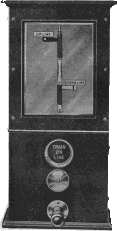
-A) Except where instructions are issued to the contrary, the line must not be considered clear, nor must a train be allowed to approach from the signal box in rear, in accordance in Regulation 3, i.e. unwarned, until all the necessary points have been placed in their proper position for the safety of the approaching train and the line is clear as under: -
(i) At a crossing-place, if the line on which the approaching train has to run be clear to the starting signal, and the facing points are set for that line.
(ii) At a terminal station, if the line on which the approaching train has to run be clear to the point of which the train usually runs, and the facing points are set for that line.
(iii) At a junction (other than a crossing-place), or at a junction with a double line, if the line for which the points are set be clear at least a quarter of a mile beyond the home signal, and no other train be signalled on the block instruments or by fixed or hand signals to cross or foul such line within that distance.
(iv) At a signal box which is not a crossing place, if the line be clear for at least quarter of a mile beyond the home signal and permission has not been given for a train to approach in the opposite direction.
�When an additional home signal is provided a quarter of a mile in rear of the inner home signal the �Is Line Clear?� signal may be accepted when the line is clear to the inner home signal. This permission will not apply during fog or falling snow unless Fog-signalmen are on duty at the distant and outermost home signal.
-B) After permission has been given for a train to approach in accordance with regulation (4) (i.e. unwarned), no obstruction of the line on which such train require to run must be allowed within a distance of a quarter of a mile ahead of the home signal or within any other prescribed clearing point, until the train has been brought to a stand at the home signal, or has passed into the section in advance, or the cancelling signal has been received.
-C) If the line be not clear, or if from any other cause the signalman is not in a position to give permission for a train to approach when the signalman in rear forwards the �Is Line Clear?� signal, that signal must not be acknowledged until the signalman to whom the signal has been sent is prepared to receive, when he must give permission for it to approach in accordance with the prescribed regulations.
-A) When the line is clear to the home signal only, the �Is Line Clear?� signal must not be acknowledged in accordance with regulation 3, but the �Section Clear but Station or Junction Blocked� signal must be given, and when this signal has been acknowledged the block indicator must be placed to the �Line Clear� position. The signalman receiving this signal must, if a stop signal is provided in advance of the box and the train has not already passed the home signal, bring it quite or nearly to a stand at that signal before lowering it, and, unless a fixed warning signal is provided, must, as the train is approaching the box, exhibit to the driver a green hand signal, held steadily, which the driver should acknowledge by giving a short whistle as an indication that he understands that the section ahead is clear to the next home signal but that the station or junction ahead is blocked. The necessary fixed signals may then be lowered for the train to proceed and the �Train Entering Section� signal may be given.
�If the driver does not acknowledge the hand signal, the signal controlling the entrance to the section ahead must not be lowered until the train has been brought to a stand at it.
�If there is not a stop signal in advance of the box the signalman must, unless a fixed warning signal is provided, stop the train in accordance with Rule 40 and verbally instruct the driver that the section is clear to the next home signal but the station or junction ahead is blocked, after which a green hand signal, held steadily, must be exhibited to the driver.
�WHEN, HOWEVER, THE SIGNALMAN ON LOWERING HIS HOME SIGNAL SEES OR FINDS THAT THE SIGNALMAN IN ADVANCE HAS LOWERED HIS DISTANT SIGNAL, OR TAKEN OFF THE SLOT, HE MUST NOT STOP THE TRAIN AT HIS BOX, BUT ALLOW IT TO PROCEED WITHOUT WARNING THE DRIVER OR EXHIBITING A CAUTION HAND SIGNAL.
-C) Where a warning signal is provided the green hand signal must not be exhibited, but the warning signal must not be lowered until the train has been brought quite, or nearly, to a stand at it.
-D) Except where instructions are issued to the contrary, when a train has passed the signal box before it has been accepted and is brought to a stand owing to the signal controlling the entrance to the section ahead being at danger, the driver will understand that the lowering of such signal is an indication that the section is clear to the next home signal but that the station or junction ahead is blocked. When a train is drawing forward from the signalbox to the signal that controls the entrance to the section ahead and the �Section Clear but Station or Junction Blocked� signal is received, the signal must not be lowered until the train has been brought to a stand.
� ADVANCED STARTING SIGNALS, OR STARTING SIGNALS IN ADVANCED POSITIONS MUST NOT BE USED DURING FOG OR FALLING SNOW FOR A TRAIN TO DRAW UP TO, WAITING FOR PERMISSION TO PROCEED INTO THE SECTION IN ADVANCE, UNLESS THERE IS A TRACK CIRCUIT IMMEDIATELY TO THE REAR OF SUCH SIGNALS. DURING FALLING SNOW, SUCH SIGNALS MUST NOT BE USED FOR THIS PURPOSE UNLESS THEY ARE ALSO ELECTRICALLY REPEATED IN THE SIGNALBOX.
-F) AT TERMINAL STATIONS WHERE SPECIAL AUTHORITY IS GIVEN FOR TRAINS TO BE ACCEPTED IN ACCORDANCE WITH THE �WARNING ARRANGEMENT� (REGULATION 5), WHILE VEHICLES ARE STANDING AGAINST THE BUFFER STOPS, THE HOME SIGNAL MUST BE KEPT AT DANGER IN SUCH CIRCUMSTANCES UNTIL THE INCOMING TRAIN HAS BEEN STOPPED AT IT, AFTER WHICH IT (OR THE �CALLING-ON� ARM WHERE PROVIDED) MAY BE LOWERED.
� WHEN THERE IS MORE THAN ONE ASSISTING ENGINE AT THE REAR OF A TRAIN, A MESSAGE ON THE SPEAKING INSTRUMENT MUST BE SENT TO THE SIGNALMAN IN THE BOX IN ADVANCE IMMEDIATELY FOLLOWING THE �ENGINE ASSISTING IN REAR OF TRAIN� SIGNAL STATING THE NUMBER OF ENGINES AT THE REAR OF THE TRAIN.
� The �Train Out of Section� signal must not be given until the assisting engine or engines have arrived.
� AN ENGINE MUST NEVER ASSIST A PASSENGER TRAIN IN THE REAR EXCEPT WHERE AUTHORISED BY THE SUPERINTENDENT OF THE LINE AND THE CHIEF MECHANICAL ENGINEER.
� Note: This regulation applies only at places where the use of Assisting Engines is specially authorised.