 |
| A Desert Camping Retrospective Judy Warren, Fujairah Women's College, UAE |
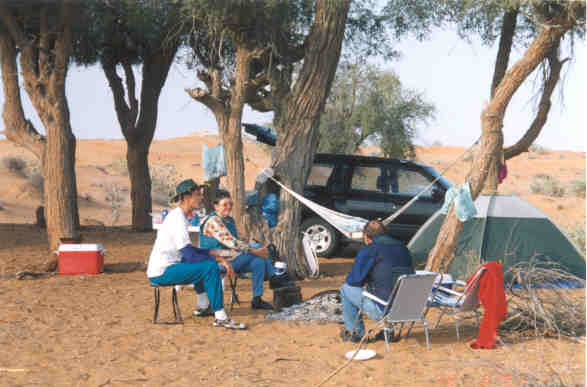
"I pity the man who can travel from Dan to Beersheba and cry 'Tis all barren!" (Lawrence Sterne, 1713-1768) The desert has always fascinated me. All that sand, the sinuous shapes of the dunes, the shadows that lean one way and then another, the clean air, the silence, the immensity of it all� I grew up surrounded by evergreen trees. Mountains wore layers of green. Rain poured down and snow fell in season, but when I got a vacation or a chance to go somewhere, I often suggested the desert. It may surprise you to know that the USA has many states with desert. Even as far north as Washington State, the entire central plateau was once dry land, complete with small cactus and tumbling tumbleweeds rolling along in the sandy soil. The advent of irrigation brought orchards and wheat fields into the land that was once desert, but you can still find traces of it. "High desert" we call it. As you drive south into central Oregon state, there is more high desert. Backtrack along the faint wagon tracks left along the Oregon Trail by hopeful settlers and then head south and you will soon come to the two large deserts that stretch across the American southwest, the Mohave and the Sonora. In those beautiful deserts, some filled with saguarro cactus, some with joshua trees and smoke trees, some ablaze with magenta prickly pear blossoms in season, you can hear coyotes-wild dogs-singing to a night sky that holds more stars than you have ever seen in one time. Then we moved to the UAE, where there was desert in all directions, and which sat beside the magnificently solitary Rub Al Khalee, the Empty Quarter� It was only a matter of time before we gathered up enough camping gear here to get out into the deserts of Oman and the Emirates to try to reprise our other desert camping experiences. There were a few differences to consider regarding Middle East camping. You only have to see the hundreds of tire tracks crisscrossing the dunes to know that even remote areas get midnight visitors driving through. Were we safe from nocturnal "desert drivers?" We always tried to situate the tent so some big obstacle was there to protect us, but even so we had to wave flashlights and yell to the shebab that came rocketing by our tent in the dead of night. Could the car get us there and back, overloaded as we usually were? As you know, we often went out with camping friends, the Garretts, as a foursome, and we all liked our creature comforts. Tents, cushy mattresses, hammocks, coolers full of gourmet food�it all had to come. We tested the limits of all-wheel drive, but we always got atop the dune we wanted. Several times we had to try the desert-driving trick of letting some air out of the tires and having the passengers hike the last bit. Would we encounter any hostile creatures out there? We studied up on snakes, rodents, insects, spiders and poisonous plants of the Emirates, but in the end, the camels and the goats proved to be the most pesky. Goats made off with bread and fruit from our unattended camp, and camels insisted the shade was theirs. On our last official camping trip, a large, hairy camel spider put in a surprise appearance between the campfire and where Larry had been comfortably sitting eating coconut cake for dessert. The cake went one direction, Larry went the other, and the spider put on a burst of speed and headed right for our tent. Buddha would not have been happy with us that evening, as we did severe harm to a living thing, but camel spiders in your sleeping bags are not a good camping experience. Several hours later the widow of the late spider, only slightly smaller than her mate, leaped lightly onto the outside of our tent and pattered around looking for him in vain. I finally sent her flying with a swat from inside. We found Middle East camping surprisingly like the deserts of home, with a number of fine desert camping spots that were scenic and peaceful. Often the sand was reddish and rippled with wind waves, and there were ghaf trees or acacia trees for shade (and to hang the hammocks on), and Sodom's apple bushes for touches of green in the desert. Once the winter rains began, the deserts we camped in began to bloom, producing tiny white, pink and yellow flowers and shoots of tender green grass in the sand. The trees were suddenly full of miniscule leaves. We always brought the binoculars so we could identify the birds of the desert. At our last camp we had so many tiny purple sunbirds who sang to us the whole time that we named it "Sunbird Camp" in their honor. Besides birdwatching, the deserts are a fine place for starwatching. The night skies over the deserts of the Emirates are fantastic if you are anywhere away from the ambient light of cities or highways. Looking at the heavens leads to those familiar discussions of "How big is the universe," "What's the name of that constellation?" and "Is that a satellite or a UFO?" Now it's time to pack up and go back to the USA. We will truly miss this type of desert camping, though, even if we find other dunes and other trees full of singing birds. It is seldom as barren as you first think, and it bears a much closer look. Go with friends, as we did, to enjoy it together, or go for a solitary camp-out. You will find more there than you realized, plus a great sense of peace, tranquility and harmony with nature. |
|
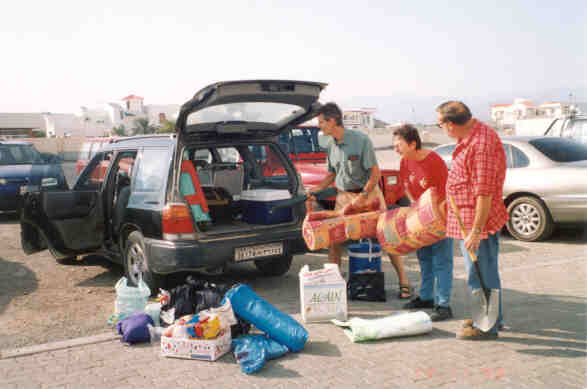 |
| "Are you sure this will all fit?" |
| "Ahhhh, it doesn't get much better than this!" |
 |
 |
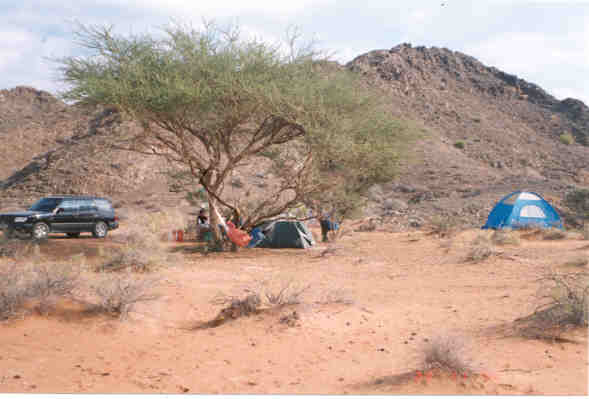 |
| Our Thanksgiving-Day campout, 2000, at Al-Ghail camp. Yes, we had turkey and all the trimmings. |