
By Rev. J. R. Middleton
The Gordons O' Girnoc
The Girnoc Farms
Past Research
Location Map
Gordon Tombstones
Sources
Home


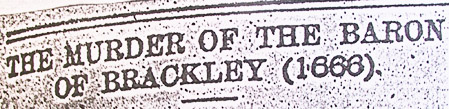
By the Rev. J.R. Middleton
Aberdeen 'Free Press'
13th November 1901
In the parish records of Glenmuick there are several interesting references to this tragedy, the occurrence of which nearly 240 years ago is continued in public memory by the traditionary ballad "The Baron of Brackley." The Ballad effectually preserves the memory of the event: it does very little in the way of giving anything like an authentic account of it. Fortunately, however, there are sources of information, which supplement and correct the ballad, and explain the following entries in the ecclesiastical records:
"16th December 1666 - The said day no worshippe, the minister being ar Edr as witnesse upon Bracklie's business."
"23rd December 1666 - The said day the minister his vice being to preach at Tullich, being come home upon Saturday night, immediately before the said day, and being wearied after travell, he preached heir upon Joh: 18 and 9."
For explanation of what "Bracklie's business" was, reference must be made to the Records of the High Court of Justiciary and of the Privy Council, before the former of which, on the 22nd of November of the same year a case came up for hearing in consequence of proceedings taken by Margaret Burnet, "relict of John Gordon of Brackley." At her instance "criminal letters" had been issued against:
William Farquharson Elder at Milne of Tullich,
Alexander Farquharson of Invercauld,
Charles Farquharson of Monaltrie,
And 19 others, from places so far away as Cromar and Towie,
Who were indicted for the murder of John Gordon, his brother and his uncle.
At the same time Duncan Davidsone in Dalmackathie, Alexander Young in Toldow, John Gordon in Dorsansillie, and 20others from place the names of which, in almost every instance, still survive in Glenmuick, were indicted for the muder of John MacKenzie in Inverey, Malcolm Gordon, and John McWilliam there. These cross actions were entered till 30th of November, when all parties and their witnesses were ordained to be present under penalty of 200 merks.
Such was the business that took the minister of Glenmuick to Edinburgh in December 1666; and the proverbial deliberation of the law, together with the length of time required to make the journey, explains how he came to be returning to his manse more than three weeks after the date when the case was first called in court.
We also know something of how he came to be a witness in the case at all. A document among the Invercauld papers (to which further allusion will be made) records the fact that he was sent by Inverey, apparently on the very day of the murder, as a messenger to Brackley, to convey to the Baron, Inverey's news in regard to the matter which was in dispute between them. It may not be necessary to seek for any explanation of such a commission beyond the circumstance of the minister's official position. Even now ministers are often entrusted with curious confidences, and are employed in delicate negotiations between estranged friends; and in that age they still more frequently played many parts, medical and juridical, as well as their proper part of ghostly counsellor. But there may be a special reason why the minister of Glenmuick was on this occasion employed as intermediary by Inverey. His name was Ferguson. His neighbour in the Kirk of Crathie was a Ferguson too - the ancestor he was, by the way, of the ill-fated Robert Fergusson the poet. Ferguson of Crathie's daughter Agnes had married James Farquharson of Inverey, and had become the mother of the fierce youth who made the attack on Brackley. What more likely than that the ministers of Glenmuick and Crathie were related, and that, therefore, in asking him of Glenmuick to be his deputy to Brackley, Inverey was asking the good offices of one who was more or less closely connected with his house?
Be that as it may, Ferguson went to Brackley, and for aught that appears to the contrary, may have been an eye-witness of the tragedy. He, at all events, knew the circumstances that led up to it, and was in a position to give important evidence as to the matters in dispute, and as to the relations subsisting between the two lairds. His position as an intermediary we may well believe to have been no enviable one; and even as witness his truthful testimony, which ever side it opposed, was very likely to get him into trouble. We know for a fact that his soul abhorred the contentious, violent, murderous habits which prevailed around him in his upland parish; so much so that he determined not to give his sons a University training, but to bring them up to mercantile pursuits, which would secure residence in the well-ordered community of Aberdeen, where throughout the eighteenth century representatives of his family continued to be coopers and burgesses of the city. The family has now no living representatives of the name Ferguson, but through the female line, it still survives in a distinguished son of Bon Accord Mr John Wright Duff, Professor of Classics in the Durham University College of Science, Newcastle.
As to the case before the Court, neither Ferguson's evidence nor any other that was available, was enough to make the issue clear. Inverey petitioned that "the matter might be recognised by the Lords of the Privie Counsell," and for delay "while the precognissione take effect"; the widow gave her comment on the condition of "being secured from any further injury or violence from the persons pursued in the meantime"; and Inverey was accordingly taken bound to that effect under a penalty of 5000 merks, and all parties were directed to appear on the 4th June following.
On that date (4th June), however, no sederunt of the Privy Council is recorded, and the case is not actioned in the records of that body till the 2nd of July 1668, when on the petition of Francis Farquharson of Finzean, Brackley's widow agreed to a suspension of the process against him. This member of the Farquharson clan was not mentioned in the earlier summons, but it now appears that he too was one of the accused, and the charge is much more specific in his case than in the former document. He was accused of invading Brackley's lands "with eight score persons armed with swords, and weapons invasive, with a view to driving away the Baron's cattle"; and it was alleged that when Brackley and his retainers sought to rescue their property they were "shot and wounded, and immediately died upon the place." Finzean was therefore accused of being "airt and pairt" in the murder. But he repudiated the charge, declared his willingness to underlie the law, being innocent, he craved that the "dyet" might be deserted, and no new letters directed against him. The widow again gave her consent, and the Council accordingly grant and crave of the petitioner, and also grant relief of Alexander Beith of ---Beltie, Finzean's cautioner.
The next appearance of the case is a year later, 6th July 1669. On this occasion the summons names 37 persons, all those discussed at first hearing and nearly 20 more "with their associates to the number of eight score persons," and the charge is precisely the same as in the case of Finzean. Their petition is also the same as his, and the minute bears that this process: "being often called and continued from dyet to dyet, and the said Margaret Burnett being often called and not compearing, and the accused compearing by their counsel offering themselves to be ready to abide legal trial," the Justices thereof desert the dyet against them. Thereupon the accused "took instruments and protested for relief of their respective cautioners, which the Justices admitted."
In this not very satisfactory fashion, the case against the murderers of the Baron of Brackley appears to have taken end, so far as the reported proceedings of the Privy Council show. But that it continued to trouble Inverey for a number of years thereafter seems certain from documents that are still extant. Two such documents have been found by Dr John Taggart (?) among the Invercauld papers, and are printed, as transcribed by him in the fourth (?) volume of Reports of the Historical MSS. Commission. One of these is of date 1685, and is a warrant by the Lord Chancellor for the apprehension of John Farquharson of Inverey and others, his followers, who had been outlawed for not compearing at their trial, and had subsequently continued for many years in their "outlawry, associating with themselves a company of thieves, murderers and sorcerers." But there is nothing to identify the case; and Professor F. J. Child, of Harvard, who discusses the matter in his English and Scottish Popular Ballads, is disinclined to admit its identity with the case of Brackley nearly twenty years before, remarking, "Unless he were of an unusually peaceable habit Inverey might in such a time have had several broils on his hands." That is true, but as tending to confirm Dr Stuart's opinion that the warrant in question applies to Inverey's connection with Brackley, there is to be taken into account the fact that the second document quoted bears so late a date as 1677, and is a "memorandum for John Farquharson of Inverey and others," giving the story of the Baron's slaughter from Inverey's point of view, and also in order to controvert it, the view of the Baron's representatives. The date of this memorandum is important. It shows that eleven years after the event, there was still some reason for Inverey making a defence of his conduct, that is at a date more than half-way towards the year 1685, when a warrant was issued for his apprehension. The probabilities do not therefore appear to be entirely on the side of Professor Child - indeed, when it is remembered that Inverey or his friends have still occasion to argue in his defence in 1677, and that in 1685 the warrant expressly states that he had "continued many years in his outlawry," one is inclined to think that the probabilities are rather on the side of Dr Stuart. However it may have been, the warrant leaves no doubt as to Inverey's character, and suggests the reflection that if his friends did not steal Brackley's cattle and murder their owner, such proceedings were at least entirely in keeping with his mode of life!
Apart from the inferences to be drawn from its date, the memorandum is of great interest in respect of what it tells us of the cause of dispute between these two Deeside worthies of a by-gone age. Briefly, the facts are these: Inverey and his people had been found guilty by the Sheriff of Aberdeen of "killing black fish" (that is, taking Salmon out of season), and had been sentenced to pay a fine. But it was one thing for the Sheriff to pronounce sentence, another thing to secure payment of the money. To make his decision take effect in Braemar was evidently beyond his power. For, instead of dealing directly with the offenders, he sold to Brackley the fines exigible from them, leaving it with the Baron to recover them as best he could. Herein was the beginning of trouble. With others, Inverey maintained, the Barron settled on friendly terms, but declined to do so with him; whereupon being on his way to the market at Tullich, he sent the minister of Glenmuick and two others as messengers to say to Brackley that he was willing to settle the fines on the same terms as had been allowed to others. This offer Brackley rejected; convened his followers while the matter was being discussed; and, having done so, attacked Inverey - or, as it is more forcibly expressed in the contemporary document, "loused several shots upon him and his followers." In necessary self-defence shots were returned, and, in the issue, three men were killed on either side.
When told from Brackley's point of view, the story takes this form: - Inverey convoked his people to be revenged on the Baron for putting the law in execution against him. He came with an armed force to the house of Bracley and required the laird to restore the cattle that had been poinded in payment of the fines. The Baron gave a fair answer, yet the Farquharsons drove away not only the poinded cattle, but, in order to draw him from his house, Brackley's own cattle also. While endeavouring to rescue these cattle the Farquharsons fell on him and murdered him and his brother.
The memorandum proceeds to controvert this version of the affair, and accounts for Inverey's presence on Brackley's land with an armed force by the fact that he was then the "Captain of the Watch," and that he and his ancestors had been in use to attend the market at Tullich with a like number of men to guard it, and so on. But this explanation does not very satisfactorily dispose of the presumption against him. The Castle of Brackley was not on the direct road from Braemar to Tullich. To reach it implied a considerable digression from any probable route, and Inverey must forever lie under the suspicions which that fact creates as to his motives and intentions. Certainly on the point - particularily in view of the inconclusive proceedings in Court - it seems impossible to reach. No other evidence helping towards a judgement appears to be procurable. Every reader must judge for himself. But probably most will conclude that the presumption is altogether against Inverey's having marched to Brackley with pacific intentions. Had he gone accompanied only by the peace-loving Ferguson, while his armed retainers were marched to Tullich, it would have been possible to give credence to the story of the memorandum. But to make a business call attended by eight score armed men is not convincing evidence of the latter's peaceful intentions, or as to the friendliness of spirit in which, on that far-off September morning:
Inverey cam' doon Deeside whistlin' and playing',
And was at brave Bracley's yetts ere it was dawin.
Such is the opening stanza of the ballad, to which scarcely any reference has yet been made. So far, we have dealt with the facts, not with tradition. But the story as told in the ballad in its four-fold form is full of points of interest, some of which will be dealt with in a second paper.
Part II - 22nd November 1901 - The Aberdeen Free Press
To one who desires no more than the bare historical facts of the case as they are to be gleaned from the authentic records of the Privy Council, and have been already stated, the ballad is of little use, being wholly unreliable as a historical authority. But nevertheless it has an interest and an importance of its own, as will be found by anyone who is fortunate enough to secure perusal of the costly volumes by Professor F. J. Child, of Harvard, on the English and Scottish popular ballads. In that work four versions of the Baron of Brackley are printed, not one of which harmonises in every particular with all the rest. The result is a bewildering diversity of detail, through which, however, Professor Child pilots the reader in a masterly analysis.
Of the points raised only a very few can be noticed here, one of which is as to the identity of the lady who was the wife of the Baron of 1666. In the Deeside Guide version, that known most to Aberdeenshire readers, she is called Catherine Fraser, and the picture presented of her character is by no means a favourable one. She is represented as practically in league with her husband's murderer. The Baron is unwilling to begin the conflict, having a presentiment as to its issue. But he is driven into it by the taunts of his wife:
"Gin I had a husband, whereas I hae nane,
He wodna lye in his bed and see his kye tane,
Sea rise up, John," said she, "and turn back your kye,
Or me and my maidens, we will them defy."
Stung by this cruel sarcasm, he goes out to his fate. He and his brother and uncle are slain; and then the unnatural woman is represented as:
"Rantin' and dancin' and singing for joy,
And vowin' that night she would feast Inverey.
She ate wi' him, drank wi' him, welcomed him in.
She drank to the villain that killed her Barrone;
She kept him till mornin' and bade him be gane,
And showed him the road that he mightna be ta'en.
Now, in the facts of the case as disclosed by the legal documents already quoted there is no shadow of evidence to justify so unpleasing a picture of the lady of 1666. The wife of the Baron of that date was not "Kate Fraser," as she is called in the stanza:
Wae to you, Kate Fraser, sad may your heart be,
To see your brave Barrone's blood come to your knee.
She was Margaret Burnet (Peggy, as she is correctly called in one version, but not Peggy Dann, as she is wrongly called in another), and her family connections are known. She was the daughter of Sir Thomas Burnet of Leys, and own cousin to Gilbert Burnet, Bishop of Salisbury and historian, intimate friend and trusted counsellor of William and Mary - one of the sons of Aberdeenshire, of whom all Aberdeenshire men are proud. She is believed to have married Brackley against the wishes of her friends, so that the marriage was probably one of affection and not a "marriage de convenance," out of which such conduct as the ballad suggests might more readily have sprung. Moreover, a second marriage to one James Leslie, a doctor of medicine, still further discountenances the alleged scandal.
In this manifest confusion of two or possibly three ladies of Brackley there is evidence that the ballad is not a homogeneous document, but is an amalgam of verses which originally referred to totally different times. This evidence is strengthened by other inconsistencies with known facts - for example as to the scene of the slaughter. The indictment already quoted from the Privy Council Records, makes it almost certain that the Baron and his friends fell in the immediate neighbourhood of the castle - they "died upon the place." As soon as the ruse of driving away his own cattle succeeded in drawing Brackley from his house, outside the protection of the castle walls, he was set upon and slain. Local tradition is in harmony with that historical statement, but no person living in the neighbourhood can now point to the spot, though Dr Joseph Robertson, writing the Deeside Guide in 1832, was able to say that it was known to him. The ballad gives no help here. It rather darkens counsel, for it says:
When they were assembled on the castle green
Nae man like brave Brackley was there to be seen.
"Strike, dogs," cries Inverey, "and fecht till y're slain,
For we are twice twenty and ye but four men."
These lines agree with the legal document, but not so what follows:
At the head o' Rineatan the battle began,
At Little Aucholzie they killed the first man.
A Stanza which seems to remove the encounter to a totally different place. Of a place called Rineatan in Glenmuick nothing is known. But one of the versions gives "Etnach" for "Rineatan," and this makes a possible sense. Etnach is just over the hill from Brackley, in Glen Tannar, and was a possession of the Baron, for the safety of the cattle there, forms one of the anxieties of his wife:
There's four-and-twenty milk-white nowt, twal o' them kye.
In the woods of Glen Tanner, it's there that they lie:
There are goats on the Etnach, and sheep on the brae,
And a' will be harried by young Inverey.
The inference from these lines, read along with the last two quoted, would be that Inverey's people drove away the stock from Etnach, were attacked immediately on doing so, a running fight - a rearguard action - was fought by the thieves as they drove their booty westwards towards Braemar, and then the pursuit becoming closer when they reached Glenmuick, they made a stand near Aucholzie (a mile below the falls), where the Baron fell. In itself that makes a consistent and intelligible story, but it does not square with the authentic particulars of the Privy Council minute.
There is similar discrepancy as to the numbers engaged in the affair. Thus, in his challenge to the Baron, Inverey says - "We are twice twenty and ye but four men"; or, still more formidably - "We are four hundred and ye but four men." Another version gives - "Wi Inverey were thity-and-three: there was nane wi' the Baron but his brither to be."
Another:
Twa gallanter Gordons did never sword draw,
But against four-and-thirty, waes, me, what was twa?
And yet another:
There were wi Inverey twenty and ten;
There was nane wi' the Baron but his brither and him.
Additional arithmetic subtleties are numerous, but none of the figures of the ballad come near the "eight score" of the legal document, to the authority and superior credulity of which readers of an unromantic temperament will doubtless incline.
One other incongruity between the story of the ballad and historical fact must be referred to. This occurs in the stanza:
Then up cam' Craigievar, an a' party wi' him:
Had he come ane hour sooner Brackley hadna been slain.
Hence there is implied a friendship - an alliance - between Craigievar and Brackley. But Professor Child draws attention to the fact, noted also by Dr Joseph Robertson, that Craigivar passed to the family of Forbes in 1625, and that between the Forbes and Gordons there was not in 1666 alliance, but feud. Hence it is impossible to believe that even if Craigivar had arrived on the scene at the juncture indicated his presence would have brought any help to Brackley. They were enemies, and Craigievar would have been very little disposed to intervene.
This anachronism, together with the other inconsistencies referred to, as well as many more mentioned by Child, shows conclusively that the balled mixes up the events of at least two murders, and possibly three or four! There is substantial evidence that a previous Baron was murdered in 1592 by the Clans McIntosh and Lamont, the victim then being a very aged man, one given to hospitality and of blameless life, who was fallen upon in his house after entertaining his murderers, all unconscious that they had any ground of hostility towards him. To his fate very aptly apply the stanzas:
What sichin' and sobbin' was heard in the glen,
For the Baron o' Bracley, wha basely was slain.
Frae the head o' the Dee to the banks o' the Spey,
The Gordons may mourn him and ban Inverey.
But there is not similar reason, as we have seen, for charging baseness and treachery against Inverey in 1666. The incidents of the two tragedies are blended, and naturally enough those of the earlier event are attributed to the later. Nor, as has been said, are these two the only events of the kind that have contributed something to the ballad. A supplementary note to Child's work asserts that the ballad in one or other of its forms possibly contains references to four distinct events; and in support of a theory which implies such a disastrous fate for successive Barons of Brackley, he cites Mr William Anderson's work on Genealogy and Surnames, where, under the name Gordon, the statement is made that there was "a line of nine Barons, all of whom, in the unruly times in which they lived, died violent deaths." This sounds a little too wholesale for probability. But if there be even a half-truth in it, it is easy to understand how the ballad in the course of oral tradition (it was not printed in any form until 1806) came to embody particulars relative to wholly different events.
The people of Upper Deeside two and a half centuries ago were doubtless very familiar with violence and bloody conflict such as took place at Brackley in 1666. But it would appear there was something in the circumstances leading up to that event, or in the manner of the event itself, that caused it to have a specially hurtful influence on the social life of the community. It embroiled and embittered the people of the district for years, and the church records bear evidence of the fact in a form that would not have been expected. The Sacrament of the Lord's Supper was at this period usually celebrated once a year. But in May 1667 we find "the minister and elders judged it fitt that the Sacrament of the Lord's Supper should not be celebrated because of the animosities betwixt the three pariochines." And what the animosities were about is made certain by a similarly worded minute of April 1668, when communion was again deferred "because of the animosities about Braichlie's death." The dispute was primarily inter-tribal - Farquharsons versus Gordons; but as it happened, in the neighbourhood of Brackley the tribal division practically coincided with the parochial. The Dee flowed between the hostile communities, those on the north being retainers of Inverey, those on the south, of Brackley, the former parishioners of Tullich, the latter of Glenmuick. Though the parishes were before this time united and under the charge of one minister, they still and for long after continued to have their separate churches, where the people worshipped quite apart. The only exception to this rule was the Communion Sunday, when once a year the people of Glenmuick, Tullich, and Glengairn met together at the church of Tullich. Why should they not have so met in the year following Brackley's death? Was it because the strife-abhorring Ferguson feared for the guilt his people might incur of coming with malice and hatred in their hearts to commemorate Him who was the Messenger of Peace? That fear very likely weighed with the minister and his elders. But they had also no doubt before their thoughts a still more obvious danger - that, namely, of a probable fresh outbreak of the strife and conflict of September 1666. Farquharsons and Gordons were at the time as fire and water - conflict was the inevitable result of their coming together even though the place was the church and the occasion the Sacrament of the Supper!
That so it should have been gives a melancholy picture of the times, and makes it probable that Ferguson had but too good reason for his resolution not to allow his sons to enter a profession which required him to live among and to come into constant contact with parishioners who were forever ready to fly at each others throats. In a Christian community it was a pitiable state of affairs, and one which may well make us thankful for the progress the Gospel of Peace has since made in its divine mission. In this twentieth century it has uplifted the community from savagery to order and from cattle-rieving and murder to security of property and of life. The average moral level has been infinitely raised, though individuals (even classes, perhaps, one must sorrowfully admit) fall sadly below it. And a survey of the two and a half centuries since "Inverey cam' doon Deeside whistlin' and playin'" inspires the hope that another century may suffice to eliminate at any rate the grosser forms of offence that still remain as blots upon social and church life in the dawn of the twentieth century.
J. R. M.