| LEXICON |
| AIR. Generally similar to the Earth definition, although the term can be defined as �empty space� or �nothingness�. Used to reference space when referring to small craft operations. From the Greek aer-, from aEr. AGRO. The term is used to refer to agriculture and its accoutrements. The term utilizes the first four anglicized letters of the Greek word for agriculture. A derivation is AGRON. ALCOHOL. As a beverage. Ale and ambrosa are the two main Colonial alcoholic beverages that are seen repeatedly in the series, although others are mentioned. Ale is probably similar to what we know of as beer, being a malted grain beverage flavored with hops and brewed by slow fermentation, with moderate alcohol content (3 to 8 %). Ambrosa is more problematic in establishing its make-up. It is known to be an aged beverage, with some vintages being better than others. This, and the fact that ambrosa is aged in the bottle and not in a larger container suggests a wine or mead-like drink, perhaps something mildly sweet and fruity. If these two are indeed essentially beer and wine, it again fits well with their culture model, as wine was extremely important in Hellenistic Greece, as was beer to the Egyptians. ANDROID. An animate construct designed to closely resemble or even mimic a biological organism. Androids may be totally synthetic (true robotic), or may be partially or totally biological (bio-robotic). Derived from the Greek androeidEs, meaning �manlike�. While the Colonials apparently have extensive knowledge of such creations, and are very adept in android studies at the Colonial Bio-Robotics institutes, we are only made aware of those that exist in the fleet as they appear in the robotics lab in various states of assembly, where some indeed look very human. This coupled with Apollo and Starbuck�s reactions to Hector and Vector suggests that while androids are not commonplace within Colonial society, they are not so unknown as to be disconcerting either. Given the Colonial philosophy on such sophisticated machines, it is probable that fail-safe mechanisms are built into Colonial models. Perhaps limited life spans? ANTI-BURN BAFFLE. The protective structure between the cooling and logic module and the containment bottle/burner assembly on the Colonial Viper�s three engines. |
| A |
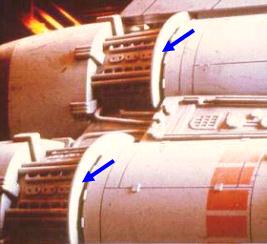 |
| Starboard View Close-up, Mk II Viper. The Anti-Burn Baffles are indicated. |