











|
|
|
|
|
|
|
|
|
|
|
|
|
|
|
|
||||||||||||
|
|
|
|
|
|
|
|
|
|
|
|
|
|
|
|
|
|
|
|
|
|
||||||
| solutions:: Action Plan of GIDOC Part(2) | |||||
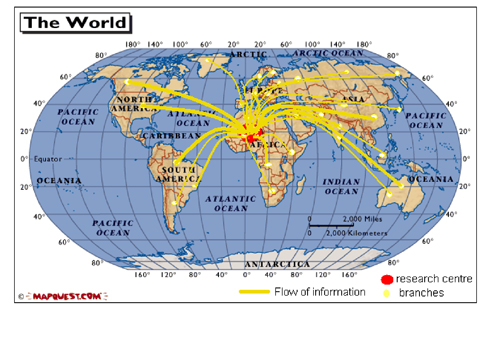
Research Research on infectious diseases was done in many different countries - there are all sorts of medicine, curing methods and techniques. GIDOC would serve as the centre of medical research work, setting up an effective and complete connection for the sake of global health. GIDOC would have its own research centre. Experts and specialists from different countries would be able to gather and work together. This cooperation could enhance and inject more collaboration into the invention and development of new ways to control certain infectious diseases. It would also disseminate research work to different collaborating research centers accordingly, so that these centers could focus on the field of their expertise, thus increasing efficiency. It would receive the most updated news and first-hand information from all research centers and laboratories in the world. This could organize the research work to avoid overlapping. Mapquest Copyright reserved: http://go.hrw.com/atlas/norm_htm/world.htm Infectious diseases needing extra focus would be identified as well. It would gather all the necessary details and inform health departments of different countries of the latest conditions. This could be implemented by having branches in different parts of the world. Countries would then form an intimate, rigid network through the coordination of this organization. In order to establish procedures and capability for systematic analyses of diseases, authorities taking charge should have adequate competence in the management and inspection of the system. Last but not least, to allow the functioning of these purposes, sufficient resources, namely capital, human labor and medical research equipments, should be allocated with contributions from different countries, especially the more developed ones.
|
|||||
Immediate Medical Help International collaboration is needed for rapid prevention and containment of infectious diseases. Global health organizations should be able to coordinate and establish the responsive measures that should be taken by countries or regions when an outbreak of a disease occurs. National strategies to safeguard against the danger of a pandemic would be introduced and technical assistance would be provided when needed. Guidelines are set up by GIDOC for governments to address the situation through planning and conducting research on emerging diseases; greater monitoring, and full transparency in reporting cases. |
|||||
Research and Planning National emergency plans would be reviewed frequently and regularly in order to assimilate new scientific knowledge in this fast-moving field. Countries should be ready to respond to a potential pandemic. When there are outbreaks of infectious diseases, countries should be able to take appropriate actions promptly to avoid the spreading of the diseases. The characteristics of an emerging pandemic should be assessed thoroughly by conducting research. An early warning system with effective responsive measures can then be set up. Resources collected from all over the world should would be centralized by GIDOC and mobilized appropriately to improve the readiness of key nations and international organizations to a potential pandemic.
|
|||||
Training A competent health workforce is needed for a global health system to function effectively. The supply, capacity and distribution of the present health workforce have to be improved greatly. |
|
||||
|
|||||
Transparency Countries should be encouraged to report any information concerning diseases detected immediately and clearly so that sufficient resources can be allocated. Other countries could then obtain information and set up measures to prevent the outbreak in their regions.
|
|||||
Improving International Co-operation Signing of Treaty As the saying goes, no man is an island. No one could ever survive alone. The same applies to a country. Every single country on the world map is inter-related in the sense that one would affect another and vice versa. For instance the US imports garments from Hong Kong while Japan exports cars to China. Without international trade, comparative advantage could not exist, the absence of which would only do both involved parties harm. Nowadays, multi-point production is getting more prevalent and an increasing number of transnational corporations are being set up. For example, the headquarters of a company is located in an international city while production sites are set up in other lower-labor cost regions. These all exemplify international cooperation. However, why is such kind of mutually beneficial cooperation constrained to trade only, but cannot be applied to combating infectious diseases together? |
|||||
To put the above ideas into practical implementation, signing of a treaty is proposed which aims at promoting international cooperation in dealing with global infectious diseases together as a united party. The following will be stated in the treaty: Each allied country is required to accomplish mandatory goals which are set according to its own country's conditions but the goals can generally be divided into two standards: standard for less developed countries and standard for more developed countries. Certainly the goals are related to health management and control of infectious diseases. For example, health education regarding AIDS transmission and safety measures against Avian Influenza has to be practiced among citizens, medical supplies have to be sufficiently in stock all the time, regular documents reporting local health situations have to be submitted to GIDOC. In times of disease outbreak, each country should announce the news immediately and GIDOC would coordinate the situation and allocate help from other member countries if the involved country needs any. |
|||||
In addition, each member country would be evaluated to see if she is capable of providing financial help to other developing countries. This measure is in line with the main purpose of the treaty: To promote international cooperation. The assisted countries could in turn offer other benefits to the assisting countries; say for example, lower tax payment could be offered. In fact GIDOC is the facilitator which helps both parties to reach a mutually beneficial compromise. At regular meetings each member country's progress or performance would be reported and should any one fail to reach the stated goals she would be penalized resulting in a breach of international status. GIDOC could propose this treaty at a global leaders' conference and convince each and every country to sign by conveying to them the importance of international cooperation and of course the benefits of it like a more ideal global healthcare system in turn creates a happier living environment, negative costs of the infectious diseases are eliminated, more resources could be allocated to economic and social development, and one's international image is promoted and so on. |
|||||
Installation of Mentoring Scheme A mentoring scheme would be developed to help developing countries in improving their healthcare situation. It might be difficult to be carried out as more developed countries tend to focus on the welfare of themselves rather than that of others, they could not visualize the fact that infectious diseases like AIDS are highly contagious or they simply might have belittled the transmittable power of infectious diseases. Measures taken like reinforcing custom checks while ignoring the needs of others reveal the misconception that their country can indeed be an island. How to eradicate such selfish thoughts and infuse the importance of international co-operation into the minds of these people? GIDOC would be responsible to take the initiative to call upon the attention of the world on the seriousness of the disease and effectually convince them the need of international co-operation. In fact, the situation is exactly the same as that of global warming. It's futile for one country to use renewable energy while another country uses petrol. In other words, is it better to have an AIDS-free world or one part of the world being healthy while having one person killed by AIDS every 2 seconds in another part? The idea of this mentoring scheme is that all parts of the world - either developed or developing would join together in fighting against infectious diseases. The situation of infectious disease control is always worse in developing countries; hence all voluntary organizations and individuals tend to put in more effort in helping them by donating money and offering medical resources. Sometimes, the distribution of medical resources is not even and systematic enough to improve the situation in developing countries. By matching a developed country with a developing country, the developed country would be responsible for helping the developing country in raising its healthcare standard. GIDOC would act as the bridge between the two and advice the developed country on how to allocate a small part of its medical resources to help the developing country for example. In doing this, each and every developing country is made sure to have a certain extent of medical backup and corresponding developed country could respond quickly to the need of the developing country. When each pair of developed country and developing country works well, the global healthcare standard could be more even; each country could deal with infectious diseases more effectively and efficiently. |
|||||
| next page:: Action Plan of GIDOC Part(3) |
|||||
|
|
|
|
|
|
|
|
|
 |
|
|||||||
 |
 |
 |
 |
 |
 |
 |
 |
|
 |
 |
 |
 |
|
||||