











|
|
|
|
|
|
|
|
|
|
|
|
|
|
|
|
||||||||||||
|
|
|
|
|
|
|
|
|
|
|
|
|
|
|
|
|
|
|
|
|
|
||||||
| solutions:: Action Plan of GIDOC Part(3) | |
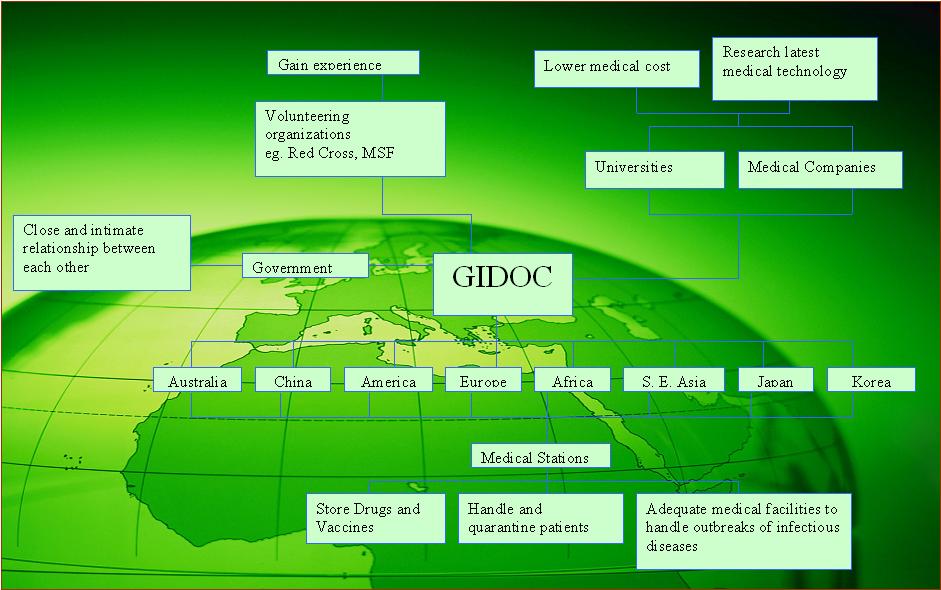
Centralization and Allocation of Medical Resources The large amount of resources would be utilized for two main purposes: to prevent massive outbreak of infectious disease from happening, and to prepare a solid yet flexible system that can contain the most dangerous outbreak in case the worst really happens. The allocation of the resources would be planned by the GIDOC, regions instead of cities as units, which would help to utilize the resource much more efficiently as the places within the same region would share the same climate and pattern of infectious disease. To prepare a region in controlling the outbreak of infectious disease, GIDOC would invest on regional 'medical stations' with adequate infectious control facilities where the infected patients in the outbreak could be quarantined and treated centrally, minimizing the chance of spread of the outbreak. These medical stations, , could also be used to store drugs and vaccines for the most prevalent disease that affect the particular region. It is to make sure the region has a good back-up of medical resources in case any outbreak occurs. In order to achieve the most effective outcome, GIDOC would cooperate with organizations such as MSF or Red Cross, as they have invaluable experience through-out their many years of work in the region. To make sure the safety measures are implanted efficiently, it is also necessary that GIDOC would have to have a close working relationship with the local government.
Besides region-specific allocation of resource, GIDOC would invest in the exploration of medical techniques, preferably in cooperation with drug companies or universities. It is to make sure the organization would always be in the leading role in winning the battle against ever-changing infectious pathogens. Having a close relation with the companies and universities would enable GIDOC to catch up with the latest development of medical technology, enabling modification of planning whenever necessary. Meanwhile, as GIDOC would contribute in the exploration of new drugs and medical technologies, it would help in lowering the cost of buying drugs as GIDOC would be one of the contributors in the first place.
|
|
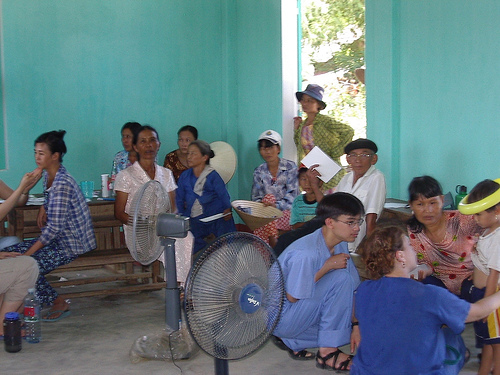
Regional Medical and Monitoring Stations In less developed and developing countries, since the governments put little emphasis on medical care for the people, voluntary organizations take initiatives in setting up primitive clinics to provide medical help to those people in need. However, due to the lack of cooperation between the 2 parties -governments and voluntary organizations, many clinics are forced to close down, some establishment plans of clinics in those countries might even be banned. Therefore, GIDOC could act as mediator as a middleman in negotiating with governments and voluntary organizations, so as to reach a common consensus on an issue. Through negotiations, the 2 parties could then understand more about one another's role and so cooperation between the 2 parties could be enhanced. The voluntary organizations could then obtain permission in setting up clinics from the governments more easily. |
|
| Also, in case of a breakout of a disease, the governments could then cooperate and give help to the clinics to halt disease spread. Moreover, GIDOC could also help to monitor the quality of health care of those clinics to the public by setting up regulations and guidelines for voluntary organizations, so that the public could acquire basic medical care services close to the standard of those in developed countries. | |
In addition, through communication and cooperation between GIDOC and voluntary organizations, comprehensive prevention campaigns against diseases could be conducted and the diseases could be treated more efficiently and easily to prevent their spread by providing medical information and help to voluntary organizations. In so doing, the continuity and effectiveness of the clinics could be maintained.. Therefore, with GIDOC managing regional medical and monitoring stations, the development of the health care in the world could be balanced and so, the less developed and developing countries would not be vulnerable to diseases.
|
|
next page:: about:: The Project |
|
|
|
|
|
|
|
|
|
|
 |
|
|||||||
 |
 |
 |
 |
 |
 |
 |
 |
|
 |
 |
 |
 |
|
||||