|
|
More on this:
Reprogramming of human fibroblasts to ESCs achieved
UW-Madison scientists also guide human skin cells to embryonic like state
Yamanaka Turns Human Fibroblasts to ESC-like Cells
Turning
adult cells embryonic
Friday, 08 June 2007
Study
Identifies 5 Genetic Themes Key to Keeping Stem Cells in A Primitive,
Flexible State
Wednesday, June 20, 2007
For more than 25 years, stem cells have been defined based on what they can
become: more of themselves, as well as multiple different specialized cell
types. But as genetic techniques have become increasingly powerful, many
scientists have sought a more molecular definition of stem cells, based on
the genes they express.
Now, a team of Canadian scientists has identified 1,155 genes under the
control of a gene called Oct4 considered to be the master regulator of the
stem cell state. A comprehensive molecular definition of stem cells is
emerging: according to this research, stem cells are cells that keep their
DNA packaged in a flexible format, keep cell division tightly controlled,
prevent signals that might trigger death, repair DNA very effectively, and reinforce
all of these characteristics by tightly controlling how molecules can move
within the nucleus. The study will be published in the June 20 edition of
the online, open-access journal PLoS ONE.
“You could call this a
‘theory-of-everything’ for stem cells,” said senior author Dr. Michael Rudnicki, referring to the
often-cited theory of everything for physics. Dr. Rudnicki is a Senior
Scientist and Professor at the Ottawa Health Research Institute and the
University of Ottawa. He also leads the Sprott Centre for Stem Cell
Research in Ottawa and Canada’s Stem Cell Network.
While previous studies have tried to compare gene expression in different
types of stem cells, the strategy used in this study was unique. Rather
than simply searching for any genes expressed by stem cells, the
researchers looked for genes whose expression was also correlated with the
master stem cell regulator gene Oct4. They also applied very rigorous
analysis methods, using data from StemBase, the largest stem cell gene
expression database in the world. Designed by bioinformaticist Dr. Miguel Andrade, the database
includes data from thousands of DNA microarrays submitted mainly by
scientists in Canada’s Stem Cell Network. All data is freely available at http://www.stembase.ca/.
Lead author Ms. Pearl Campbell
noted that understanding how stem cells maintain their identity is key to
the emerging field of regenerative medicine.
“These findings may help us to
understand how the key genes which control cell fate are regulated, and
how, when dysregulated, they can lead to disease. This may ultimately allow
us to develop targeted therapies to stimulate adult stem cells within our
own bodies to repair damaged tissues, and may provide further areas of exploration
for the treatment of cancer.”
Reference:
- Oct4 Targets
Regulatory Nodes to Modulate Stem Cell Function
L.
Ed.
CellNEWS
2007-06-20
How to Make Stem Cells Stay Growing
Stem cell researchers find 'master gene'.
Friday, 30 May 2003
In a report published in Cell this week, scientists from the University of Edinburgh identify a new protein central to the unique properties of embryonic stem cells. The report reveals that the protein Nanog, named after the mythological Celtic land of the ever young 'Tir nan Og', is required for the special ability of stem cells to multiply without limit while remaining able to make many different types of cell.
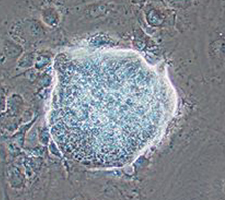
Mouse embryo stem cells grown on a layer
of feeder cells.
Photo by the courtesy of S. Yamanaka.
|
Embryonic stem cells are fundamental to the normal development of all tissues and organs in the body. They are unique because they can divide to produce identical copies of themselves and, under certain conditions, can differentiate into other types of cell in the body. A central goal in stem cell research is to understand how this choice between self-renewal and differentiation is determined so that one day stem cells may be used to generate new tissues for damaged or diseased organs. Until now, very little was known about the molecular mechanisms that determine stem cell behaviour. This new finding establishes a fundamental role for Nanog in controlling embryonic stem cell identity.
The research group at the Institute for Stem Cell Research, University of Edinburgh has shown that the Nanog gene, which is only expressed in pluripotent cells, plays an essential function in maintaining stem cells. Dr Ian Chambers who isolated the Nanog gene said:
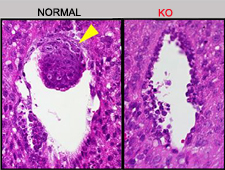
The left panel shows a normal mouse
embryo with pluripotent epiblast (arrow),
which is completely absent in mutant
Nanog-null embryo’s (right).
Photo by the courtesy of S. Yamanaka.
|
"Nanog seems to be a master gene that makes embryonic stem cells grow in the laboratory. In effect this makes stem cells immortal. Being Scottish, I therefore chose the name after the Tir nan Og legend."
The Edinburgh paper is published along side a study from Dr Shinya Yamanaka from the Nara Institute of Science and Technology in Japan. The two groups realised they had discovered the same gene last year and have since collaborated to bring this work to completion.
These results are significant because Nanog is likely to control other genes linked to both self-renewal and pluripotency. Understanding how Nanog works may ultimately explain the unique properties of embryonic stem cells. It is hoped that this will lead to reliable identification and growth of stem cells in the laboratory.
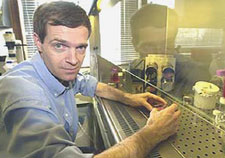
Austin Smith at his sterile hood, culturing
stem cells.
|
Professor Austin Smith leading the Edinburgh research team, said:
"This discovery is very exciting. If Nanog has the same effect in humans as we have found in mice, this will be a key step in the developing embryonic stem cells for medical treatments."
"Until now, pluripotency and stem cells have been a black box, really," said professor Smith.
"If we want to use these cells in the clinic someday, we have to understand how they are controlled. But there's been at least one major piece missing to even begin to understand that, which was
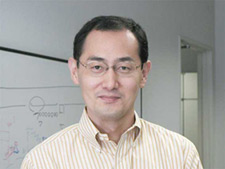
Stem cell researcher Shinya Yamanaka.
Photo by the courtesy of S. Yamanaka.
|
Nanog."
"No other previously identified important genes can match Nanog in the ability to maintain pluripotency," Dr Shinya Yamanaka said in an interview with Rick Weiss at the Washington Post.
He also added that Nanog’s discovery puts scientists "close to the summit" of understanding the essence of stem cells. However, he said, "We do not know at this moment how Nanog is regulated."
"When we solve this question, we will probably be on the top of the ladder," Yamanaka said. In other words, scientists have yet to identify the signal that tells Nanog to turn on early in an embryo's existence.
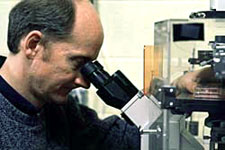
Developmental biologist James Thomson
in his Primate Research Center lab.
Photo by Jeff Miller, April 1999.
|
James Thomson, the University of Wisconsin scientist who first isolated human embryonic stem cells in 1998, commented the finding in Washington Post and said:
"As we know more and more about pluripotency, it probably will be possible to reprogram cells to make stem cells out of any cell in the body. This is an important step in that direction."
However, Thomson, as several others, warned that it would not be an easy task to obtain.
Source: Press release from the ISCR.
About The Institute for Stem Cell Research
is a multidisciplinary research institute focused on the molecular, cellular and developmental biology of stem cells. Our mission is to acquire an understanding of the mechanisms of stem cell self-renewal and differentiation processes and to provide scientific foundations for the application of cell replacement therapies in the treatment of human disease and injury.
About Nara Institute of Science and Technology
The Research and Education Center for Genetic Information are engaged in Functional Genomics, which aims to determine broadly the function of various genomic components. On the basis of genomic information and technology, they strive to determine the development and differentiation of microbes, animals and plants, and the molecular function of stress and environmental responses. In particular, Assoc. Professor Shinya Yamanaka’s group is centred around research and education about Stem Cells, Gene Targeting and Transgenesis, Regenerative medicine, and RNA processing.
|
|
|
Reference:
- The Homeoprotein Nanog is required for maintenance of pluripotency in mouse epiblast and ES cells.
Mitsui, K., Tokuzawa, Y., Itoh, H., Segawa, K., Murakami, M., Takahashi, K., Maruyama, M., Maeda, M., and Yamanaka, S. (2003).
Cell,
Vol 113, 631-642, 30 May 2003.
- Functional Expression Cloning of Nanog, a Pluripotency Sustaining factor in Embryonic Stem Cells.
Chambers, I., Colby, D., Robertson, M., Nichols, J., Lee, S., Tweedie, S., and Smith., A. (2003).
Cell,
Vol 113, 643-655, 30 May 2003.
|
|
