|
|
More on this:
Reprogramming of human fibroblasts to ESCs achieved
UW-Madison scientists also guide human skin cells to embryonic like state
Yamanaka Turns Human Fibroblasts to ESC-like Cells
How to Make Stem Cells Stay Growing
Friday, 30 May 2003
Turning Adult Cells Embryonic
Friday,
08 June 2007
Embryonic stem cells are unique because they can develop into virtually any
kind of tissue type, an attribute called pluripotency. Somatic cell nuclear
transfer (“therapeutic cloning”)
offers the hope of one day creating customized embryonic stem cells with a
patient’s own DNA. Here, an individual’s DNA would be placed into an egg,
resulting in a blastocyst that houses a supply of stem cells. But to access
these cells, researchers must destroy a viable embryo.
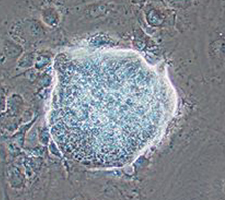
Mouse embryo stem cells grown on a layer
of feeder cells.
Photo by the courtesy of S. Yamanaka.
|
Now, scientists at Kyoto University, Whitehead Institute, Harvard
University and UCLA have all demonstrated that embryonic stem cells can be
created without eggs. By genetically manipulating mature skin cells taken
from a mouse, the scientists have transformed these cells back into a
pluripotent state, one that appears identical to an embryonic stem cell in
every way. No eggs were used, and no embryos destroyed.
“These reprogrammed cells, by all
criteria that we can apply, are indistinguishable from embryonic stem
cells,” says Whitehead Member and MIT professor of biology Rudolf Jaenisch,
senior author of one of the papers that appear online June 6 in Nature.
What’s more, these reprogrammed skin cells can give rise to live mice,
contributing to every kind of tissue type, and can even be transmitted via
germ cells (sperm or eggs) to succeeding generations.
“Germline transmission is the final
and definitive proof that these cells can do anything a traditionally
derived embryonic stem cell can do,” adds Jaenisch.
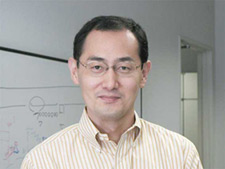
Stem cell researcher Shinya Yamanaka.
Photo by the courtesy of S. Yamanaka.
|
Nanog."
Shinya Yamanaka’s
group at Kyoto University in Kyoto, Japan, last year reported a landmark
discovery that by activating four genes in a mouse skin cell, they could
reprogram that cell into a pluripotent state resembling an embryonic stem
cell. They took ordinary skin cells from a mouse and reprogrammed them to
look and act like embryonic stem cells by introducing several pluripotency
genes into the cells by a retroviral vector.
In last year's article,
Shinya Yamanaka
and colleagues showed that a combination of four factors, Oct3/4, Sox2, Klf
and c-Myc, when introduced into mouse embryonic or adult fibroblasts,
yielded pluripotent cells that closely resembled embryonic stem cells. However,
the resulting cells were limited when compared with real embryonic stem
cells, and the Kyoto team was unable to generate live cloned mice or
chimaeras from these cells.
These cells, called iPS cells, where further selected for high Nanog
expression in the present studies.
The three studies published now, one
of which was led by Yamanaka, show various ways to select among
these fully pluripotent cells. To identify which cells had become
pluripotent, the groups looked for expression of the gene Nanog.
This marker pinpointed pluripotent stem cell lines that, when comparing
genetic and chromatin characteristics, more closely matched embryonic stem
cells than the cells generated in the 2006 article.
Stem cells selected in this way results in iPS cells where the four
transferred genes (Oct3/4, Sox2, c-myc and Klf4) were strongly silenced.
Rudolf Jaenisch
group, at the Whitehead Institute for Biomedical Research in Cambridge, Mass.,
used the same system as Shinya Yamanaka,
reprogrammed fibroblasts to a pluripotent state by in vitro induced
expression of the four transcription factors Oct3/4, Sox2, c-Myc and Klf4. They
then selected for Nanog-expressing
cells. They show that DNA methylation, gene expression and chromatin state
of such induced reprogrammed stem cells are similar to those of ES cells.
Notably, the cells — derived from mouse fibroblasts — can form viable
chimaeras, can contribute to the germ line (sperm or eggs) and can generate
live late-term embryos when injected into tetraploid blastocysts.
From the high Nanog-expressing
cell clones, they obtained adult chimaeras, with one clone even
transmitting the gene-modified cells through the germ line to the next
generation. However, some offspring developed c-myc induced tumours. Thus,
iPS cells competent for germline chimaeras can be obtained from
fibroblasts, but the retroviral introduction of c-Myc gene should be
avoided for clinical application in the future.
“Germline transmission is the final
and definitive proof that these cells can do anything a traditionally
derived embryonic stem cell can do,” adds Jaenisch.
“I think initially we were quite
surprised that it worked so easily. We did it, and the first time, it
worked,” Alex Meissner,
co-author of the Nature study led by Rudolf Jaenisch,
told The Scientist.
The findings “tell us now that we can
understand the reprogramming process by understanding the way those four
genes work.”
To optimize the method for application in human cells, Meissner and others
plan to look for other safer ways to induce somatic cells to form
pluripotent cells. He said
it is possible that human somatic cells will require different or
additional factors.
“There's a little more work to do
before we can translate it to humans. But it's a very important finding,”
Meissner said.
Jaenisch cautions that “all these
results are preliminary and proof of principle. It will be a while before
we know what can and can’t be done in humans. Human embryonic stem cells
remain the gold standard for pluripotent cells, and it is a necessity to
continue studying embryonic stem cells through traditional means.”
An additional paper from Konrad
Hochedlinger report similar findings, formerly a participant of the
Jaenisch lab and now at Center for Regenerative Medicine at Massachusetts
General Hospital and Harvard Stem Cell Institute. Dr. Kathrin Plath, an assistant professor of biological chemistry,
from the Institute for Stem Cell Biology and Medicine at UCLA (ISCBM) also
took part in this study. This study
is published in the inaugural issue of the journal Cell Stem Cells.
“If we can successfully reprogram a
normal human cell into a cell with almost identical properties to those in
embryonic stem cells without SCNT, it may have important therapeutic
ramifications and provide us with another method to develop human stem cell
lines,” said Dr. Owen Witte, ISCBM director and a Howard Hughes Medical
Institute investigator.
“Up until now, it’s been unclear
whether a cell could be reprogrammed back into an embryonic stem cell state
without the use of SCNT, so that makes this a very important finding,” Witte
added.
A fourth study showed a way to use discarded, abnormal embryos from
fertility clinics to make embryonic stem cells.
Kevin Eggan, also of the
Harvard Stem Cell Institute and a former member of the Jaenisch lab, has
made cloned mouse stem cells and cloned mice by adding an adult cell
nucleus to an already fertilised mouse embryo (zygote). Earlier, this has
only been done with just an unfertilised egg.
To investigate alternative techniques, the group led by Eggan generated
abnormal mouse zygotes (fused egg and sperm), similar to human embryos
generated during in vitro fertilization that contain defects that render
them non-viable. They removed the cells' mitotic chromosomes, replacing
them with mitotic chromosomes from a donor mouse embryonic stem (ES) cell.
After the group removed mitosis inhibitors, the cells divided and formed
blastocysts, which could either be implanted in the uterus of a mouse to
produce live mice, or used for isolation of cloned stem cells.
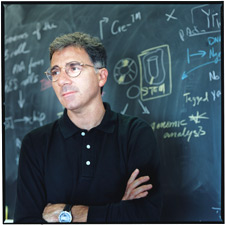
Dr. Douglas A. Melton.
©2004 Kathleen Dooher for the Howard Hughes
Medical Institute.
|
Harvard Stem Cell Institute co-director Doug Melton hailed the work, saying, “These new studies, done with mouse cells, point the way to
experiments that can be tried with human cells and represent some of the
most exciting work in stem cell biology and genetic reprogramming.”
Melton further said, “These exciting
papers both address an important issue in developmental biology, namely,
how can we change — or reprogram — a cell, turning it 'back' to a more
embryonic state with a greater potential? The promise of both approaches is
the possibility that we will be able to create embryonic stem cells from
patients, and use those cells to study the root causes of degenerative
diseases.”
Although Eggan and Melton received Harvard approvals a year ago to proceed
with experiments using SCNT to produce stem cell lines containing the
chromosomes of patients with diabetes and Parkinson's disease, they were
prevented for an entire year from conducting any experiments because of a
lack of ova donors.
“I don't think it should be
surprising that we don't have any donors,” says Eggan.
“Although the law in Massachusetts is
broadly supportive of stem cell work, there is a real double standard — a
woman can donate her ova to help another woman get pregnant, but she can't
undergo the exact same procedure for potentially lifesaving research and be
compensated. So it was our desperation over the lack of ova donors that
made us ignore 25 years of developmental biology and look for another
solution.”
The solution, the Eggan group found, is to remove the chromosomes from the
fertilized egg and replace them with the chromosomes from the donor cell just
at the point when the cell is about to divide for the first time.
In past experiments, researchers had removed the intact nucleus, which may
have contained factors necessary for the reprogramming of the cell, and
thus those previous attempts at reprogramming failed. But by removing the
chromosomes and not the nucleus, Eggan and colleagues were able to
reprogram cells that produced embryonic stem cells containing the genetic
material of the donor cells.
“I think [the four papers] are
exciting in the sense that they further our understanding of nuclear
reprogramming and [its ability] to produce embryonic stem cell lines which
we can use for therapeutic cloning,” Vanessa
Hall from the Department of Experimental Medical Science at Lund
University in Lund, Sweden, said in a comment.
“One of the downfalls [of the
studies] is that if we want to take this to a therapeutic level, it's going
to be very difficult to use genetic modification to induce embryonic stem
cells from human somatic cells,” Hall said.
Still, many technical hurdles remain for possibly translating this work to
human cells. For example, the homologous recombination technique used to
isolate the pluripotent cells does not yet work in human embryonic stem
cells. Also, using cells that contain viral vectors for gene transfer can
pose health risks.
“We are optimistic that this can one
day work in human cells,” says Marius
Wernig, who is a postdoctoral researcher and led the work in Jaenisch
lab.
“We just need to find new strategies
to reach that goal. For now, it would simply be premature and irresponsible
to claim that we no longer need eggs for embryonic stem cell research.”
|
|
