1. Roses: Long considered
a symbol of beauty and love, the rose figures into many myths and
fairy tales. Romantic writers and poets have used the flower as a
metaphor for emotion, beauty, passion, and true love throughout the ages.
An all-star in the world of weddings, the rose is far from boring,
particularly when it comes to color -- the rose is available in solid
colors and bicolor varieties, and there are striped roses and tipped roses
as well. More than three thousand varieties of roses are grown commercially,
many available year-round and that are surprisingly affordable. And though
roses are associated with luxurious fragrance, not every rose is scented.
Three main types are likely candidates for your wedding flowers: hybrid
tea roses (the classic, uniformly-shaped commercial roses generally seen
at your local florist), spray roses (a rose with five to ten small heads
on each stem and a "natural, garden-grown" look), and garden roses (expensive,
old-fashioned varieties with bushy, open heads and delicious scents).
|
2. Tulips: Although
it's most often associated with the Netherlands, this flower is actually
a native of Persia. Representing "consuming love" and "happy years,"
the tulip can be a meaningful wedding choice. The flowers are grown
in a wide range of colors, including white and cream; pastels like
pink, yellow, and peach; and vibrant hues like magenta, red, and purple.
Available during much of the year, the most common tulips are very
affordable, though rare varieties can be expensive. The versatile tulip
can enhance both elegant wedding settings and more casual venues, and
work well in almost any permutation -- from bouquets to boutonnieres to
table arrangements. Three main varieties are commonly used: Dutch tulips
(typically seen at neighborhood florist shops and in gardens), French
tulips (expensive and elegant, with extra-long stems and large tapered
blooms), and parrot tulips (noted for their ruffled, striped petals
in intense colors).
|
3. Calla Lilly: Also known
as the arum lily, this elegant, trumpet-shaped blossom originated
in Africa and symbolizes "magnificent beauty" in the language of flowers.
The calla lily's distinctive form has been depicted in Art Nouveau and
Art Deco works, in addition to twentieth-century photography. Two types
are commonly available: a large-headed variety with a long, smooth
stem and suitable for tall arrangements or presentation-style bouquets,
and a miniature version ideal for nosegays and boutonnieres. Creamy ivory
is the most popular color, but calla lilies also come in yellow, orange,
mauve-pink, and dark purple.
|
4. Lilly of the Valley: With
bell-shaped florets dangling from a thin stem, the lily of the valley
is sometimes called "the ladder to heaven." The fresh, perfumed scent
from its tiny flowers is unmistakable. In Norse mythology, the flower
is linked to Ostara, the goddess of springtime, and while most plentiful
during this season, it remains available -- and very expensive -- most
of the year. So while a fistful of lily of the valley might be your dream,
a more affordable alternative may be to use just a few stems to infuse
a bouquet or centerpiece with its wonderful fragrance. Most people know of
the white variety, but lily of the valley also comes in a very rare rosy-pink.
|
5. Hydrangea: With its
big bushy head and intense shades of pink, blue, burgundy, and purple,
it's no wonder that the hydrangea represented "vanity" in the Victorian
language of flowers. One of the most popular varieties changes in
color as it grows from bubble-gum pink to sky blue, depending on the
acid level of the soil. A stem or two of this moderately priced, scentless
shrub flower helps fill out arrangements and bouquets, and a few sprigs
make a charming boutonniere. You'll find the hydrangea in white and shades
of green, pink, burgundy, and blue.
|
6. Peony: The peony
has a large, full head, strong perfume, and bright color. But despite
this outward showiness, the flower acquired the Victorian meaning
"bashfulness." Cultivated in Asia for more than a thousand years and
developed further by the French, the peony is available in two main
types, the herbaceous and the tree peony (the latter's flowers do not
last as long when cut). A bouquet made solely of peonies can be gorgeous;
the flower can also be used to create beautiful centerpieces and arrangements.
Grown in single- and double-flower styles, this expensive bloom is
seasonally available from late spring to early summer but can be imported
in the fall.
|
7. Ranunculus: Looking for
a cost-effective alternative to roses or peonies? Try the lush,
multi-petaled ranunculus, a relative of the buttercup. First seen
by Westerners in the Far East around the thirteenth century, this mild-scented
flower features several blossoms on a stem with fernlike foliage. To
carry ranunculus is to tell your partner, in the Victorian language of
flowers, "I am dazzled by your charms." A natural for the bridal bouquet
or bridesmaid nosegays, the ranunculus also makes a whimsical boutonniere
and is available in many colors including white, yellow, orange, and
pink.
|
8. Stephanotis: The
Victorian meaning for this flower is "marital happiness," making
the dainty white Stephanotis an obvious choice for weddings. The star-shaped,
waxy florets actually grow on a flowering vine; each must be individually
wired or placed onto a special holder before it can be arranged. A
bouquet of stephanotis blossoms is one of the most traditional a bride
can carry, and a stephanotis boutonniere is a classic choice for a formal
wedding. Mildly scented, moderately priced, and available year-round.
|
9. Sweet Pea: The sweet pea,
which signifies "lasting pleasure," was first brought to England
from Sicily in 1699, and the English have had a love affair with this
delicate flower ever since. Its candy-like scent and ruffled blossoms
make this an old-fashioned favorite in bouquets for the bride and her
bridesmaids. The sweet pea's many colors range from white to intense
pinks and purples, and its scent can be strong and sweet.
|
10. Gardenia: Surrounded
by dark green, waxy leaves, the exquisite gardenia exudes a sultry,
heavy scent. It was this intoxicating fragrance that captivated an
English sea captain traveling through South Africa in 1754, prompting
him to bring home one of the native plants as a souvenir. Gardenias are
lovely tucked into a bouquet or floating in a low bowl as a centerpiece,
and a single gardenia makes a wonderful scented corsage. But be gentle:
the delicate, creamy ivory petals of this expensive flower can bruise easily.
Large three- to four-inch blossoms, as well as a miniature variety, are
available.
|

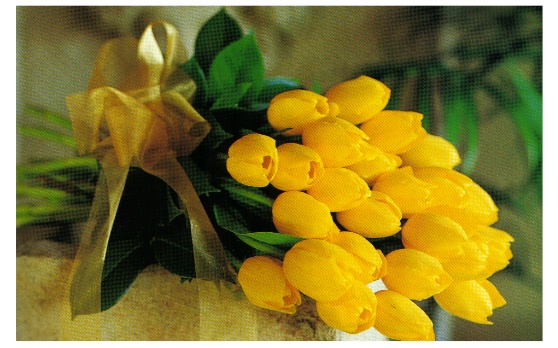 Yellow Tulips
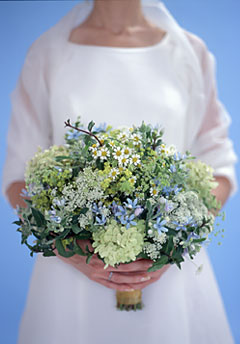 This inexpensive composition uses casual flowers
in a formal shape: pee gee hydrangeas, chamomile, queen anne's lace,
lady's mantle, and tweedia. Mint adds greenery and a subtle scent.
This inexpensive composition uses casual flowers
in a formal shape: pee gee hydrangeas, chamomile, queen anne's lace,
lady's mantle, and tweedia. Mint adds greenery and a subtle scent.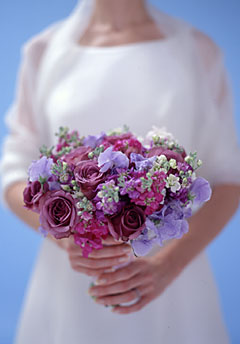 With ultra-vivid hues, this charming little cluster
just might steal the show. The palette is achieved with deep lavender
roses, lavender sweet peas, and stock in pinks and purples. Bonus:
The roses and sweet peas have a heavenly fragrance.
With ultra-vivid hues, this charming little cluster
just might steal the show. The palette is achieved with deep lavender
roses, lavender sweet peas, and stock in pinks and purples. Bonus:
The roses and sweet peas have a heavenly fragrance.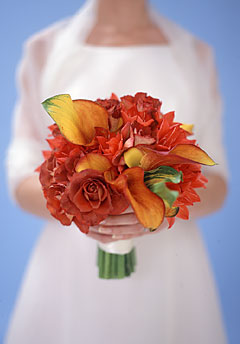 Adventurous, attention-getting color adds a twist
to a classic dome bouquet. Fiery miniature amaryllis mix here with
russet and gold calla lilies and two-toned Leonidas roses.
Adventurous, attention-getting color adds a twist
to a classic dome bouquet. Fiery miniature amaryllis mix here with
russet and gold calla lilies and two-toned Leonidas roses.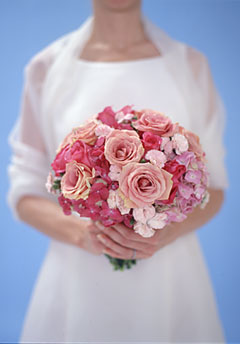 Ever think pink could be so many colors? Monochromatic
bouquets (stick to 3-4 flower types) pack a punch. Here, in varying
shades of pale to hot pink, are hydrangeas, roses, and-big surprise-carnations.
Ever think pink could be so many colors? Monochromatic
bouquets (stick to 3-4 flower types) pack a punch. Here, in varying
shades of pale to hot pink, are hydrangeas, roses, and-big surprise-carnations.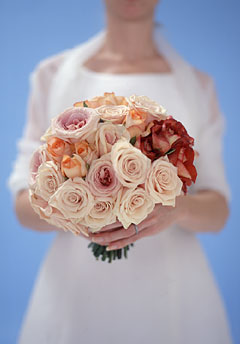 Everyone's favorite wedding flower gains something
in a spectrum of colors which gradually grow more intense. Here,
an assortment of roses in cream to russet hues: Elize, Sahara, peach,
and two-toned Leonidas.
Everyone's favorite wedding flower gains something
in a spectrum of colors which gradually grow more intense. Here,
an assortment of roses in cream to russet hues: Elize, Sahara, peach,
and two-toned Leonidas.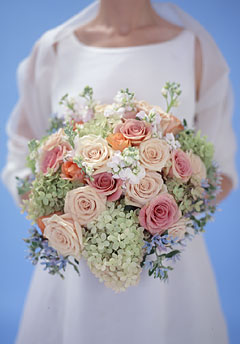 Even an armload of blooms can have a bridal look.
Pee gee hydrangeas are a lovely, lacy accent to stock and pale blue
tweedia; roses in a range of related hues (Sahara, Rustique, and
peach) keep the color fresh.
Even an armload of blooms can have a bridal look.
Pee gee hydrangeas are a lovely, lacy accent to stock and pale blue
tweedia; roses in a range of related hues (Sahara, Rustique, and
peach) keep the color fresh.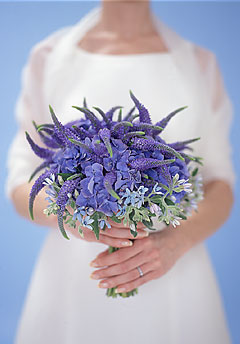 Smaller-scale bouquets are a good way to experiment
with texture. Here, spiky blue veronica, a cost-cutting wildflower,
pokes up above blue hydrangea and tweedia.
Smaller-scale bouquets are a good way to experiment
with texture. Here, spiky blue veronica, a cost-cutting wildflower,
pokes up above blue hydrangea and tweedia.