 |
 |
 |
 |
| The Website | Different Sentiments, One Call | Affiliations |
| Sentimyento reflects on the calls and aspirations of the masses, and their continuing struggle to fight for their rights. The website contains stories, photos, and other outputs that mirror the social injustice that the basic sectors of society are experiencing and their collective action in asserting their rights. | The Online Journalism in the UP CMC (so far)
Online journalism in the University of the Philippines College of Mass Communication Department of Journalism has produced concrete, positive results, one of which is the production and operation of the department's website, the Headlines and Deadlines. Headlines and Deadlines was created and is being maintained by some junior and senior Journalism students, led by the Journalism representatives to the Student Council. It is positive that Journalism 117 or the Online Journalism course led the students to constructing the website, as the course offers basic HTML guidelines and principles, equipping Journalism students to understand the trends of online journalism. It is also positive that the students were able to put into practice what they have learned in their Online Journalism classes. In the most basic, though, it is positive that the Journalism Department offers this course, since some universities and colleges still do not see the importance of this shift in journalism. The UP Journalism Department is among the universities that saw the importance of online journalism education and included Online Journalism course in their curriculum. In the advent of the Internet, news organizations have not only been creating online versions of their papers, but others are actually leaving the world of papers and now focusing more on expanding their reach online. Also, with the technology today, almost everyone can produce and distribute their own news or information in what is known now as citizen journalism. It only shows that online journalism has really made its mark and online education is much more needed now. However, the Online Journalism Course in the College of Mass Communication is only offered as an elective, therefore not requiring Journalism students to take it. It is quite disappointing that students can actually graduate without having to the knowledge and understanding of the emergence of Online Journalism, which they are sure to encounter when they get out of school. Online Journalism class as an elective may be attributed to the readiness of the department to offer it as a required course. The department has only one computer laboratory with 17 computers (not all are functioning well). The Internet connection that is necessary in Online Journalism education is not stable, which leaves students sharing computers or doing their works at home. The laboratory fees, which increase yearly as part of the provisions of the Tuition and Other Fee Increases, are supposed to cover the expenses in their Online Journalism class, but it is disappointing the students do not get what they pay for. These are just some of the problems that the Online Journalism course offered by the Journalism Department in UP has to face. It is a good start, yes, but it needs further improvement. Mr. 'RtR'
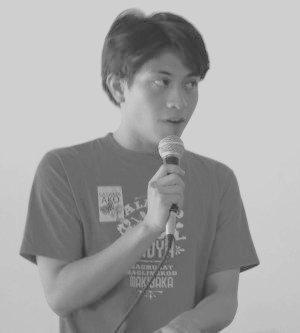 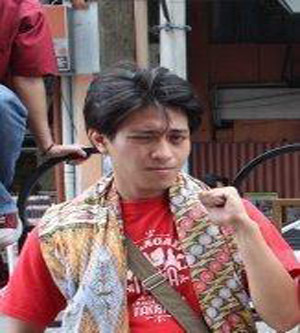
He is but a familiar face in the College of Mass Communication. Very familiar you get to see his face in almost every class you attend and every classroom you enter. He is the current Vice Chairperson of the CMC Student Council, and now running for the position of Chairperson under the Student Alliance for the Democratic Rights in UP (Stand-UP). One can bet every student in CMC knows his name and his face. Rupert Francis Mangilit is not popular because he is good-looking. He is not popular because he is the smartest. He goes to school with loose shirts, rugged pants, and worn out rubber shoes. He brings one notebook and a pen and a bulk of readings, which he struggles never to forget when going to class. He strives to attend his classes, but sometimes, he doesn�t. You can call him a typical UP student, yes, if not for UP students� identity crisis nowadays. Unlike the new set of students now slowly prevailing in UP, Rupert comes from a middle-class family, who cannot afford to pay P20, 000 for tuition. That is why his parents got worried about Rupert transferring from Los Banos to Diliman, thinking his transfer would be covered by the Tuition and Other Fee Increases. Upon knowing it wasn�t, his parents were relieved. On the other hand, Rupert was agitated. Looking back, Rupert remembers his elementary days in a Catholic school, where one of his teachers asked him to go around and sell vegetables for her. He was obedient then, having been lectured everyday in his Religion class to follow his teachers all the time, and being a diligent student who wants to earn extra points for Conduct. While going around, he was thinking, �Di ba dapat nagaaral ako at di nagbebenta ng gulay sa mga titser?� During these times, his father lost his job and so, Rupert, being the eldest among three children, had to transfer to a public school. �It's an everyday struggle to make both ends meet. Tatay ko dinidilihensya lang pamasahe namin,� says Rupert. The difficulties he had gone through as a kid encouraged him to study harder. In elementary and high school, he strived to excel in the different subject areas, with English among his favorites. He also aimed for high grades. He also excelled in different school organizations knowing that he would be earning plus points for extra-curricular activities, plus the fact that school organizations and activities are a plus to his credentials. �Sobrang palaaral ako, but for the wrong motivations-credentials, honor, ganyan. I was educated but not learned back then.� He admits he had with him the objectives of a typical �ideal student leader� when he ran as Vice Chairperson in the CMC Student Council Election last year. He saw it as another challenge to serve his college, although seeing it before at the surface level. �Dati ayoko nang nagrarally at maging �tibak� in general. Masakit sa balat at pagpapawisan lng ako. Ganun ako magisip then...When I saw Neo-Angono's banned mural, it hit me... Tapos yung photo visit sa Tondo. I then pondered, are pictures enough? Can I do more?� That was when he realized that being a student leader is not just about planning students� activities. He realized what he can do not only in asserting the rights of the students but of the basic sectors of society as well. �Pag napapalapit ka kasi sa masang inaapi, mas naiintinidhan mong kelangan mong lumaban, maging boses nila at kelangan mo silang tulungang tumindig.� These days, maybe he�s not the correct person for a typical UP student, not because Rupert and his principles changed, but because the definition of a �typical UP student� did. While majority now of the students would prefer reading �The Devil Wears Prada� instead of the �Philippine Social Realities,� while most of them would choose to go to Trinoma instead of going to Mendiola, and while UP students now talk about the latest gossips uploaded in Multiply instead of the global financial crisis, Rupert is with a relatively small group of students wearing red. Rupert and this group do not get tired of educating the students and encouraging them to assert their rights. No doubt his face is a familiar one in CMC. Almost everyday, he gets into a class and discusses issues-from local to national to international. He knows about the challenge of facing a brand new set of �UP students,� and he wholeheartedly accepts it. It is never too late, after all. UP students' call echoed: "Yes" to the CRSRS Referendum |
Tudla Productions is an alternative media collective that strives to specialize in documentary productions, tackling significant social issues and the plight and aspirations of marginalized sectors in society. Pitik-Mulat Networkis a network of professional photographers, enthusiasts, and students, who engage in exposure trips and photo shoots to produce photos representative of today's social truths. |