| The Geometry of Space-Time: A Teaching Package |
| >>The General Theory of Relativity (GR): The Key Ideas |
| >>The Bending of Light: Proof of GR? |
| >>Non-Euclidean Geometry: Space, but not as we know it |
| >>Exotic Geometry: A look at the Universe around us |
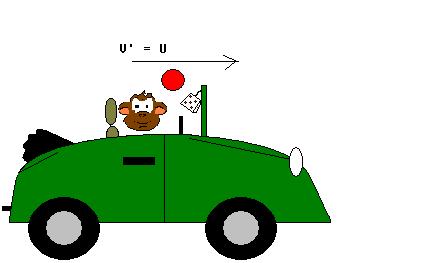
| One reason why Einstein's Special Theory of Relativity was needed was because of the special problems that cropped up when scientists noticed that the speed of light is a constant everywhere in every direction (Michelson-Morley Interferometer). This caused problems with the Newtonian model for measuring time. One of these problems is called the velocity addition problem. The observed constancy of the speed at which light travels tells us that the Newtonian model of space and time is flawed. But the flaws don't become noticeable until we start trying to describe things moving near the speed of light. Mind Experiment: If we were to place Bob the monkey in a car with a ball and tell him to throw the ball in the same direction as the motion of the car, we would have this situation: The velocity addition problem is illustrated in the figures above. If we are the observer in the rest frame and the car drives past at V then Bob throws the ball (place mouse over the picture) with a velocity of U (as measured in his rest frame) then we should just add up the velocities and assume the ball is moving at V'=V+U Classically speaking this is correct. Velocity addition works for very low velocities such as these under discussion. But what happens when we ask Bob to hold a laser and shine it in the direction of the motion of the car? Does the light (in our frame of reference) travel with V'=V+U ? where U is now the speed of light? That would imply that the speed of light is not constant. This is contrary to the observed behavior of Nature (Michelson-Morley Interferometer). Therefore the Newtonian model of time being experienced equally by all observers must not be a good model for Nature. It was then suggested that perhaps time can flow at different rates� Time does not flow at a constant rate? Now, the Newtonian laws of physics are very clear: Time is absolute. It flows uniformly and inexorably at the same universal rate, independently of how one moves. Sadly, science was then faced with a problem with technology. The clocks that were available were just not accurate enough to reveal the truth. With this, despite being believed by many, nobody was willing to assert with conviction that time really does dilate. |
 |
| The velocity addition problem |
 |