| The Geometry of Space-Time: A Teaching Package |
| >>The General Theory of Relativity (GR): The Key Ideas |
| >>The Bending of Light: Proof of GR? |
| >>Non-Euclidean Geometry: Space, but not as we know it |
| >>Exotic Geometry: A look at the Universe around us |
 |
| V'=V+U ? Where U is now the speed of light?? That would imply a speed greater than the speed of light!! Einstein says that's not possible. What happens? It was then suggested that perhaps time can flow at different rates and that space can be warped... Time does not flow at a constant rate? Space can be warped? Newtonian laws of physics are very clear: Space and Time are absolute and it must be that the speed of light is relative to the observer. |
| The velocity addition problem |
| Einstein's Special Theory of Relativity was needed as the Michelson-Morley experiment showed that the speed of light was constant. |
| This caused problems with the Newtonian model. One of these problems is called the velocity addition problem (VAP). |
| The observed constancy of the speed at which light travels tells us that the Newtonian model of space and time is flawed. But the flaws don't become noticeable until we start trying to describe things moving near the speed of light. |
| Mind Experiment: |
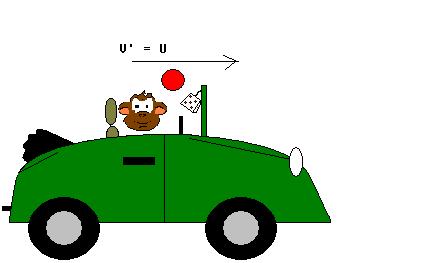
| If we were to place Bob the monkey in a car with a ball and tell him to throw the ball in the same direction as the motion of the car, we would have this situation: |
| External observer watches Bob the monkey drive past in the car |
| Initially, the ball is in Bobs' hand, thus travelling at the same speed as the car, V'. |
| When he throws the ball (place mouse over the picture) in the same direction as the car, the ball is now seen to be travelling at V', where U is the speed he threw the ball in his frame of reference. |
| Galileo vector addition tells us this is correct, and indeed it is alot of cases |
| However, now consider giving Bob a torch. |
| When he shines it in the same direction the car is moving, he will observe the light to be travelling at the speed of light |
| What do we, the motionless observer see? |
 |
 |
|
|
 |
|
|