"Our Goal is Fair Play"



that FIFA has sanctioned the following Law Amendments for 2003-2004:
 At the IFAB meeting in March 2003, only minor
amendments were made to the Laws. The changes are as follows:
At the IFAB meeting in March 2003, only minor
amendments were made to the Laws. The changes are as follows:
The procedure used to determine the winner of
a match with kicks from the penalty mark.
The team that wins the toss now has the choice of whether to take the
first or second kick.
In the additional instructions for referees, assistant referees and 4th
officials, the Board has now added a provision reminding referees to apply
the Law correctly in cases of infringement by players entering the penalty area
before the ball has been kicked or goalkeepers moving off the goal line before
the ball has been kicked.
FIFA also granted permission to experiment with the use of high-frequency radio
communication systems between match officials, which will improve the
co-ordination of actions between match officials in a more efficient manner. The
first test was conducted at the FIFA Confederations Cup from 18-29 June 2003, in
France.
 Grand
Final Day 2003 is upon us and it is important and a timely reminder
to all referees that this festive day (whether it be Friday night, Saturday or
Sunday) is the showcase of the Football Association.
As officials, it is important that we give it everything we have to ensure that
the days are memorable and successful days for all concern. Immerse
yourself into the excitement of the day. Be part of the gala
atmosphere. Lets not ruin it for players that have worked so hard to get
to the finals by being sloppy with our decisions.
Grand
Final Day 2003 is upon us and it is important and a timely reminder
to all referees that this festive day (whether it be Friday night, Saturday or
Sunday) is the showcase of the Football Association.
As officials, it is important that we give it everything we have to ensure that
the days are memorable and successful days for all concern. Immerse
yourself into the excitement of the day. Be part of the gala
atmosphere. Lets not ruin it for players that have worked so hard to get
to the finals by being sloppy with our decisions.
As you will only have 1 game to referee (or a couple of lines to run), now is
the time to run that little harder to be closer to the zone of play to make that
right decision. Blow that whistle a little bit harder to ensure that it
gets over the spectators' excitement and noise. Polish your boots, wash
your uniforms - look the part.
For Assistant Referees, it can be quite a harrowing time, trying to keep excited
spectators - aunts, uncles, grandparents to stand behind the ropes or
lines. It is frustrating but understand that soccer is a spectator
sport. Spectators excitement all adds to the atmosphere of making Grand
Final Day so memorable. So... be sympathetic and speak to offending spectators
kindly. They don't mean to piss you off... They are just having a
great time. Stay cool.
Have a great day and for those of you who have been appointed to a centre, my
congratulations.
Soccer
becomes Australia's top sport
- Roy Morgan,11th August 2003
Soccer has taken over as the number one played team sport in Australia. A steady increase in participation over the last three years has seen the sport take over the mantle from cricket, which held the position for a number of years.
The chart below shows national participation in Soccer being 1,218,000 in March 2003 ahead of Cricket (1,067,000) and Basketball (892,000). These are the latest findings from the Roy Morgan Sponsor MAP, which interviewed around 100,000 people aged 14 or over during the last four years.
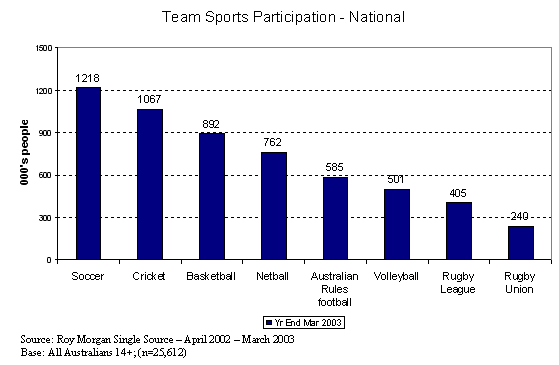
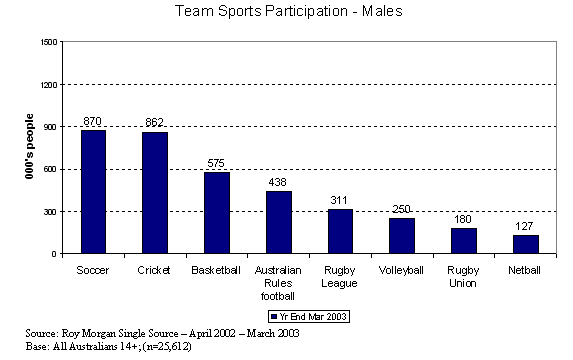
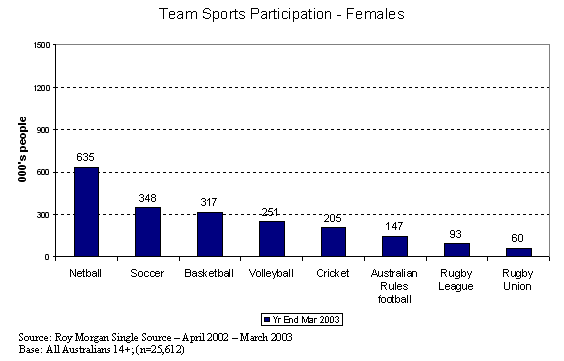
Soccer's wide appeal across both males and females is a factor as to why it has taken over as number one sport. The charts below show that Soccer is rated the highest participated sport among men, while it is the second highest participated sport, behind netball, for women.
The contact sports such as Australian Rules, Rugby League and Rugby Union don't rank as high on the overall participation rates due to their limited appeal across both genders.
Soccer has shown steady growth over the last three years in participation, increasing from 831,000 participants in March 2000 to over 1.2 million in March 2003. Over the same period, participation in cricket has increased from 957,000 in March 2000 to 1,067,000 in 2003.
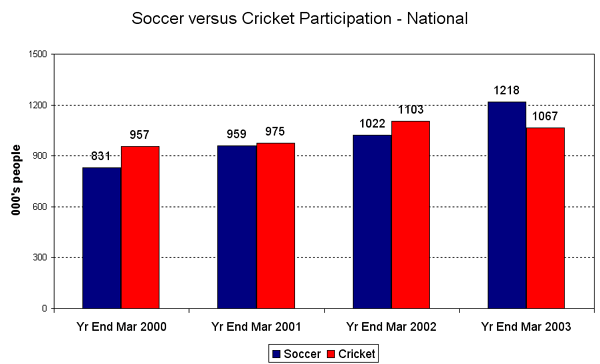
The increase has occurred at the time of high profile events such as the popularity of the World Cup in Japan in 2002, and the myriad of Australian Soccer players making their mark in international competitions.
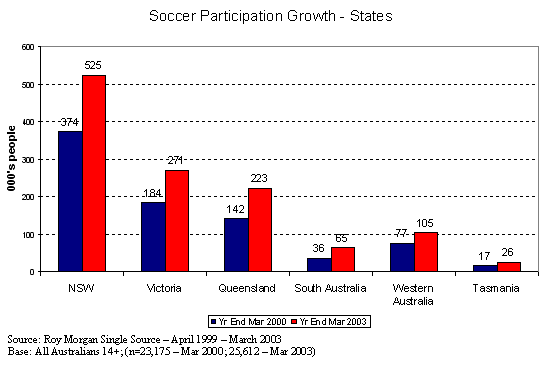
Looking at the chart below, it can be seen that the increase in Soccer participation over the years has been enjoyed across all states, in particular New South Wales (374,000 to 525,000), Victoria (184,000 to 271,000) and Queensland (142,000 to 223,000).
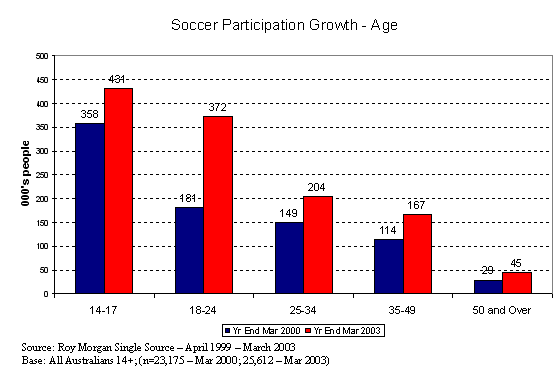
Further interrogation shows that the increase in Soccer has been due to the younger age groups with the 14-17 year bracket increasing from 358,000 to 431,000. The sharpest increase in participation was in the 18-24 age group. In the three year period participation increased a massive 106% from 181,000 to 372,000.
The 431,000 14-17 year olds participating in Soccer equates to 41% of the population in that age group. This indicates that Soccer may be playing a major factor among our school sports.
A
little bit of fun. Is it a case of over exposure? Bringing the game
into disrepute? What's you decision?
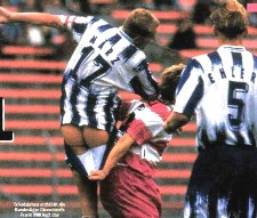 Shirt Pulling? No way I pulled his shirt Ref !!!!!!
A
RED CARD FOR 'ALL' TACKLES FROM BEHIND?
Law 12 states that a direct free kick (or a penalty kick) is awarded when a player kicks, trips, jumps, charges, strikes or pushes an opponent carelessly, recklessly or whilst using excessive force. Therefore, if a challenge is made from behind, and the Referee deems the tackle to have endangered the safety of the opponent, the Referee must sanctioned this as 'serious foul play'.
A fine balance has to be reached between protecting players and keeping the game physically challenging for players. Red cards should be issued to players when tackles from behind are made using excessive force. But, the yellow card is more often the punishment when the tackle is reckless or careless. There is no doubt that the action taken by Referees over the past few years has resulted in less tackles from behind and less serious injuries for the players. Because of the combative nature of the game, this type of tackle will never disappear completely.
Not all tackles from behind endanger the safety of an opponent. A tackle from behind can range from a simple soft tap of the ball by a defender between an attacking player’s legs to a 'full blown' violent challenge from behind. As in all cases, the Referee makes the decision on the level of punishment to be applied depending on the severity of the tackle. Football is a physical contact sport – and although recent changes in Law interpretation have prevented many injuries from happening – too much emphasis on limiting physical contact will harm the combative element of the game. Referees, players and coaches have a responsibility to insure that the incessant (dangerous) tackling from behind (seen in the 1990’s) does not creep back into the game. And that the correct punishment is applied by the Referee who remains the sole judge in such cases.
The simple criteria to use, is the same criteria that the Referee would normally apply for any other (Direct Free Kick) tackle made by an opponent in a manner considered by the Referee to be careless, reckless or using excessive force. With the added reminder that tackles made from behind using excessive force must ALWAYS be punished by a sending-off.
2003
ANNUAL GENERAL MEETING
The Annual General Meeting has been set down for Thursday, October 30, 2003 at 7:00 pm at the Merrylands Bowling and Sporting Club, Oxford Street, Merrylands. Come along and participate in selecting you new committee for 2004. How about joining the committee and help run you referee's association. Nomination forms are available under the "Referees Reports" link on the main page. We hope to see you there.