 |
| American Aircraft |
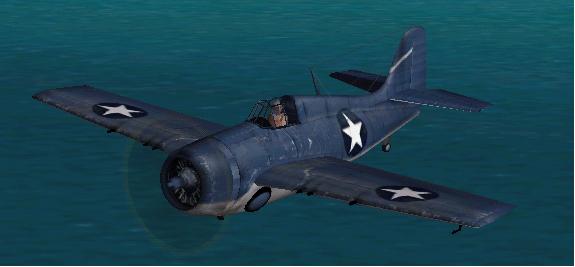
| Grumman F4F-4 Wildcat |
| Specs: Weight- 5,785/ 7,951 lbs fully loaded Wing Span- 38 feet Length- 28 feet 9 inches Engine- Pratt & Whitney R-1830-86 Twin Wasp 14 cyl. radial (1,200 hp) Max Speed @ Altitude- 277 kts/318 mph@ 19,400 feet Ceiling 34,900 feet Initial climb rate 1,950 feet/min Range- 770 miles |
| This tubby little cairrer fighter was easy, forgiving, and even fun to fly. The Wildcat was Grumman's first modern all metal monoplane fighter, but in some ways its design looked back to a simpler time. To raise and lower the landing gear the pilot had to hold the stick with his left hand while he used his right hand to turn a crank- attached to a bicycle chains and sprockets- 33 times. For the first year of the war the Wildcat took the brunt of the air battle against the Japanese, but its deficiencies meant that it could compete only if pilots used team tactics - especially the "Thach Weave"- to defeat tighter turning, faster climbing Zeros and Oscars. The Wildcat was stoutly constructed, well armored, with the same six .50 caliber Brownings carried by Hellcats, Corsairs, and Mustangs. While its greater weight and less efficent wing were liabilities in a dogfight, the Wildcat's larger, more powerfull engine combined with these traits to give the Wildcat superior diveing ability. Although larger, heaver ,faster, and more maneuverable fighters came into service, the Wildcat remained in production, mostly because of its compactness. The growing US fleet of small CVE "Jeep" carriers carried a larger number of Wildcats than of any other fighter type. |
| Strengths - Tough and rugged construction -Six .50 caliber guns provide good firepower - Good armor protection & self sealing tanks - Easy, even fun to fly |
| Weaknesses - Slow climb rate - Limited speed, maneuverability and range - Narrow langing gear makes non-carrier take-offs and landings tricky- and dangerous |
| Tips for combat - Stick together with your squad mates (power in numbers) - Use team tactics - use the weight and power of your plane to dive away from trouble -if an enemy fighters latched to your tail, you probably can't evade by out climbing or maneuvering, so turn into him to go head-to-head. You've got the firepower to do alot of damage and the armor to withstand more hits, so playing "chicken" isn't as crazy as it sounds. - if you score a hit on the enemys fuel tanks and uoi can see unignited feul vapor leaking out, fire at the plume to ignite it with your tracers. |
|
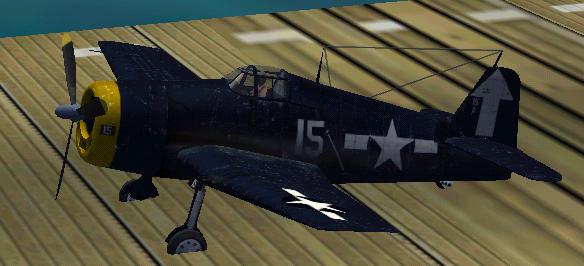 |
| Grumman F6F-3 Hellcat |
| Specs: Weight- 9,042/ 11,381 lbs fully loaded Wing Span 42 feet 10 inches Length 33 feet 7 inches Engine- Pratt & Whitney R-2800-10 Double Wasp 18 cyl. radial air cooled (2,000 hp) Max Speed @ Altitude- 327 kts/376 mph @ 17,300 feet Ceiling- 38,400 feet Initial climb rate- 3,500 feet Range 1,090 mi |
| Simple, rugged, and deadly, yet easy to fly, the Hellcat was another product of the " Grumman Iron Works". It was a larger, heaver, faster, and more powerfull refinement of Grumman's F4F Wildcat, and the first American fighter to exceed the preformance of the Mitsubishi Zero. Its immense 18 cylinder, 2000 horsepower radial engine gave it the power to dictate the terms of engagment. Its speed, maneuverability high altitude capabilitys and typical Grumman toughness made it a winner against all comers. the 12,000+_Hellcats produced accounter for three-forths (3/4) of all US Navy air to air kills. Its combination of performance and survivability put the fighters in the Pacific theater, along with the Vought Corsair |
| Strengths - Rugged Grumman construction -Easy to fly -Competitive speed and manueverability -six .50 cal guns, serious firepower -Armor and self sealing tanks increase survivability |
| Weaknesses -Not the fastet American fighter -Still not a nimble as the Zero |
| Tips for combat - At 20,000 to 25,000 ft the Hellcat can out manuever Zeros and Oscars, but below 20,000 ft it remains very dangerous to dogfight against them - The Hellcat is far from the fastest US fighter, but its faster than the Zero. Use the power of its 2,000hp engine to keep combat in the zone where your plane performs best -The Grumman is well armored, very tough, and has heavy firepower. Use these advantages to bore in on the attack. if attacked, turn into the enemy and use your firepower for a devasting head on attack -Stick together; team tactics are still execlent insurance for Hellcat pilots. Dont assume that you can count on the F6F to keep you safe if you go off on your own, especially against the late model Japanese fighters like the George |
| On to page 2 |
 |
| For more info on US planes check out our Links page or this site ---> |
 |