 |
| American Fighters |
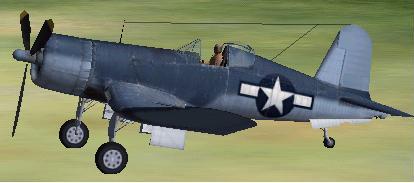
| Vought F4U-1A Corsair |
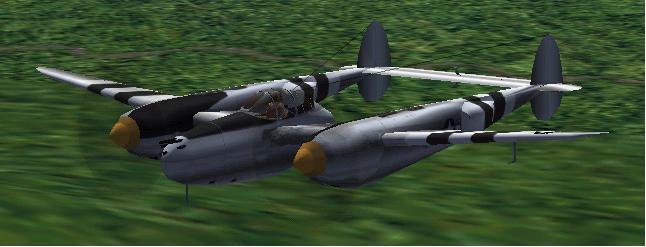
| Lockheed P-38F Lightning |
|
 |
| Specs: Weight- 8,892/14,000 lbs fully loaded Wing Span- 41 feet Lenght- 33 feet 4 inches Engine- Pratt & Whitney R-2800-8 Double Wasp 18 cyl radial air cooled (2000hp) Armament- Six .50 cal Browning M2 machine guns Max Speed @ Altitude- 363kts/417mph@19,900 ft Ceiling- 36,900 feet Initial climb rate 2,890 ft/min |
| Specs Weight-12,264/15,900 lbs fully loaded Wing Span- 52 feet Length- 37 feet 10 inches Engine- Two Allison V-1710-49/53 liquid cooled V-12 (1,325 hp each) Armament- One 20mm Hispano M1 cannon with 150 rds + four .50 cal Browing Machine guns with 500 r.p.g. plus up to 2,000 lbs of bombs Max Speed @ Altitude- 343 kts/395 mph @ 25,000 ft Ceiling- 39,000 Inital climb rate 2,500 ft/min Range 900 mi ; with drop tanks 1,750 mi |
| Big, tough and fast, the gull winged Corsair was a formidable fighter against any opposition. The Corsair's signature gull wing prevented its immense propeller from chewing up the deck while keeping the landing gear struts short enough not to buckle in rough carrier landings. Initially the Corsair's shock adsorbers were too stiff, causeing a disastrous bounce on landing that could catapult this heavy fighter right over arresting cables on the deck. This defect relegated the Corsair to land based operations untill 1944. Then the Navy and Marine Corps aviators opperated the "Bent Wing Bird" from carriers and land bases, dominating the Pacific skies along with the Grumman F6F Hellcat. Like their comrades flying the Hellcat and the Army P-38 Lighting, Corsair pilots could use the power of their fighters to engage the Zero at higher speeds and altitudes where the legendary Mitsubishi fighter struggled to compete. The Corsair did pose some problems for pilots: its long nose limited forward vision on the ground and also made it hard to see the Landing Signal Officer on final approach to a carrier landing. Its spin characteristics made recovery difficuly as the nose dropped and the spin tended to tighten. Nevertheless, the Corsair was a thorough-bred with top notch acceleration, speed, and maneuverablity, respected and feared by its opponents. Some Japanese pilots called the Corsair "Whistling Death" because in a dive the wind whistled through the big fighter's wing mounted oil coolers. |
| Strengths - High speed, excellent maneuverability - Heavy armament ( six .50 cal guns) |
| Weaknesses - Limited forward makes taxiing and carrier landings more risky than other fighters - Spin characteristics can be dangerous for the unwary, as nose drops and spin tends to tighten |
| Tips for Combat -Use the Corsair's power, acceleration, and manueverability to engage enemy fighters at high speeds and altitudes where the Zero and Oscar struggle to complete and where the George will find it hard to out fly you - If attacked, turned in to the enemy for a head on attack or, altitude permiting, use the Corsair's mass and power to dive away from attackers. |
| The strikeing appearance and high performance of the Army's Lockheed P 38 Lightning made a powerful first impression. It used liquid cooled engines, but its twin Allison V 12's made you feel alot better about flying long distances over water. Twin engine reliablity and long range were big assets, particulary in the Pacific theater, where the top scoreing American aces, including Richard Bong and Thomas McGuire, were flying it to record numbers of victories. Its countter rotating propellers neutralized torque effects and made the P 38 a smooth aircraft to fly. Heavy firepower concentraited in the nose, and modern tricycle landing gear, also made the P 38 popular with pilots. Big, heavy, and fast, the lightning could out dive any fighter except the P 47 Thunderbolt, but a long fast dive from high altitude could cause its twin tail booms to oscillate. Unchecked, the booms could break. You had to limit your dive speed, or auger in. The P 38's size and weight meant that it couldn't turn with more nimble fighters, but they combined with its twin engine power to give the Lightning an exclent zoom climb. Pilots had to keep their speed at 300 mph or better to slam this big, impressive bird through enemy formations, then climb away from Zeros and Oscars to make another diveing pass. If you get low and slow with a Zero, or Oscar, the folks back home will be getting a telegram from Uncle Sam. |
| Strengths - Fast, good climb rate, excellent dive - Heavy armament centralized in nose -Counter rotating props eliminate torque effects - long range with twin engine safty |
| Weaknesses - Slow turning; not as maneuverable as smaller, lighter single engine fighters - "F" model can break up in a long power dive from high altitude due to "compressibility" - Turbocharged Allison engines suffered in cold climates - Getting low and slow in a dogfight can be dangerous |
| Tips for Combat - Use the P 38's weight, power, and diving qualities to dictate the terms of engagement with "Boom and Zoom" tactics. Attack from above, engage at more than 300 mph, slash through the enemy formation with guns blazeing, and then zoom back up in a shallow climb at a rate the enemy can't match. - Dont dogfight against more nimble adversaries; they'll out run you every time, especially at low to medium speeds and altitudes - The p 38 can out dive enemy fighters, so dive away from trouble if you have to- but don't do this from extreme altitude. You may risk locking up your control surfaces and not be able to pull out of the dive |
| For more infromation on US Planes, check out Links section or try this site --> |
 |