 Digital Technology for Analog Synthesis
The two current Design Venues are;
- MIDI or Analog Voltage compatible, micro-controller based, Digitally Controlled Oscillators, with Gate and Trigger Controls for analog synthesizer integration,
- An Event Sequencer (ESQ), the name i use to descibe a 4 channel Control Recorder. This device digitally records incoming control signals and then allows cataloging, ordering, as well as, editing these "events" for replay in simple or a complex way.
Event Sequencer
The figure on the left links to a diagram which attempts to depict simple use of one channel of this Event Sequencer. "Events" recorded do not have to be of similar length, composition, or replayed at a uniform tempo and order.
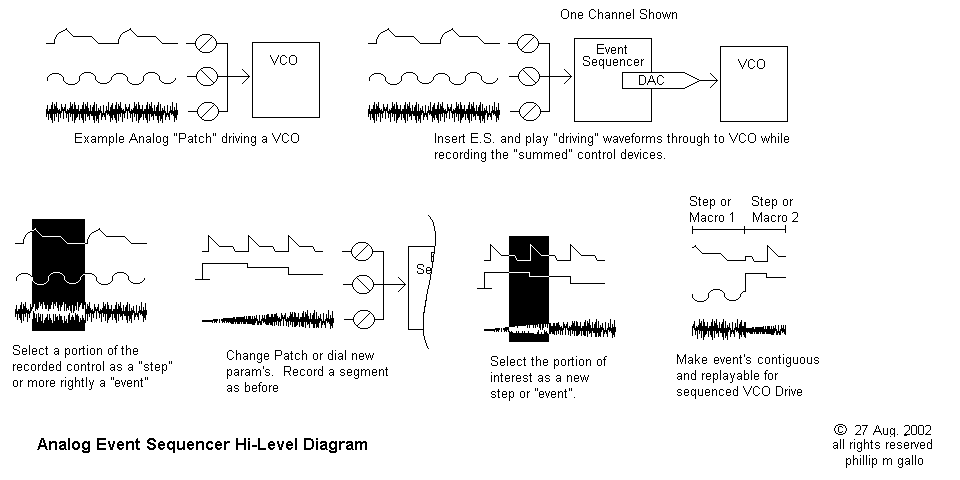 The diagram indicates the Event Sequencer samples the incoming control signals as a "control recorder". The entire recording or a User edited portion of the sample recording can be made recallable as a "Event".
Simply used, a ESQ is triggered and replays a single Event such as the recording of an ADSR. Additional flexibility can be achieved by Sequencing Events where the rate, order, and probability of replay is triggered, periodic, or a function of analog or digital inputs.
An Event Sequencer can extend the apparent "Module Depth" by replicating one or the sum of a very complex patch, freeing these modules for additional processing.
ESQ Detail
Digital FM Oscillators
Two projects currently exist under this heading:
- Microcontroller based Oscillators
The continuing effort to use generic, easy to get, hardware configured to generate sound
- MIDI and Analog interface for Yamaha OPN Oscillators
"Loosening up" the DX sound.
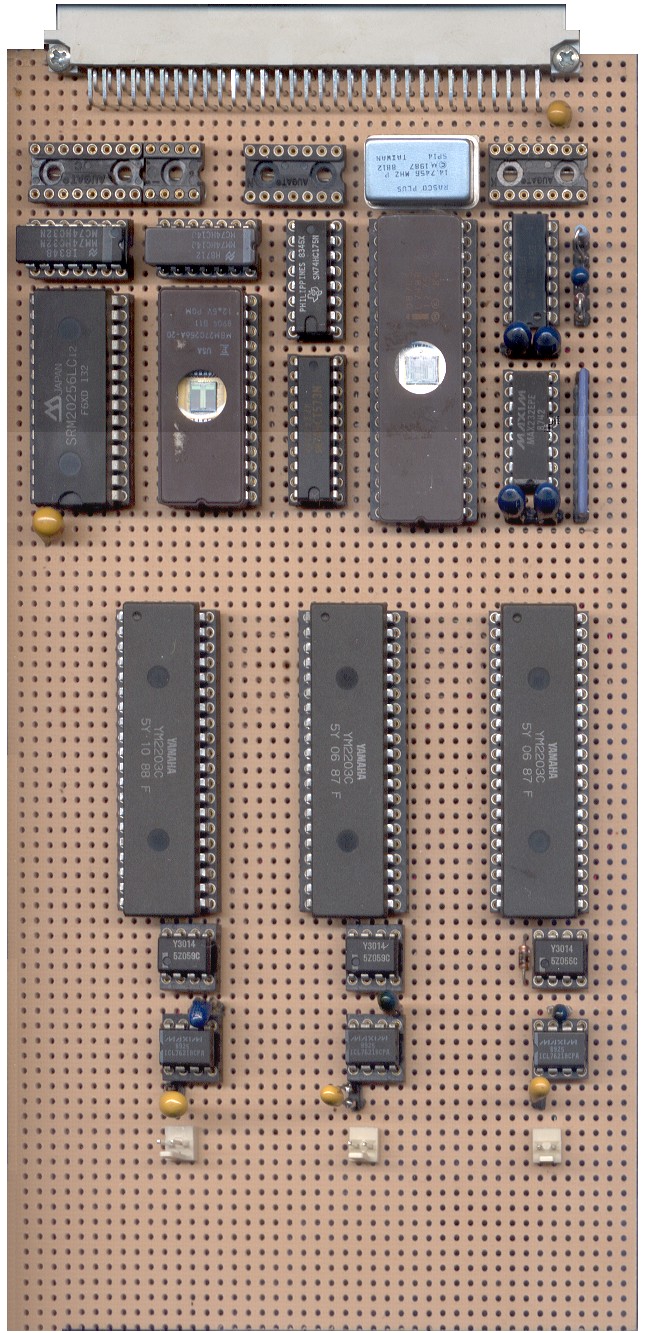 The Yamaha YM2203C OPN Chip is an evolved AY-3-8910 Programmable Sound Generator (PSG) socket compatible chip. A device intended for the "Games" market (including arcade types).
The standard, simple, 3 channel square wave oscillators, are augmented by three channels of 4 Operator FM Phase Modulation. The addition of a microcontroller host results in a highly integrated way to implement 9 FM capable DCO's.
The photograph to the left links to a larger picture of a DCO project constructed around 1993. This card was produced in concert with companion digital cards such as 3 Channel VCO DACs, A 12 Bit companding sampling card, and 98 key interface and other digital synthesizer circuits. Sadly, once complete and tested, these cards where "stored away" due to distraction with computer based recorder, sequencer, synthesizer, environments.
Current Efforts
The intention to resurrect the Yamaha YM2203C 9 Voice FM DCO card, in late 2002, was to provide full featured MIDI and ANALOG interfaces, in order to naturally integrate with other instruments.
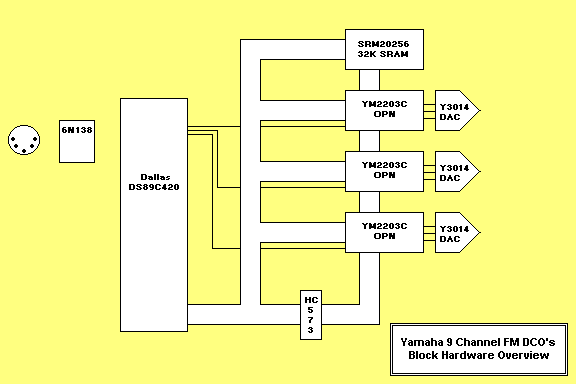 An initial modification to the FMDCO Board was to exchange the intel 8751 with a Maxim/Dallas DS89C420. This is a higly integrated, high speed, 8051 variant which executes at 32MHz with many instruction requiring a single machine cycle. This speed and capacity increase provides the "head room" need to perform sophisticated algorithms simulataneously on behalf of all 9 oscillators.
for voice assignment, portamento, integrated modulation source such as LFO's, Random Noise, and variable Pitch set or bend.
An initial modification to the FMDCO Board was to exchange the intel 8751 with a Maxim/Dallas DS89C420. This is a higly integrated, high speed, 8051 variant which executes at 32MHz with many instruction requiring a single machine cycle. This speed and capacity increase provides the "head room" need to perform sophisticated algorithms simulataneously on behalf of all 9 oscillators.
for voice assignment, portamento, integrated modulation source such as LFO's, Random Noise, and variable Pitch set or bend.
This micro is also highly integrated with 1K of single cycle SRAM, 3 16 Bit counters, two serial interfaces, Watchdog, etc. But also implements a simple serial "BOOT LOADER" so that programming is fast, simple, and easy. The current executable is in assembler.
Next Steps
In the construction of Analog compatible Digital modules, consideration must be given to DCO Control Input and Voice Output.
Control Input with both MIDI and Control Voltage interfaces allow maximum flexibility.
Analog Interface
DCO analog inputs are input using a 14 Bit Analog to Digital Conversion. The output Waveforms are the result of a 16 Bit Digital to Analog Conversion. Control signals to interface to down-stream modules are provided by "Bit" ports.
The core of the DCO is the numerically control oscillator computation. The Yamaha OPN uses a serial sound generation architecture to which you interface using standard 8 bit parallel input/output.
Click for Image
