 Control Recording for Analog Synthesizers
The Event Sequencer (ESQ) provides for the recording, replay, and editing of control events to augment control resources within an analog synthesizer or to produce control capabilities not easily produced using any other method.
The EQU is comprised of three (3) high level function blocks;
- 8 Channels of Analog to Digital Conversion where control signals/events are input for recording;
- A Processor providing the intelligence and the user interface behind the functionality of the ESQ;
- 8 Channels of Digital to Analog Conversion which drives analog synthesizer elements such as VCO's, VCF's, VCA's, or other voltage controlled devices.
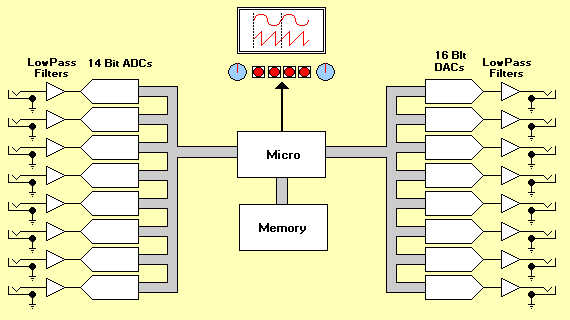
Depicted above, are the three major elements of the ESQ. One of these elements (the Processor) further partition into:
- The User Interface;
- The Memory Store;
- The Analog Interface.
The Memory Store has a depth in events equal to the sample rate and the number of channels used. For example, if the input sample rate is set to 100 samples per second (suitable for ADSR, LFO, Key Activations), and a single channel is being recorded, 200 bytes per second of memory store is used. If all eight channels were enabled then 8*200 or 1600 bytes would be used for a second of recorded control signalling.
Analog to Digital Conversion
The eight (8) input channels terminate at a Texas Instruments TLC3578 14 bit, 8 channel Analog to Digital Convertor. This device is capable of sampling at a 200K samples per second. This 200K/s rate is distributed across the 8 channels providing a 25K/s rate per channel. This rate is fast enough to accomodate audio inputs not exceeding 10KHz. While intended to record slow moving control events such as ADSR's, LFO's, or key activations, this sample rate does allow audio modulation to be input. The use of sharp low pass filtering attenuates un-intentional "aliasing" but does allow for "intentional" aliasing when appropriate for use. Intentional aliasing is also accomodated by the variable frequency input sampling.
