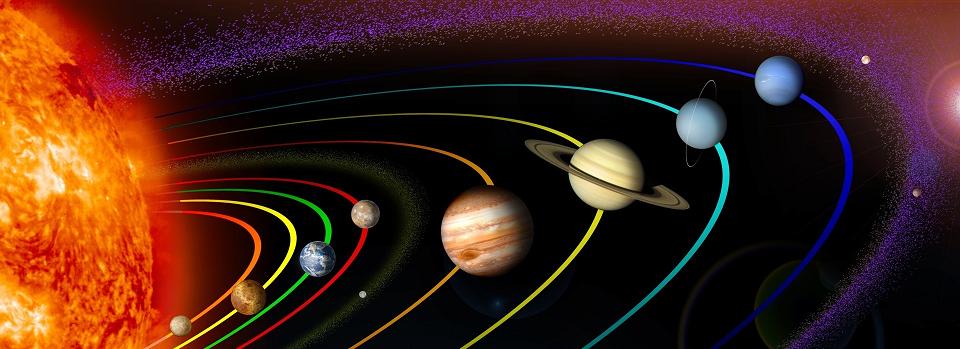
A galaxy is a massive, gravitationally bound system consisting of stars, stellar remnants, an interstellar medium of gas and dust, and dark matter, an important but poorly understood component.
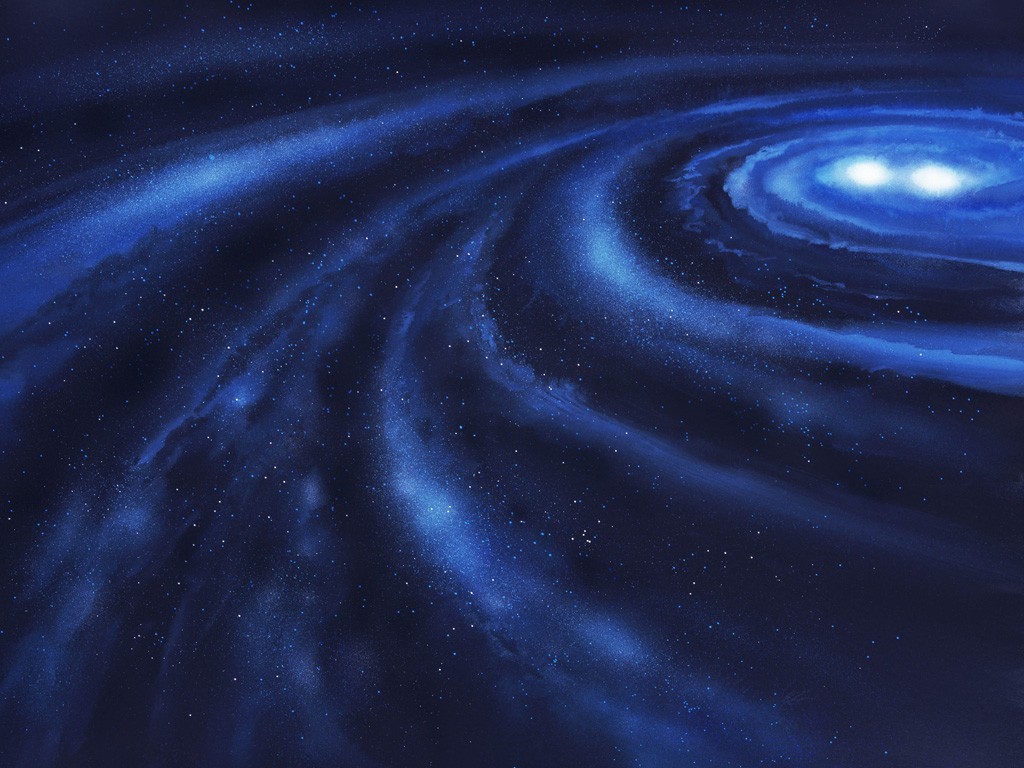
The Milky Way is the galaxy that contains our Solar System. Its name "milky" is derived from its appearance as a dim glowing band arching across the night sky in which the naked eye cannot distinguish individual stars.Galileo Galilei first resolved the band of light into individual stars with his telescope in 1610. In the past, astronomers thought that all of the stars in the universe were contained inside of the Milky Way. Following the 1920 Great Debate between the astronomers Harlow Shapley and Heber Curtis, observations by Edwin Hubble definitively showed that the Milky Way is just one of many galaxies.
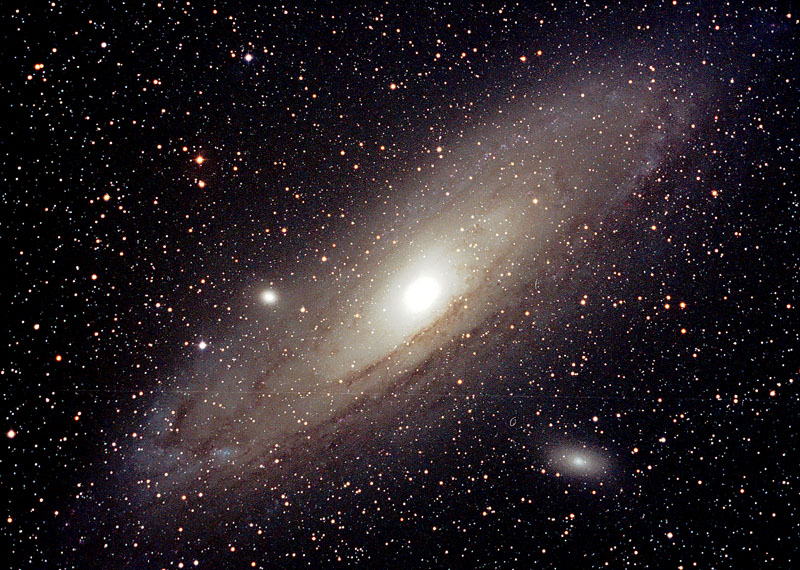
An elliptical galaxy is a galaxy having an approximately ellipsoidal shape and a smooth, nearly featureless brightness profile. They are one of the three main classes of galaxy originally described by Edwin Hubble in his 1936 work The Realm of the Nebulae, along with spiral and lenticular galaxies. They range in shape from nearly spherical to highly flat and in size from tens of millions to over one trillion stars. Originally, Edwin Hubble thought that elliptical galaxies may evolve into spiral galaxies, which later turned out to be false.Stars found inside of elliptical galaxies are very much older than stars found in spiral galaxies.

A spiral galaxy is a certain kind of galaxy originally described by Edwin Hubble in his 1936 work The Realm of the Nebulae and, as such, forms part of the Hubble sequence. Spiral galaxies consist of a flat, rotating disk containing stars, gas and dust, and a central concentration of stars known as the bulge. These are surrounded by a much fainter halo of stars, many of which reside in globular clusters. Spiral galaxies are named for the spiral structures that extend from the center into the disk. The spiral arms are sites of ongoing star formation and are brighter than the surrounding disk because of the young, hot OB stars that inhabit them.
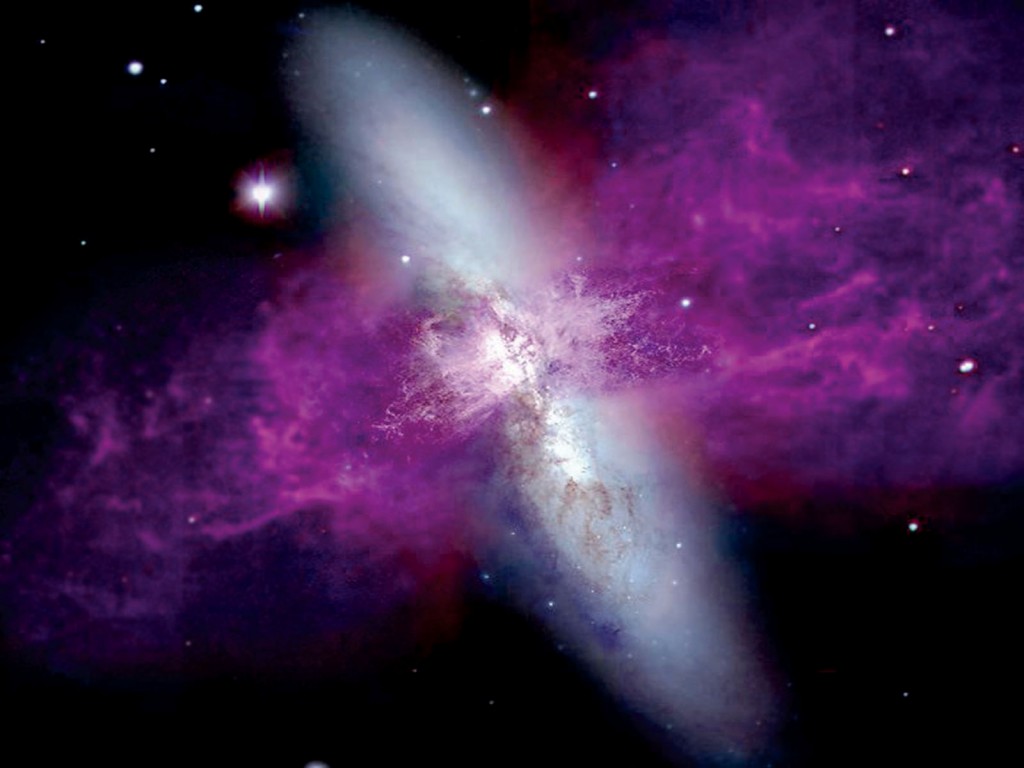
A starburst galaxy is a galaxy undergoing an exceptionally high rate of star formation, as compared to the long-term average rate of star formation in the galaxy or the star formation rate observed in most other galaxies. In a starburst galaxy, the rate of star formation is so large that the galaxy will consume all of its gas reservoir, from which the stars are forming, on a timescale much shorter than the age of the galaxy. As such, the starburst nature of a galaxy is a phase, and one that typically occupies a brief period of a galaxy's evolution. The majority of starburst galaxies are in the midst of a merger or close encounter with another galaxy. Well-known starburst galaxies include M82, NGC 4038/NGC 4039 (the Antennae Galaxies), and IC 10.


