KENSINGER KF
History
Part One - 1950-1963
Ned Kensinger was born in 1914 in Bryant, Ohio in the United States of America. His father was a building contractor and had hoped that his son would follow him into this profession as soon as he was old enough to do so but young Ned had other ideas. Bryant, Ohio was, at the time, situated along the route from Cleveland to Chicago used by the U.S. Mail planes, which at that time were war surplus De Havilland DH.4 biplanes. It was watching these aircraft flying overhead that started Kensinger’s enthusiasm for flying. In 1933 Kensinger graduated from college and the following year went on to gain his pilots licence flying an OX5 powered Waco 10 biplane.
In 1935 Kensinger designed and built his first aeroplane, a small parasol monoplane similar to a Pietenpol Aircamper and likewise powered by an engine from a Model A Ford automobile. Unfortunately his first aeronautical creation did not last too long as he ground looped the aircraft on an early test flight causing it to flip over, damaging it beyond economic repair. All of this naturally created a great deal of concern for his parents but did little to dampen his enthusiasm for flying.In 1945 a group of pre-war race pilots set about drawing up the specification for a new class of racing aircraft which would allow for amateur constructors to design and build their own small racing aeroplanes to a stringent set of rules. This new racing class created a lot of interest amongst amateur constructors and industry to such an extent that industrial giant, The Goodyear Tyre and Rubber Co., agreed to become the major sponsor; hence these small aeroplanes became collectively known as Goodyear racers.
During 1949 Ned Kensinger designed and built a midget racer with a tube and fabric fuselage and wooden wing to take part in these races and named it 'Tater Chip' on account of the wing being, as his son described it "as thin as a potato chip!" The aeroplane registered as N31E was regularly raced with some success by a number of well-known race pilots up until 1960 when it was destroyed in a mid-air collision during a race meeting at Chicago.By the summer of 1949 Kensinger was now running his own company, The Aircraft Repair Service in Peoria, Illinois. One of the first big projects undertaken was the restoration of a twin engine Grumman Widgeon amphibian for an airline pilot by the name of Robert J. Ferguson. The Widgeon had been wrecked after it hit a log during a water landing, causing it to capsize resulting in a considerable amount of damage to the wings and hull. Ferguson was so pleased with the high standard of restoration that he asked Kensinger to build him a small sports aeroplane.
Early in 1950 Robert Ferguson had managed to acquire a set of drawings for the all metal Long Midget aeroplane from the widow of the designer Dave Long who had been tragically killed in the crash of his pre-production example of the LA.1 Midget, N10N. Kensinger quickly began construction of what was to become the first non-Long built example of the Midget.
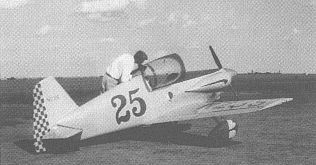
The original FAA paperwork shows that the aeroplane was to have been named 'Spook' but for some reason the aircraft was simply known as the KF (K for Kensinger and F for Ferguson). Completed in the autumn of 1953 and powered with a brand new 90hp Continental C90-12F four cylinder normally aspirated engine the KF appeared in a very sporting canary yellow and royal blue colour scheme with white pin stripes and wearing the registration N23S and racing number 25. The aeroplane was named as 'Miss Fort Worth' in honour of Ferguson’s fiancée, the daughter of a brick magnate in Fort Worth, Texas. As the aeroplane had been built as a sports aeroplane rather than a racer it was fully equipped with a radio and a very comprehensive electrical system which included lights, a generator and a specially made Beech-Roby, electrically controlled, variable pitch propeller. All this weight proved to be something of problem as N23S appeared very under-powered for its weight resulting in the flight characteristics not being as good as had been hoped for.
Kensinger KF, N23S shortly after completion in September 1953.
By 1954 Ned Kensinger had moved his company to Fort Worth, Texas and had taken on the maintenance of the aeroplanes of the Cole Brothers, Duane and Marion, who by this time had established themselves as a travelling air show in their own right with aerobatic Cubs and overpowered Stearmans. Robert Ferguson had got married and was now living in Fort Worth but the KF was still in Illinois. Marion Cole agreed to fly N23s from Illinois to Texas and found the aeroplane needed every bit of power from the C85. As it got hotter the further south he flew so the aeroplane's performance became more marginal to the point that he could not get the aeroplane to climb much higher than 500 ft and the handling became a bit tricky.
Once in Kensinger's new workshop all the electrical systems and none essential equipment were stripped out of N23S, resulting in an aeroplane which was now considerably lighter and flew more like a racer. The change in the performance was astonishing. During the following year N23S appeared at a number of demonstration races flown by Marion Cole racing Ned Kensinger in his modified Buhl Pup, N383Y and Paul Schroeder in his Dragontail racer.
Ned Kensinger's modified Buhl LA.1 Bull Pup, N383Y with the fuselage of N23S just visible behind.
In the spring of 1956 Robert Ferguson sold N23S to Herman T. Feind of Moody, Texas and for the next three years very little is known of the aeroplane’s history until in 1959 it was purchased by the enigmatic Milton C. Blair, an entrepreneur from Pacoima, California.
When Blair acquired N23S it had been damaged following a heavy landing that resulted in the collapse of the undercarriage due to a fractured torque tube. Both tubes were replaced with heavier gauge steel tube and the engine replaced for a nearly new C90 from a wrecked Aircoupe. The KF was duly registered to Blair Enterprises, Inc., the now tired looking yellow scheme gave way to a striking overall gold paint scheme with cream trim but no race numbers just N23S painted large on the fuselage sides. However during some of the early flights from Fox Field, the aeroplane had a disturbing tendency to viciously snap roll inverted near the stall, a problem that pilot and engineer Dick Ennis cured by attaching a small anti-tab to the aileron in the form of a piece of welding rod. Once this and a couple of other small issues were resolved N23S was found to be a delightful aeroplane to fly.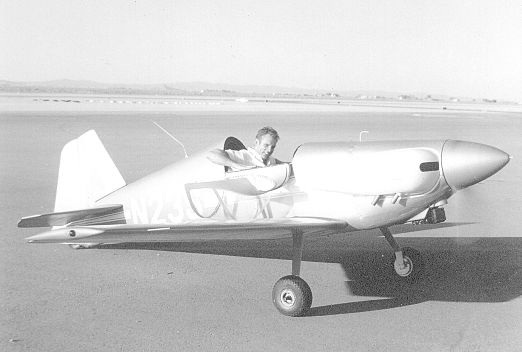
Dick Ennis prepares to take, the now gold, N23S for a short test flight from Fox Field, California in 1961.