KENSINGER KF
History 1964 - 1969
In the early 1960s English airfields were awash with war surplus light aircraft from companies such as De Havilland, Percival and Miles. Due to an economic restriction it was not possible to import light aircraft from overseas so as a result the choice of available and affordable designs was very limited. Once the import restriction was lifted in the early 1960s the importing of American designs from Cessna and Piper really took off as flying clubs re-equipped with modern all metal trainers and tourers to replace their old wooden designs. It was a timely occurrence, in the space of two years a great many of the old British aeroplanes had been grounded due to failure of the glue joints. As it was not economical to make the necessary repairs many Miles and Percival aeroplanes were simply just burnt for fire practice or left to rot in the long grass behind a hangar.
Homebuilt aircraft of the early 1960s were mostly single seat, all wood aircraft with low powered engines that had been designed prior to the war, such as the Luton Minor and the Currie Wot. The formative years of the British homebuilt aircraft movement flickered into life in 1962 when Milton Blair imported the famous Le Vier Cosmic Wind, N22C ‘Ballerina’ into the UK. Blair’s enthusiastic low level aerobatic demonstration of the Cosmic Wind at Southampton was, as many of those who witnessed the event would agree, a truly memorable occasion. Suddenly here was an all-metal single seat aeroplane that was fully aerobatic with a top speed in excess of 200 mph and a roll rate of 360 degrees per second.
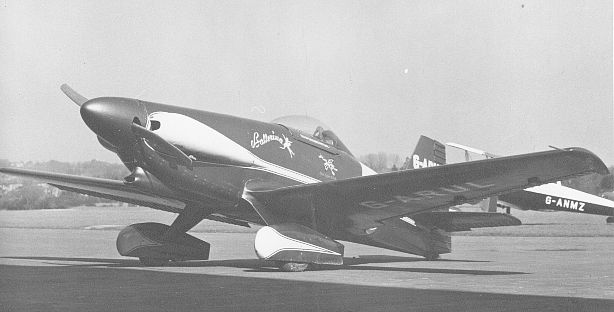
Le Vier Cosmic Wind, G-ARUL 'Ballerina' at Redhill in the summer of 1963.
Following the acquisition of the Cosmic Wind by the Tiger Club at Redhill the aeroplane, now registered as G-ARUL, became a familiar sight at air displays and air races across Britain. The aircraft won the King’s Cup twice but tragedy took an unfortunate hand in 1966 at Halfpenny Green when the ‘Ballerina’ stalled out of a high-speed turn at the scatter pylon and crashed during the start of that years Goodyear Trophy race. The pilot survived but the aeroplane was written-off and the wreck returned to Redhill.
Such was the impression made by the Cosmic Wind that the Tiger Club’s Norman Jones launched a competition to design a Goodyear type midget racer. The winning design was the Luton Beta a small low wing monoplane of all wood construction, which featured a monocoque fuselage making construction by amateurs quite a complex task, only about three Betas were completed by amateur constructors in Britain and none of these have been raced. Following their success with the Druine Turbulent and Condor Rollason Aircraft & Engines manufactured four examples of the Beta all of which became highly successful on the air racing circuit in the early 1970s. Today only one original Rollason Beta exists the other three having been destroyed, two in fatal accidents and one in a fire. In 1962 Paul Bannister was England’s leading air racing pilot. His mount at the time was a small Belgian aeroplane the Tipsy Nipper, G-APYB, in which Bannister won many races including the 1962 King’s Cup at Coventry. What Bannister really wanted was an out and out racing aeroplane and the Cosmic Wind was the answer to this need for speed. Trouble was that Cosmic Winds were very rare and commanded a high price if you could find one for sale. Bannister decided to contact Norman Jones to find out how to contact Milton Blair with a view to obtaining a Cosmic Wind.
The Kensinger KF, now G-ASSV, arrives at Halfpenny Green Aerodrome in early 1965.

G-ASSV at Shoreham Airport for the King's Cup Race in June 1965.
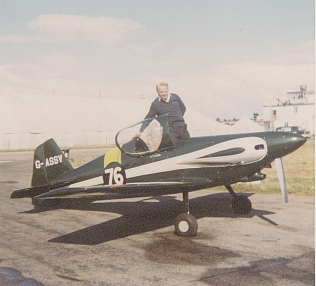
Paul Bannister with G-ASSV at Halfpenny Green in September 1968.
Page not completed