The Conflict and the Compromise: Galileo vs. the Vatican
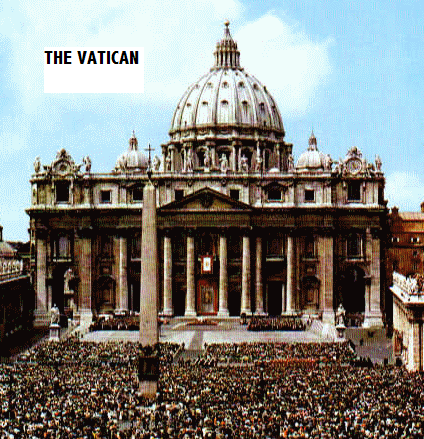
Although Copernican theories, the kind of theories Galileo supported, were mostly true, not all agreed with this. In fact, Aristotle's theories were dominant at that time. People thought that everything revolved around the Earth, our planet. The Vatican (the residence of the catholic pope) heartily dissagreed with Galileo's ideas.
In 1592, Galileo began teaching mathematics at the University of Padua. During that period, he began writing a treatise now referred to as De motu, or "On Motion." This impugned Aristotle's idea of two classes of motion: natural (the fall of an object) and violent (a flying object). Eventually, he went to Rome.
In 1609, he began experimenting with lenses after hearing about Dutch instrument makers being able to magnify an object after putting two lenses together. This led to creating a telescope, which he used to learn more about the planets. He found that Jupiter had moons, and discovered four of them. He was also the first to notice sun spots. Once he had shown this novel device to others, suddenly his irrational ideas seemed more real. However, many refused to believe the telescope was showing them true images.
Early in 1616, Copernican books were censored and the Jesuit cardinal Robert Bellarmine commanded not to expose his ideas to the public anymore. Galileo wrote several books concerning Copernican ideas, but almost all of them were burned by the church, who regarded Galileo and his ideas as "heresy." Many trials were held with Galileo, and he was threatened with torture and death many times.
Cardinal Bellarmine had previously told him to treat Copernicus's ideas only hypothetically and for scientific purposes, without thinking Copernican concepts as literally true or attempting to rewrite them in the Bible. However, he was also an ally in which he gave Galileo an affadavit that told him not to defend of hold his Copernican ideas. However, he was still free to express his view. Galileo worked on one of his major books - "Dialogue on the Tides," in 1624-1630. He was warned when he completed the work that that title seemed to imply he held the belief that the earth was actually moving, so he changed the title to "Dialogue Concerning the Two Chief Systems of the World-Ptolemaic and Copernican".
Armed with the affadavit, Galileo thought he was safe. However, in 1633, He was ordered to recant his ideas. A supporter of Aristotle's ideas brought a presumably forged, unsigned memo that restricted Galileo from holding, defending, or teaching Copernican ideas. Although he never really did, in order to escape punishment, he says he does recant his ideas. He was placed under house arrest for a decade until he died in 1642 at his villa.
The "Compromise"
When Galileo was still alive, there really was no real compromise. The Pope, who had complete power of the city at that time, disagreed with his ideas and his opinion never changed. Only in the year of 1979 did the Catholic Church admit their defeat. The Vatican was the residence of the Pope. This was where the Roman Catholic Church was, and this was probably the most important place to the people at the time. The Church had complete power over the people, and the Church believed Aristotle was right. This was why Galileo was one of the only ones who practiced Copernicanism.