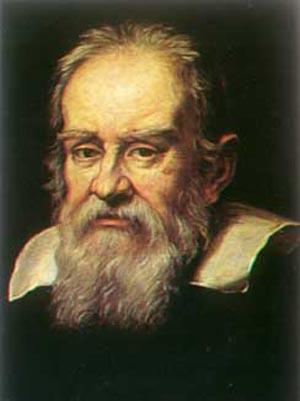
 Galileo
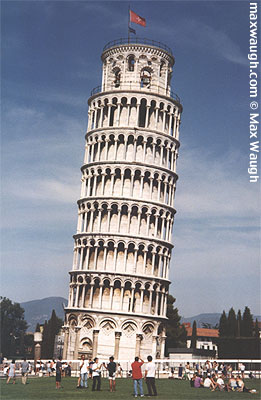 The Leaning Tower of Pisa
Galileo was a very significant part of history, and made many contributions to science, astronomy, and physics. Some even labeled him, "The Father of Modern Science!" He was born in Pisa (a populated city in Italy) in 1564, his parents being Vincenzo Galilei (his father), a famous lutenist at the time, and Giulia Galilei, who was his mother. He went to the University of Pisa in 1581, where his father hoped he would study medicine. However, Galileo was more interested in the subjects of science, mathematics, and astrology.
In Galileo's time, people believed the
theories of Aristotle, another mathematician that existed long ago. However, Galileo proved many of his theories wrong. Aristotle thought that objects of different weight would hit the ground at different times. In 1590, Galileo proved this
false by dropping balls of different weight from the Leaning Tower of Pisa at the same time. All of them hit the ground at the
same time.
Galileo disproved one of Aristotle's theories once again in 1609, where he would observe planets through a
telescope and discover that they also could have a moon like the Earth, and that the Sun was the center of the Universe.
Not all believed him, though, and a long-lasting verbal conflict ensued. Galileo passed away in 1642 in his villa at Rome, Italy.
Galileo
The Leaning Tower of Pisa