Bill`s 04 TJ
aka snakedoc
BRAKES
08-29-2007, 05:56 PM #24
mrblaine
Web Wheeler
Join Date: Dec 2004
Posts: 3,986
#1- EBC Green 7000 series SUV pad
Outstanding grip across a very broad range of temps. Very fade resistant, kind to rotors, quiet after break-in, and mind boggling in their stopping ability. ($100 +-) Moderately difficult to break-in.
#2- Napa SD series severe duty premium pads
Nearly as good as the EBC but not quite. Bit more difficult to bring up on the break in, quiet, fade resistant, cold stop not quite as good as the EBC. ($90 +-)
#3 Centric 105 series Ceramic Pre-Scorched. Best all around pad for the money.
Outstanding cold stops, great hot stops, fade resistant, no noise, chamferred and slotted for NVH. Moderate to easy to break-in. ($50+-)
#4 Performance Friction Carbon Metallics Decent pad for the money. Not that good cold, easy to glaze if you don't drive aggressively, moderately difficult to break-in, but outstanding performance if you get them hot and keep them there. Not that good in the colder climes, pretty good where it stays hot.
($50+-)
None of these pads exhibit any abnormal rotor or pad wear. None are any more or less affected by water than the other.
We have one more pad set to test and I suspect barring anything bizarre they will make the list. Included in the testing are 1 more set of Napa's that didn't make the cut, 2 sets of Axxis, 2 sets of Hawks, 3 sets of other Centric offerings and 1 set of Morse pads.
If I reach for a pad to show someone what Van's brakes can do, I grab the 105's.
__________________
A note from JF Administration- Please help keep the tech forums technical.
08-30-2007, 11:28 PM #29
mrblaine
Web Wheeler
Join Date: Dec 2004
Posts: 3,986
mrblaine's Profile
Where can I find these 'Centric 105 series Ceramic Pre-Scorched'?
http://www.brakewarehouse.com/centric_brake_pads.asp#1
My apologies. I don't buy them by their name, so it didn't dawn on me they are the Posi-Quiet Ceramic pads. If you look at the link I provided, you will note that it gives the prefix for each formulation of pad. I think the Extended Wear pads are 104 or 106.
I know Centric's numbering system, so if I want a pad that fits the industry designation of 652 which is the pad shape, and I want it in the Ceramic compound, I order part number 105.06520. Or, if I wanted the other compounds, I just put a 106. or 104..
Bear in mind if you do try the 105's, you will need to still break them in.
__________________
A note from JF Administration- Please help keep the tech forums technical.
09-08-2007, 11:16 AM #10
mrblaine
Web Wheeler
Join Date: Dec 2004
Posts: 3,986
The problem with PF pads is they like to be used aggressively or they glaze over.
If you have a few hours to do some reading, you can find me in several brake discussions making that very point despite what everyone says.
They are a good pad that is very sticky when broken in properly and used accordingly. Drive very mildly and you won't be happy with them.
And for the record, it does take about 4-500 miles to bed the pads and almost double that to season out new rotors. If you turned your existing, then 4-500 miles is all you need to see all the performance you will be getting provided the break-in is kept up.
Go do several moderate stops from 35-40 down to 3 mph. Several as in 8-10 and do them back to back. Then go for a drive for 10 minutes or so and cool them down. After the cool down, do a harder stop from 60-3 and cool down again. Do another one and cool down and then see how they are.
If that break-in doesn't bring them up, then you have another issue.
__________________
A note from JF Administration- Please help keep the tech forums technical.
br>
09-08-2007, 03:37 PM #13
mrblaine
Web Wheeler
Join Date: Dec 2004
Posts: 3,986
mrblaine's Profile Quote:
Originally Posted by ADub07
I think I found the problem....peaked at the rotors through the wheels. The rotors look odd to me. Instead of a shiney fairly smooth surface you would expect to see on an in-service rotor, most of the rotor surface looks like the surface of a casting. Its smooth and shiny out near the edge, but the further inward you travel on the radius, the rougher the surface gets. I'm going to pull the wheels off when it cools down tonight and check things over better.
You are describing the normal wear pattern of a overused set of OEM brakes. The OEM caliper design is most adequate for what it's designed for and the booster master combo generates very good line pressure to operate the calipers.
What's happening and may be part of your problem, is you are using the brakes very hard with lots of pedal travel. The high pressure flexes the caliper open enough to reduce pressure at the edge furthest from the caliper bridge or nearest the center of the rotor.
That produces the wear pattern you describe, but I typically only see it on vehicles with larger tires, lift, and more weight than stock.
Why you would get it has me a tad baffled.
__________________
A note from JF Administration- Please help keep the tech forums technical.
09-08-2007, 07:03 PM #17
mrblaine
Web Wheeler
Join Date: Dec 2004
Posts: 3,986
mrblaine's Profile Quote:
Originally Posted by ADub07
Here is what the rotor looks like. It had a uniform surface finish when I installed it.
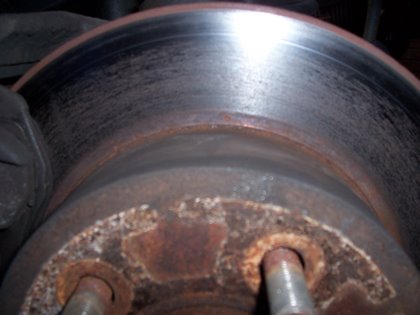 It looks exactly as I pictured it based on your previous description and what I know to be inherent flaws in the TJ brakes.
You really have no easy way to true the pads back up to get them to sit flat against the swept area on the rotor.
Part of your poor braking is now caused by the pads being worn at slight angles which messes up your moderate braking and the only way you get good brakes is to try and lock them up.
I'm also not convinced that this is caused by the pads. You may have something else going on that I can't discern without seeing the rest of the brake parts.
Pull it apart if you feel like it and take pics of the guide sleeve bolts and make sure they aren't bent. Also make sure the sleeves move back and forth in the caliper pretty easily.
See if there are any divots worn in the knuckles where the ends of the pads ride.
Do your best to try and tell if the calipers are sitting square to the rotor.
Before you yank it apart, put the axle on jackstands and have someone push on the pedal while you watch what the caliper does. There should be nearly zero movement and only a miniscule amount of flexing while it mashes the pads into the rotor. If you get any movement that looks like the caliper is trying to square itself up and then mash the pads, you need to find out why.
Also find out if both rotors are wearing the same. I suspect they are or you would have reported a horrid pulling issue.
Let us know-
__________________
A note from JF Administration- Please help keep the tech forums technical.